Cosmetic Production Workflow and Quality Control for Creams, Sunscreens, and Serums
Asked by: sasikarn.str
On: February 11, 2026
Product Type:
Cosmetics
Answered
Question
Regarding the production of creams, sunscreens, scrubs, and serums, what are the specific processes involved from receiving raw materials to producing the Finished Goods (FG)? Please provide details on the following:
- Detailed production line workflow
- Quality Control (
QC) and Quality Assurance (QA) steps required throughout the process - Equipment and tools needed from start to finish
- Differences in production processes between each product type (cream, sunscreen, scrub, serum)
- Does MySkinRecipes provide any equipment or tools to support these processes?
Answer
The production process for cosmetics like creams, sunscreens, scrubs, and serums follows a structured workflow to ensure safety, stability, and efficacy. Below is a detailed breakdown of the production line from raw materials to finished goods (FG).
1. Receiving and Quality Control of Raw Materials (IQC)
- Process: Receiving raw materials and packaging.
- QA/QC: Check Certificate of Analysis (COA), physical appearance, color, odor, and perform microbial testing if necessary.
- Equipment: Weighing scales, sampling tools.
2. Preparation and Weighing
- Process: Weighing ingredients according to the formula.
- QA/QC: Double-check weights against the Batch Manufacturing Record (BMR).
- Equipment: Precision digital scales.
3. Bulk Production (Mixing and Emulsification)
This stage varies slightly depending on the product type:
- Creams and Sunscreens: Usually involve an oil phase and a water phase heated separately (approx. 70-75°C) and then emulsified using high shear.
- Sunscreens require intensive homogenization to ensure even dispersion of UV filters.
- Serums: Often water-based. Ingredients are dissolved or dispersed. If it's an emulsion serum, a homogenizer is used.
- Scrubs: Similar to cream or gel bases, but scrub particles (exfoliants) are added at the final stage at a lower temperature and lower mixing speed to prevent damage to the particles.
- Equipment:
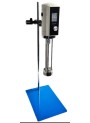
- Homogenizers: Essential for creating stable emulsions (e.g., Bearing (Composite) Homogenizer 2.2KW or 4.0KW).
- Heating Tanks: For melting waxes and oils.
4. In-Process Control (IPC)
- Process: Testing the "Bulk" before filling.
- QA/QC:
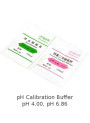
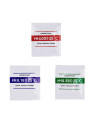
- pH Testing: Using a pH meter (with pH Calibration Buffers).
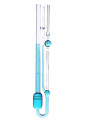
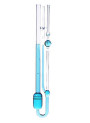
- Viscosity: Ensuring the thickness is correct (using a Viscometer).
- Stability/Appearance: Color, odor, and texture check.
- Equipment: pH meter, Viscometer.
5. Filling and Packaging
- Process: Transferring the bulk into primary packaging (bottles, tubes, jars).
- QA/QC: Check filling weight/volume accuracy and seal integrity.
- Equipment:
- Filling Machines: For liquids or creams.
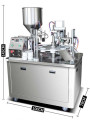
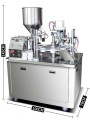
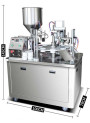
- Sealing Machines: For tubes (e.g., Ultrasonic tube filling and sealing machine).
6. Final Quality Control (FQC) and QA
- Process: Final check of the finished product.
- QA/QC:
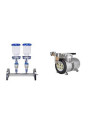
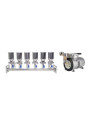
- Microbial Testing: Ensuring no contamination (using a Microbial Limit Tester).
- Packaging Check: Labeling accuracy, batch coding, and overall appearance.
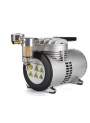
- Equipment: Microbial Limit Tester, Vacuum Pump.
7. Storage and Distribution
- Process: Storing in a temperature-controlled warehouse before shipping.
Differences in Production Lines
- Viscosity: Serums (low viscosity) use different filling pumps than thick scrubs or creams.
- Shear Force: Sunscreens and creams need high-shear homogenization, while scrubs need gentle mixing for the particles.
- Temperature: Some serums with heat-sensitive actives must be processed at room temperature (Cold Process).
MySkinRecipes Support
MySkinRecipes provides various industrial-grade tools to support your production line, including:
- Mixing & Emulsifying: High-performance homogenizers ranging from 2.2KW to 7.5KW for different batch sizes.
- Filling & Sealing: Ultrasonic tube sealing systems for professional packaging.
- Lab & QC: pH calibration solutions, viscosity measurement tools, and microbial testing equipment to ensure your products meet standard requirements.
Related Products Mentioned
Bearing (Composite) Homogenizer 2.2KW
Equipment
Bearing (Composite) Homogenizer 4.0KW
Equipment
Bearing (Composite) Homogenizer 7.5KW
Equipment
Calibration service Viscosity meter (ISO/ready to issue certificate)
Lab Testing Service