The Chemistry and Manufacture of Cosmetics, 4th ed.
Supports the distinction between cosmetic dyes, lakes, pigments, and dispersions.
Schlossman, M. L. The Chemistry and Manufacture of Cosmetics, 4th ed., Allured Business Media, 2009.
I would like to ask what type of colorant should be used in body massage oil.
I previously ordered an oil-soluble type from Shopee, but it settled out. It did not dissolve 100%, and I can still see powder/sediment floating.
For body massage oil, first decide the target appearance:
The sediment you saw from the Shopee colorant means it did not truly dissolve in your actual oil system. Possible causes include: it was actually a pigment/lake rather than a true dye, it is incompatible with your oil blend, it was used above its solubility, or the supplier documentation/quality was insufficient. More mixing can disperse particles better, but it cannot make an insoluble pigment become a clear solution.
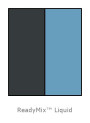
About ReadyMix™ FD&C Blue No.1 Lake (Polyglyceryl-2 Triisostearate Based): this is a ready-to-use oil/ester-based lake dispersion with 40% CI 42090 pigment. It is easier to incorporate than dry lake powder and can be mixed into oil or directly into a formula. However, it is still a lake dispersion, not the same as a true molecularly dissolved oil-soluble dye for a perfectly clear massage oil. In a low-viscosity oil, please test for settling in the final bottle. Catalog use range: 0.1–10%, adjusted by shade target and stability testing.
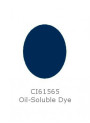
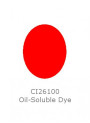
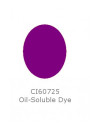
If you want a clear transparent massage oil, browse the Cosmetics > Make-Up > Oil Soluble Dye group. Examples of the correct product type include D&C Violet No.2 (CI 60725) (Oil-Soluble, EasyDissolve), D&C Green 6 (CI 61565) (Oil-Soluble, EasyDissolve), D&C Red 17 (CI 26100) (Oil-Soluble, EasyDissolve), or D&C Yellow No.11 (CI 47000) (Oil-Soluble, EasyDissolve), depending on the shade and the permitted use area for your finished product.
Suggested lab check before production
Sources supporting the key technical claims in this answer
Supports the distinction between cosmetic dyes, lakes, pigments, and dispersions.
Schlossman, M. L. The Chemistry and Manufacture of Cosmetics, 4th ed., Allured Business Media, 2009.
Supports cosmetic formulation stability testing and colorant use considerations.
Barel, A. O., Paye, M., and Maibach, H. I. Handbook of Cosmetic Science and Technology, 4th ed., CRC Press, 2014.
Supports the principle that insoluble particles require wetting, dispersion, and stabilization rather than dissolution.
Tadros, T. F. Applied Surfactants: Principles and Applications, Wiley-VCH, 2005.