Formulation Review for Water-Based Serum with Vitamin C
Asked by: sirikosin
On: September 09, 2019
Product Type:
Cosmetics
Answered
Question
I have the following formulation and would like to know if any corrections are needed:
- Flora Solve Clear 5%
- Isododecane 5%
- Glycerine 2%
- Ethyl ascorbic acid 1%
- Laurocapram 1%
- Sweet melon 1%
- AnyGel 0.75%
- Triethanolamine 0.5%
- Phenoxyethanol (extra pure) 0.5%
- Vitamin E 0.1%
- Water
Are there any necessary corrections for this formula?
Answer
Formulation Review
Thank you for sharing your formula. Here is some information about the ingredients based on our database:
- Flora Solve™ Clear (Fragrance Solubilizer): Used to solubilize fragrance or essential oils in water-based formulas without alcohol. The recommended usage ratio is 2-5 parts Flora Solve Clear to 1 part fragrance. Your formula uses 5% Flora Solve Clear and 1% Sweet Melon fragrance, which is a 5:1 ratio, within the recommended range. It should be mixed with the fragrance first before adding to the main water phase.
- Isododecane: A light, volatile emollient often used to provide a dry, non-greasy feel. We found several types of Isododecane products.
- Glycerin: A common humectant that attracts and retains moisture in the skin. It is water-soluble and typically used at 1-100%, though direct application of 100% is not recommended. Your usage at 2% is well within the typical range.
- L-Ascorbic Acid (Ultra-Fine): This is a potent form of Vitamin C known for brightening, anti-wrinkle, and antioxidant properties. The Ultra-Fine grade is designed for easier dispersion, especially in anhydrous formulas, but it is not stable when dissolved in water. It requires a low pH (2.0-4.0, FDA recommends >= 3.5 for skin application) and should be mixed in the final step below 30°C. Its low stability in water is a key consideration for your water-based formula.
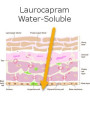
- Laurocapram (Water Soluble): A penetration enhancer suitable for water-soluble active ingredients. Recommended usage is 1-3%, with 2% recommended. Your usage at 1% is within the range. It should be mixed in the water portion below 60°C.
- Sweet Melon: This appears to be a fragrance oil. We found products matching this name.
- AnyGel™ (Dehydroxanthan Gum): A water gelling agent that provides a non-greasy gel texture and has good resistance to acid, alkali, and electrolytes. Recommended usage is 1-2.5%. Your usage at 0.75% is slightly below the recommended range for gelling, which might affect the final texture.
- Triethanolamine 99%: Used to adjust pH and increase alkalinity. The usage rate should not exceed 2.5%. Your usage at 0.5% is within this limit. It is mixed in the step where pH adjustment is needed.
- Phenoxyethanol (Extra Pure): A preservative effective against bacteria but less so against fungi. It is water-soluble and used at 0.5-1.0% (max 0.5% for eye products). Your usage at 0.5% is within the recommended range for general products. Consider if a broad-spectrum preservative is needed or if combining with another preservative is advisable for fungal protection.
- Vitamin E (Tocopheryl Acetate): A stable form of Vitamin E used as an antioxidant. Recommended usage is 0.1-1%. Your usage at 0.1% is at the lower end of the range. It is oil-soluble and mixed with other oils or emulsifiers, avoiding heat over 5 minutes.
Considerations:
- Vitamin C Stability: L-Ascorbic Acid (Ultra-Fine) is highly effective but unstable in water. Its inclusion at 1% in a water-based formula requires careful pH control (ideally 3.5-4.0) and consideration of packaging (airtight, opaque) to minimize oxidation. The low concentration (1%) is also below the typical recommended range for whitening (15%) or general wrinkle reduction (3%). If the goal is whitening or significant anti-wrinkle effects, a higher concentration or a more stable Vitamin C derivative (like Ethyl Ascorbic Acid or Ascorbyl Glucoside) might be more suitable, although this would change the formula significantly.
- AnyGel Concentration: The 0.75% concentration of AnyGel is below the recommended 1-2.5% range for gelling. You may need to increase this amount to achieve the desired gel texture.
- Preservation: While Phenoxyethanol is a good preservative for bacteria, its limited effectiveness against fungi might require the addition of a co-preservative or switching to a broad-spectrum option, depending on the product's intended use and potential for microbial contamination.
- Overall Formulation: The interaction and compatibility of all ingredients, especially the solubilizer, oil phase (Isododecane, Vitamin E), water phase, gelling agent, and pH adjuster, need to be carefully evaluated for stability and performance.
While I can provide details on individual ingredients, I cannot definitively say if the formula needs correction without full stability and compatibility testing.
Related Products Mentioned
Vitamin E (Tocopheryl Acetate)
Cosmetics
Vitamin C (L-ascorbic acid) (Ultra-Fine)
Cosmetics
Triethanolamine 99%
Cosmetics
Glycerin (USP/Food Grade)
Cosmetics
Phenoxyethanol (Extra Pure)
Cosmetics
AnyGel™ (Dehydroxanthan Gum)
Cosmetics
Laurocapram (Water Soluble)
Cosmetics
Fresh Melon
Fragrance/Flavor
Isododecane Gel (Thixotropic)
Cosmetics