Guidance on Mixing Skincare Actives and Sunscreen into a Gel Base
Question
I want to mix the following ingredients into Pure Aloe Vera Gel (ID 80):
- WhiteCumin™ 2x
- Hi-Quercetin®
- FastRelief™ 1609
- Repair Activator™ BG
- AminoSilk™
- AcneBee (ID 920)
- Centella Asiatica (ID 294)
- SPF Protect Plus (ID 479)
Can you provide guidance on how to mix these ingredients into the gel base and their compatibility? I am aiming for a combined skincare and sunscreen product.
Answer
Cosmetic Formulation Guidance for Your Selected Ingredients
Based on the ingredients you're interested in and the information available, here is a guide to help you understand their compatibility and suggested usage rates when mixing into a gel base like Aloe Vera Gel.
It's great that you're starting to explore making your own formulations! As the staff mentioned, checking the details on each product page on the MySkinRecipes website is crucial, especially for recommended usage rates and specific mixing instructions. Reading the beginner's guide is also highly recommended.
Here is some information about the ingredients you listed that were found in our system:
Ingredient Information and Mixing Notes
WhiteCumin™ 2x
- Function: Skin brightening, anti-aging, antioxidant.
- Recommended Usage Rate: 1-4% (suggested 2.5-3.0% for whitening/anti-aging).
- Mixing: This is a yellow liquid that dissolves directly in water. Mix it into the water phase of your gel formulation. Avoid sunlight and high heat. Store in the refrigerator (4-8°C). Note that high concentrations might give your gel a noticeable yellow tint.
- Compatibility: Water soluble, should mix well with a gel base.
Hi-Quercetin®
- Function: Helps prevent scarring (use after wound is closed), wound healing, anti-inflammatory, antioxidant, anti-allergic, reduces irritation, restores skin barrier.
- Recommended Usage Rate: 1-10% (suggested 1-2%). Higher amounts can make the formula dark yellow and temporarily tint skin yellow.
- Mixing: This is a yellow-brown liquid that dissolves in water. Mix into the water phase. The formula's pH must be lower than 6.0 for stability. Avoid light and heat. Store in the refrigerator (4-8°C).
- Compatibility: Water soluble, should mix well with a gel base, but requires the final formula pH to be below 6.0.
FastRelief™ 1609
- Function: Quickly reduces sensations of irritation, heat, swelling, and redness.
- Recommended Usage Rate: 1-3% (suggested 1%).
- Mixing: This is a clear oil. It dissolves in oil. Do not use heat when mixing. The formula pH should be in the range of 3.0-6.5. Store in the refrigerator (4-8°C).
- Compatibility: This ingredient is oil-soluble. Mixing it smoothly and stably into a water-based gel like Aloe Vera Gel can be challenging and may require a solubilizer or emulsifier to prevent separation.
Repair Activator™ BG
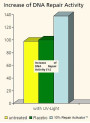
- Function: Helps repair skin DNA damaged by UVA, anti-aging.
- Recommended Usage Rate: 5-100%.
- Mixing: This is a liquid (Butylene Glycol base) that dissolves directly in water. Shake well before mixing. Mix into the water phase. Avoid heat in the final mixing step. Store in the refrigerator (6-8°C). The pH is typically 4-5.5.
- Compatibility: Water soluble, should mix well with a gel base.
AminoSilk™
- Function: Adds softness and smoothness, enhances waterproof performance (texture enhancer).
- Recommended Usage Rate: 1-5% (suggested 3%).
- Mixing: This is a white powder. It can be dissolved in oil, silicone, cream, or powder. Store at room temperature.
- Compatibility: This ingredient is a powder that dissolves in oil/silicone/cream/powder bases, not water. Incorporating it smoothly and stably into a water-based gel will be difficult and likely require specific formulation techniques or dispersing agents. It is primarily intended for powder or cream products.
Ingredients Not Found Directly in Search
For the following ingredients, I recommend checking their specific product pages on the MySkinRecipes website for detailed usage rates and mixing instructions, as they were not found with specific IDs in this search:
- Pure Aloe Vera Gel (ID 80) - This will be your base.
- AcneBee (ID 920)
- Centella Asiatica (ID 294)
- SPF Protect Plus (ID 479)
General Compatibility in a Gel Base
Mixing water-soluble ingredients like WhiteCumin 2x, Hi-Quercetin, and Repair Activator into a water-based gel like Aloe Vera Gel should be relatively straightforward, provided you respect the pH requirements (especially for Hi-Quercetin and FastRelief) and avoid excessive heat.
However, incorporating oil-soluble ingredients like FastRelief and powders like AminoSilk into a water-based gel is more complex. They are unlikely to mix in smoothly on their own and may separate over time, affecting the texture and stability of your final product.
Important Considerations
- Separate Skincare and Sunscreen: As the staff advised, it's generally best to create separate formulations for skincare actives and sunscreen (like SPF Protect Plus). Sunscreen formulations often require specific bases and mixing methods to ensure the UV filters are evenly dispersed and effective, and mixing them with numerous skincare actives in a simple gel base might compromise their performance and result in an unpleasant texture.
- Start Simple: When you are new to formulating, it's a good idea to start with a few ingredients at a time to see how they mix and affect the base gel. This helps you understand the process and troubleshoot more easily.
- Follow Instructions: Always adhere to the recommended usage rates, mixing methods, and storage conditions provided for each ingredient on its product page. This is essential for safety, efficacy, and product stability.
Mixing these ingredients is possible, but pay close attention to the solubility of FastRelief and AminoSilk and consider starting with a simpler combination of the water-soluble ingredients first.