Hair Wax Formulation Issues: Hard Texture and Silicone Separation
Question
My hair wax formula has two issues: the texture is too hard, and the silicone gel separates when heated with the other ingredients. The formula is:
- Beeswax 25%
- Vaseline petroleum 25%
- Oil 20%
- Lanolin 10%
- Shea butter 10%
- Silicone gel 10%
How can I make the wax softer and prevent the silicone separation?
Answer
Okay, I understand your hair wax formula and the issues you're encountering.
Your formula consists of:
- Beeswax 25%
- Vaseline petroleum 25%
- Oil 20%
- Lanolin 10%
- Shea butter 10%
- Silicone gel 10%
This is an anhydrous (water-free) formulation.
Here's an explanation of the issues and how to address them:
Why the Wax is Hard
Your formula is hard because it contains a high percentage of ingredients that are solid or semi-solid at room temperature:
- Beeswax (25%) is a primary structuring wax that provides hardness.
- Vaseline petroleum (25%) is a semi-solid that contributes to the structure and consistency.
- Shea butter (10%) is a butter that is solid at room temperature, adding richness but also contributing to hardness.
These components make up 60% of your formula (excluding the Lanolin, which is a thick paste/liquid, and the liquid oil and silicone gel). To make the wax softer and easier to scoop, you need to reduce the proportion of these harder ingredients and/or increase the proportion of liquid oil or softer emollients.
Why the Silicone Gel Separated
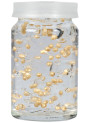
While many silicone ingredients are heat-stable and compatible with oils, the separation you observed when heating the silicone gel with your other ingredients suggests an incompatibility. This could be due to:
- The specific type of "silicone gel" you used: It might be a blend or dispersion that is not designed to be heated with the other components in your formula. Some silicone gels are meant to be added at lower temperatures during the cooling phase.
- Incompatibility with other ingredients: Although silicones are generally compatible with many oils and waxes, specific grades or types might not mix well with certain oils, petroleum jelly, or natural butters at high temperatures.
- Processing method: Ensure all oil-soluble ingredients, including waxes, butters, petroleum jelly, and compatible liquid emollients/silicones, are heated together until fully melted and homogenous. Then, stir continuously while the mixture cools and solidifies to prevent separation.
How to Make the Wax Softer and Easier to Scoop
To achieve a softer, more scoopable texture, you can modify your formula by adjusting the ratios of your existing ingredients:
- Reduce Beeswax: Beeswax is a major contributor to hardness. Try reducing the percentage of Beeswax. Start by decreasing it by 5-10% and see how the texture changes.
- Increase Liquid Oil: Increase the percentage of your liquid "Oil". This will dilute the solid network formed by the waxes and butters, resulting in a softer product. You could increase the oil percentage by the amount you decrease the Beeswax.
- Adjust Petroleum Jelly and Shea Butter: You could also slightly reduce the percentages of Petroleum Jelly and Shea Butter, as they contribute to the solid/semi-solid nature. However, they also provide emollience and slip, so reduce them cautiously.
- Consider Lanolin: Lanolin is a soft, paste-like emollient that can improve texture and spreadability. Your current percentage is 10%, which is reasonable. Increasing it slightly might help soften the texture, but be mindful of potential greasiness at higher concentrations.
Example Adjustment (Illustrative):
You could try reducing Beeswax and increasing the liquid oil. For instance, modify your formula like this:
- Beeswax: 15% (reduced from 25%)
- Vaseline petroleum: 25% (same)
- Oil: 30% (increased from 20%)
- Lanolin: 10% (same)
- Shea butter: 10% (same)
- Silicone gel: 10% (if you can find a compatible one or omit if it keeps separating)
(Total 100%)
This is just an example; you may need to experiment with different percentages to find the desired texture.
Alternatives for Texture Modification
If the specific silicone gel you are using continues to cause separation, you can omit it and focus on adjusting the ratios of your waxes, butters, and oils as suggested above.
Other emollients or texturizers that are compatible with anhydrous systems could potentially be used, but based on the product searches performed, there isn't a specific alternative identified that directly replaces the function of a silicone for texture modification in this context from the available results. Focusing on the balance of your existing waxes, butters, and oils is the most direct way to control the hardness of your hair wax.
When making adjustments, ensure all ingredients are fully melted together and stirred well during the cooling phase to maintain a homogenous mixture.
Related Products Mentioned

Lavender Oil (bescents SH11)