Issues with GuarCat Standard and Silicone Quick-Cond in Shampoo Formulation
Question
I have some questions regarding the use of Guar Cat Standard in shampoo formulation:
- When used in shampoo, is Guar Cat Standard compatible with all types of surfactants? I tried making shampoo using a Sodium Cocoyl Hydrolyzed protein surfactant, and when I added the surfactant to the dissolved Guar Cat, the shampoo turned cloudy white. While this is acceptable if it doesn't damage the formula, I'm unsure if the cloudiness is due to incompatibility or incorrect usage.
- When adding 1% Silicone Quick-Cond at the end, the shampoo, which was previously well-thickened, immediately became liquid. Is this because Guar Cat Standard is incompatible with Silicone Quick-Cond?
Answer
Understanding GuarCat™ Standard and Silicone Quick-Cond in Shampoo
Based on the properties of GuarCat™ Standard (Cationic Guar) and Silicone Quick-Cond (PEG-12 Dimethicone), here's an explanation regarding your observations:
1. Cloudiness with Sodium Cocoyl Hydrolyzed Protein
GuarCat™ Standard is a cationic polymer, meaning it carries a positive charge. Surfactants like Sodium Cocoyl Hydrolyzed protein can often be anionic (negatively charged) or amphoteric. When a cationic polymer is mixed with an anionic surfactant, they can interact and form complexes, which often appear as cloudiness or precipitation. This interaction is a common phenomenon and is likely the reason your shampoo became cloudy white. While this cloudiness might be visually undesirable if you aim for a clear shampoo, it doesn't necessarily mean the formula is damaged or unusable, provided the overall stability and performance are acceptable.
2. Liquefaction with Silicone Quick-Cond
Silicone Quick-Cond (PEG-12 Dimethicone) is a water-soluble silicone designed to provide conditioning properties in shampoo. GuarCat™ Standard acts as both a thickener and a conditioner. The observation that adding 1% Silicone Quick-Cond caused your thickened shampoo to become liquid suggests an incompatibility or interaction between the two ingredients that disrupted the thickening network formed by the GuarCat™ Standard. Although Silicone Quick-Cond is suitable for shampoo formulations, its specific interaction with GuarCat™ Standard at that concentration appears to interfere with viscosity. This could be due to the silicone disrupting the polymer structure of the cationic guar or other complex interactions within the formula.
Recommendations
- For Cloudiness: If a clear shampoo is desired, you might need to explore different thickening agents or conditioning polymers that are more compatible with your chosen surfactant system, or adjust the surfactant blend. However, if the cloudiness is acceptable and doesn't affect stability or performance, the formula might still be viable.
- For Liquefaction: The combination of GuarCat™ Standard and Silicone Quick-Cond at 1% Silicone Quick-Cond does not seem suitable for maintaining viscosity. You could try adjusting the concentration of either ingredient, changing the order of addition, or considering alternative conditioning agents. The product description for Silicone Quick-Cond mentions it is less effective than other options like Silicone Micro-Cond, which is also suitable for clear formulas. Exploring other conditioning agents listed in the product descriptions (both silicone and non-silicone types) might help you find a combination that provides both conditioning and stable viscosity with your chosen thickener and surfactant system.
Related Products Mentioned
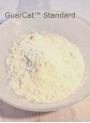
GuarCat™ Standard (1,000-5,000mpas)