Questions about Cleansing Formula Ingredients (Glycols, Alcohol, Surfactants)
Question
Based on a cleansing formula similar to Garnier's, I have several questions regarding ingredient choices and their functions:
1. Why is `Ethyl Alcohol` included in the recommended formula? Does it help make the texture lighter? Can it be omitted?
2. Can `Ethoxydiglycol` be used instead of `Butylene Glycol` to be closer to the original `Hexylene Glycol`? (Considering `Hexylene Glycol` is said to have a lighter texture than `Butylene Glycol` and `Propylene Glycol`, and its price is expected to be similar to `Ethoxydiglycol` which is more expensive than `Butylene Glycol`).
3. Regarding the `Disodium cocoamphodiacetate` in Garnier's formula, is it a surfactant for cleaning dirt and oil? Is `Poloxamer 184` alone sufficient for makeup removal, or is `Disodium cocoamphodiacetate` necessary for cleaning other dirt (requiring rinsing)?
4. In Garnier's ingredient list, `Disodium EDTA` is listed before `Poloxamer 184`. Given that `Poloxamer 184` is typically used at >= 1% and `Disodium EDTA` is usually used in small amounts (e.g., 0.2%), is this order unusual? Does it imply that `Poloxamer 184` is used at less than 1% because `Disodium cocoamphodiacetate` is the primary cleaning agent?
5. Is `Disodium EDTA` necessary in the formula?
Answer
Hello, based on the questions and answers between you and the staff, the points can be summarized as follows:
- Use of Hexylene Glycol instead of Butylene Glycol/Propylene Glycol: The staff indicated that Hexylene Glycol has a lighter texture than Butylene Glycol and Propylene Glycol. Regarding the price, it is expected to be similar to Ethoxydiglycol, which is more expensive than Butylene Glycol. Therefore, the main reason is likely the lighter texture.
- Disodium cocoamphodiacetate in Garnier's formula: The staff stated that Disodium cocoamphodiacetate is a surfactant that helps clean dirt and oil from the skin. If only makeup removal is needed, Poloxamer 184 is sufficient. However, if cleaning other dirt is also desired, Disodium cocoamphodiacetate helps but requires rinsing with water after use.
- Order and usage of Poloxamer 184 and Disodium EDTA: The staff informed that Poloxamer 184 should be used at least at 1%. The fact that Disodium EDTA (which is typically used in small amounts, e.g., 0.2%) is listed before Poloxamer 184 in Garnier's ingredient list is unusual based on the convention of listing ingredients by quantity. The staff speculated that perhaps because Garnier's formula also contains Disodium cocoamphodiacetate, which is a primary and cheaper cleaning agent, Poloxamer 184 might be used in an amount less than 1%.
- Necessity of Disodium EDTA: Although the staff did not explicitly state if it is necessary, Disodium EDTA is a chelating agent that helps stabilize the formula and enhance the effectiveness of preservatives. Its presence in the Garnier formula serves the purpose of product stability.
- Inclusion of Ethyl Alcohol in the recommended formula: The staff expects that Garnier includes Ethyl Alcohol to provide a cool and clean feeling after wiping. If this sensation is not desired, you can consider omitting Ethyl Alcohol from the formula.
- Using Ethoxydiglycol instead of Butylene Glycol: The staff stated that it is possible but not recommended for commercial production because Ethoxydiglycol is more expensive than Butylene Glycol, and using it at 10% concentration does not provide a significantly noticeable difference in texture. Butylene Glycol is therefore a more cost-effective option. However, if mixing for personal use, you can choose to use Ethoxydiglycol.
Hope this information is helpful.
Related Products Mentioned
Ethoxydiglycol (e.q. Transcutol)
Disodium EDTA
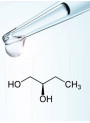
Butylene Glycol