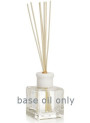
Reed Diffuser Bases and Scent Diffusion
Question
Based on my research, I know you sell Reed Diffuser Base. However, I personally want to use a base that comes from natural sources. I tried mixing Fractionated Coconut Oil with Essential Oil, but found that the scent diffusion was very low compared to mixing the same scent purely with alcohol, which diffused much more.
I would like to know:
1. Which diffuses scent better: Reed Diffuser Base or Fractionated Coconut Oil?
2. If I want to use a natural base, what options are available?
3. If I don't use alcohol for scent diffusion, what other substances (both chemical and natural) can be used to make the scent diffuse?
Answer
Subject: Regarding the use of Reed Diffuser Base
Thank you for your inquiry and for experimenting with different bases for your reed diffuser. Your observation that Fractionated Coconut Oil does not diffuse scent as effectively as alcohol or a commercial base is correct and aligns with the properties of these substances.
Let's address your questions:
Reed Diffuser Base vs. Fractionated Coconut Oil for diffusion:
- The commercial Reed Diffuser Base (Product ID 3352) is specifically formulated for optimal performance in reed diffusers. It typically contains low-viscosity solvents that are designed to wick efficiently up the reeds and evaporate consistently, carrying the fragrance into the air.
- Fractionated Coconut Oil (Product ID 169), while a natural oil, has a higher viscosity and slower evaporation rate compared to typical diffuser base solvents. This makes it less effective at wicking up the reeds and releasing the fragrance into the air, resulting in weaker scent diffusion as you observed. Therefore, the commercial Reed Diffuser Base will provide significantly better scent diffusion than Fractionated Coconut Oil.
Natural alternatives for a base:
- Finding a truly natural base that performs comparably to synthetic diffuser bases or alcohol is challenging. Most natural oils, including fractionated coconut oil, are too viscous and do not evaporate quickly enough for effective diffusion via reeds.
- Some lighter, less viscous natural oils or esters derived from natural sources might offer some diffusion, but their performance is often limited compared to synthetic options. There isn't a widely recognized, easily available "natural oil" that serves as a perfect substitute for a commercial diffuser base.
Other non-alcohol substances for diffusion (chemical and natural):
- Chemical: Besides alcohol, common synthetic bases used in commercial reed diffusers include glycols (such as Dipropylene Glycol - DPG) and various types of esters. These are chosen for their low odor, low viscosity, good solvency for fragrance oils, and controlled evaporation rate, which allows for consistent scent release.
- Natural: As mentioned, truly natural oils generally do not perform well as diffuser bases due to their properties. While you can mix essential oils with natural carrier oils, this method is better suited for direct application or oil burners rather than reed diffusers where efficient wicking and evaporation are key.
In summary, for optimal scent diffusion in a reed diffuser, a purpose-formulated base like the Reed Diffuser Base (Product ID 3352) or alcohol is generally recommended. While Fractionated Coconut Oil (Product ID 169) is natural, its physical properties make it unsuitable for effective reed diffusion. Finding a high-performing, strictly natural alternative that works as well as synthetic options is difficult.
Thank you.
Related Products Mentioned
Fractionated Coconut Oil