Shikonin Content and Solubility of Lithospermum Erythrorhizon Root Powder

Asked by: Anonymous On: May 16, 2026 Product Type: Cosmetics Answered

Question

Do you know what the approximate shikonin content is in Lithospermum Erythrorhizon Root Powder (Murasaki Powder)?

  • What is the powder base?
  • Will the product appear hazy when dispersed in water or glycol?

Answer

Based on the technical data for Lithospermum Erythrorhizon Root Powder (Murasaki Powder), here are the details regarding its composition and behavior in formulation:

1. Approximate Shikonin Content

For a natural, non-standardized dried root powder like this one, the total shikonin content (including shikonin and its derivatives such as acetylshikonin) typically ranges between 1.0% and 1.4% of the dry root weight.

  • Note: This is an estimate based on botanical literature for Lithospermum erythrorhizon. Because this product is a 100% natural ground root, the exact percentage can vary from batch to batch. If a precise concentration is required for your formulation, it is recommended to refer to the specific Batch Certificate of Analysis (COA).

2. Powder Base

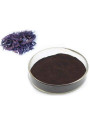
The base of this product is 100% mechanically ground Lithospermum Erythrorhizon root.

  • It does not contain external carriers such as maltodextrin or silica.
  • The INCI name is Lithospermum Erythrorhizon Root, which confirms it is the raw botanical material rather than a spray-dried extract on a carrier.

3. Appearance in Water or Glycol (Haziness)

The product will appear hazy and opaque when dispersed in water or glycols (such as Glycerin, Propylene Glycol, or Butylene Glycol).

  • Solubility: This powder is insoluble in both water and oil. It acts as a suspended botanical solid rather than a soluble dye.
  • Dispersibility: While it can be "dispersed" (spread throughout the liquid), it will not dissolve to form a transparent solution. In glycols, the powder may wet more easily than in water, resulting in a smoother dispersion, but it will remain cloudy.
  • Sedimentation: Over time, the particles will settle at the bottom of the container unless a thickening or suspending agent (such as Xanthan Gum or Carbomer) is used to keep them in suspension.
  • Color & pH: The dispersion will typically be deep purple or red. Note that shikonin is pH-sensitive; it remains purple/red in acidic to neutral conditions but can shift toward blue in alkaline environments (pH > 7).

Formulation Recommendations

  • Best Use: This powder is ideal for products where an opaque or "natural" botanical look is desired, such as clay masks, scrubs, opaque soaps, or thick creams.
  • Avoid: It is not suitable for clear toners, transparent serums, or clear gels, as the insoluble root particles will create significant turbidity.
Relevant References

Sources supporting the key technical claims in this answer

Analysis of shikonin derivatives and their hydrophobic nature in L. erythrorhizon
Frontiers in Plant Science

Supports the hydrophobic nature and insolubility of shikonin derivatives in water.

Frontiers in Plant Science: Analysis of shikonin derivatives and their hydrophobic nature in L. erythrorhizon.
Phytochemical constituents of Lithospermum erythrorhizon roots
PMC (PubMed Central)

Supports the typical shikonin content range of 1.0–1.4% in dry roots.

PMC (PubMed Central): Literature reviews on the phytochemical constituents of Lithospermum erythrorhizon roots.