PPD and Resorcinol Levels in Grey-Covering Shampoo Hair Dye
Question
I’d like to make a grey-covering shampoo hair dye with PPD.
- Normally, how much is recommended to add in the formula?
- I’ve also seen many formulas include resorcinol. If I add it, will it make the color stick better?
- I also want to use natural powder too.
Answer
For an oxidative grey-covering “shampoo hair color”, please treat it as a rinse-off oxidative hair dye system, not as an ordinary shampoo. PPD is a sensitizing hair dye intermediate and should be used only in a properly designed 2-part system with developer, label/patch-test control, and local regulatory limits checked on the ready-to-use mixture after mixing.
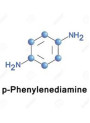
PPD level from our catalog calculation
Our PPD item is PPD (p-Phenylenediamine) (Oxidation Base / Primary). The catalog does not give one fixed universal percentage; it gives the calculation:
% in formula = Molar concentration (M) x Molecular weight (MW) / 10
For PPD, MW = 108. If using the catalog example concentration 0.025 M:
0.025 x 10⁸ / 10 = 0.27% PPD
So a common starting calculation from this system is about 0.27% PPD in the dye/colorant part at 0.025 M. If mixed 1:1 with developer before use, the final on-hair concentration will be diluted by half. Do not choose the percentage only by “more = darker”; shade and safety depend on the full primary/coupler package, pH, peroxide strength, processing time, and legal limits.
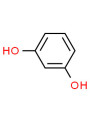
About resorcinol
Resorcinol is a coupler/secondary dye intermediate. It does not simply “make the color stick more” like a film-former. Its role is to react with the primary dye intermediate, such as PPD, under oxidation to form the final color molecule. It can help build certain brown/black shade depth depending on the dye combination, but it also changes tone, so the shade must be tested.
Using the same 0.025 M calculation for RL (Resorcinol), MW = 110:
0.025 x 110 / 10 = 0.275% Resorcinol
A practical first lab trial for a dark grey-coverage direction could therefore start around PPD 0.27% + Resorcinol 0.275% in the colorant part, then adjust with other primary/coupler dyes after strand testing. If you want better color deposition, our catalog example also uses solvents/penetration aids such as ethoxydiglycol and propylene glycol; color fastness is not controlled by resorcinol alone.
Natural powder caution
If using natural powders such as henna/indigo/herbal powders together with PPD/peroxide, please be careful. Natural powders can contain variable tannins, minerals/metals, reducing compounds, or plant impurities that may destabilize peroxide, shift the shade, darken the base, or cause uneven color. For development, it is safer to choose one main route first:
- Oxidative permanent route: PPD/primary + coupler + developer; use purified, low-metal raw materials and do stability/strand testing.
- Natural powder route: henna/indigo/herbal paste system; lower chemical dye risk but color result and grey coverage are less predictable.
If you still want a hybrid formula, start with very small lab batches, avoid metallic-salt colorants, include chelation/antioxidant control, and test: base stability, peroxide compatibility, shade on grey hair swatches, irritation/sensitization labeling, and final pH.
Related Products Mentioned
RL (Resorcinol) (Coupler / Secondary)
Ethoxydiglycol (e.q. Transcutol)