Yes—Hydrogenated Lecithin / phospholipid should be treated as water-dispersible under suitable processing, not truly water-soluble.
The important distinction is:
- It does not dissolve in water like salt, glycerin, or ethanol-soluble materials.
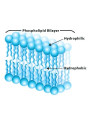
- It must be wetted, hydrated, dispersed, and deagglomerated to form a phospholipid dispersion, lamellar particles, liposome-like vesicles, or ethosome-type vesicles.
- Therefore, do not judge suitability only by whether the powder “disappears” in water. Ethosomes are dispersions, not true molecular solutions.
About the note “must contain an oil phase”
That statement is usually relevant when the material is used as an emulsifier in a normal cosmetic emulsion. It does not necessarily mean that an oil phase is absolutely required for every possible use.
For ethosomes, the system is different: ethanol and water are used to hydrate and organize phospholipids into vesicles. So an oil phase is not automatically required just because the ingredient is Hydrogenated Lecithin.
Which type is more suitable for ethosomes?
For ethosomes, the key is not simply choosing by the name “Hydrogenated Lecithin” or by HLB. Please look for a phospholipid / lecithin grade that has:
- clear INCI/composition information, e.g. Hydrogenated Lecithin, Lecithin, Phosphatidylcholine, Phospholipids, or a blend;
- stated phosphatidylcholine content, if available;
- indication that it is suitable for liposome / ethosome / phospholipid dispersion use;
- compatibility with the planned ethanol level;
- cosmetic-grade suitability for your intended application.
Hydrogenated lecithin can form more rigid bilayers than non-hydrogenated phospholipid grades, so it may not always be the best first choice if your target is a flexible ethanol-containing ethosome system. If Hydrogenated Lecithin gives large particles, poor dispersion, or instability, a non-hydrogenated phosphatidylcholine-rich phospholipid grade designed for liposome/ethosome work may be worth testing.
Catalog/product selection caution
From the available product-description context here, I cannot confidently recommend one specific MySkinRecipes Hydrogenated Lecithin product as the best ethosome-forming lipid. The sucrose ester emulsifier items mentioned in the available context are emulsifiers, not the main phospholipid for ethosomes.
So the safest selection route is to ask/verify for each candidate:
- exact INCI and composition;
- phosphatidylcholine content;
- whether it is described as water-dispersible, phospholipid-grade, liposome-grade, or only oil-dispersible/emulsifier-grade;
- ethanol tolerance and recommended use level;
- whether the active you want to load is hydrophilic, lipophilic, ionic, heat-sensitive, or ethanol-sensitive.
Practical small-batch trial process
A reasonable lab trial would be:
- Prepare a small ethanol + phospholipid phase first, if the selected grade allows ethanol wetting/dispersing.
- Add the water phase slowly with mixing, or add the ethanolic phospholipid phase into water under controlled stirring.
- Use moderate shear, high-shear homogenization, microfluidization, or sonication as process-development options depending on the particle size you need.
- Do not assume the system must become clear. Ethosome dispersions may be clear, translucent, or milky depending on lipid level, ethanol level, particle size, and the active ingredient.
- Check particle size/polydispersity if possible, plus visual stability, sedimentation or creaming, pH drift, ethanol loss, preservative compatibility, and accelerated stability.
Because you have not specified the ethanol percentage, phospholipid percentage, active ingredient, equipment, or target appearance, those conditions should be treated as trial variables, not fixed requirements.