


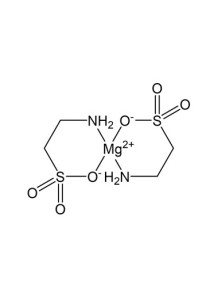
Magnesium taurate is a 1-to-2 salt of elemental magnesium (≈ 8-9 % Mg by weight) and the amino-sulfonic acid taurine
Magnesium taurate is a 1-to-2 salt of elemental magnesium (≈ 8-9 % Mg by weight) and the amino-sulfonic acid taurine. The pairing is attractive because — in theory — you get:
the cardiometabolic and neuromuscular roles of magnesium, plus
taurine’s own blood-pressure-, insulin- and membrane-stabilising actions
| Test Name | Specification |
|---|---|
| Character | White or almost white crystalline powder |
| Magnesium % | 8.5%~9.5% |
| Magnesium taurate | ≥98.0% |
| Loss on drying | ≤2.0% |
| Heavy metal | ≤10 ppm |
| Pb | ≤0.5 ppm |
| Cd | ≤0.5 ppm |
| Hg | ≤0.1 ppm |
| As | ≤0.5 ppm |
| Total plate count | ≤1000 cfu/g |
| Total Yeast & Mold | ≤100 cfu/g |
| Staphylococcus aureus | Negative |
| Salmonella | Negative |
| Escherichia coli | Negative |
| Bulk density | ≥0.60 g/mL |
| Tapped density | ≥0.95 g mL |
| 60 mesh | 100% |
No products
Magnesium taurate is a 1-to-2 salt of elemental magnesium (≈ 8-9 % Mg by weight) and the amino-sulfonic acid taurine
Magnesium taurate is a 1-to-2 salt of elemental magnesium (≈ 8-9 % Mg by weight) and the amino-sulfonic acid taurine. The pairing is attractive because — in theory — you get:
the cardiometabolic and neuromuscular roles of magnesium, plus
taurine’s own blood-pressure-, insulin- and membrane-stabilising actions
| Mechanism | - |
| Appearance | - |
| Longevity | - |
| Strength | - |
| Storage | - |
| Shelf Life | - |
| Allergen(s) | - |
| Dosage (Range) | - |
| Recommended Dosage | - |
| Dosage (Per Day) | - |
| Recommended Dosage (Per Day) | - |
| Mix Method | - |
| Heat Resistance | - |
| Stable in pH range | - |
| Solubility | - |
| Product Types | - |
| INCI | - |