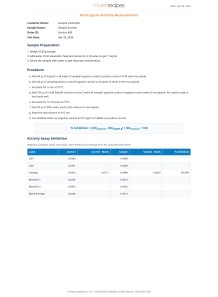
UV-VIS Anti-Trypsic (Anti-Trypsin) Activity Measurement

  • Product Code: 125877
This antitrypsin activity assay is important because it measures the ability of a sample (e.g., plant extract) to inhibit the proteolytic enzyme trypsin, which is crucial in many biological and industrial contexts (e.g., therapeutic enzyme modulation, functional food ingredient evaluation). The method uses BApNA, a chromogenic substrate that releases a yellow-colored product (p-nitroaniline) upon hydrolysis by trypsin. By comparing absorbances of control vs. sample, one can calculate the percentage inhibition of trypsin activity. Tris-HCl buffer is used instead of phosphate buffer to avoid unwanted buffer-catalyzed BApNA hydrolysis, ensuring reliable and accurate measurement.
฿2,990.00

label ชื่อตัวอย่าง

info Please enter each sample name you want included for testing

assignment คำแนะนำ

info โปรดระบุข้อกำหนดหรือเงื่อนไขเฉพาะสำหรับการทดสอบ

insert_drive_file Report of Previously Tested Sample

Select a tab and click View to open the report.

timeline ขั้นตอนการให้บริการ

ขั้นตอน ขั้นตอน ผลลัพธ์ที่คาดหวัง
1

Prepare the...

check_circle_outline

A 1 mg/mL plant extract solution ready for testing.

2

Add 40...

check_circle_outline
Each well contains 40 µL of trypsin.
3

Add 40...

check_circle_outline

Each well now contains 80 µL total volume: 40 µL trypsin + 40 µL sample/control.

4

Incubate the...

check_circle_outline

Pre-incubation for trypsin inhibition reaction to occur.

5

Add 100...

check_circle_outline

Substrate is introduced, final well volume is 180 µL.

6

Incubate the...

check_circle_outline

Enzymatic hydrolysis of BApNA occurs (or is inhibited), generating color.

7

Add 30%...

check_circle_outline

Reaction is halted by acidification; color development is stabilized.

8

Measure and...

check_circle_outline

Absorbance values (OD) for control and sample wells are obtained.

9

Calculate percentage...

check_circle_outline

Percentage inhibition result for each sample.

คุณจะได้รับรายงานสำหรับ % Inhibition of Trypsin ฟิลด์เมื่อเราให้บริการนี้

UV-VIS Anti-Trypsic (Anti-Trypsin) Activity Measurement

การวัดกิจกรรมต่อต้านทริปซิน UV-VIS

วัตถุประสงค์

เพื่อวัดกิจกรรมต่อต้านทริปซินของสารสกัดหรือสารประกอบจากพืชโดยใช้สเปกโตรสโคปี UV-VIS โดยประเมินความสามารถในการยับยั้งกิจกรรมของทริปซินบนพื้นผิว (เช่น BAPNA หรือเคซีน)

วัสดุ

วิธี

  1. การเตรียมสารละลาย

    • สารละลายสต็อกทริปซิน : ละลายทริปซินในบัฟเฟอร์ Tris-HCl จนมีความเข้มข้นสุดท้าย 1 มก./มล. เตรียมส่วนย่อยและเก็บที่อุณหภูมิ -20°C
    • สารละลายพื้นผิว BAPNA : ละลาย BAPNA (1 มิลลิโมลาร์) ในบัฟเฟอร์ Tris-HCl หรือไม่ก็ละลายเคซีน (1%) ใน PBS เพื่อทดสอบเคซีน
    • สารละลายสารสกัดจากพืช : ละลายสารสกัดจากพืชในตัวทำละลายที่เหมาะสม (เช่น DMSO) จนมีความเข้มข้นสุดท้าย 1 มก./มล. เตรียมสารละลายเจือจางต่างๆ สำหรับการกำหนด IC50
  2. ตัวอย่างควบคุมและทดสอบ

    • การควบคุมว่างเปล่า : ประกอบด้วยบัฟเฟอร์และสารตั้งต้นแต่ไม่มีทริปซินหรือสารสกัดจากพืช
    • การควบคุมเชิงบวก : ประกอบด้วยทริปซินและสารตั้งต้นที่ไม่มีสารสกัดจากพืชเพื่อวัดกิจกรรมเอนไซม์สูงสุด
    • ตัวอย่างการทดสอบ : ประกอบด้วยทริปซิน สารตั้งต้น และสารสกัดจากพืชในความเข้มข้นต่างๆ เพื่อตรวจสอบฤทธิ์ยับยั้ง
  3. การฟักไข่

    • ในแต่ละคิวเวตต์ ให้เติมส่วนประกอบต่อไปนี้:
      • การควบคุมแบบว่างเปล่า : บัฟเฟอร์ 900 µL + สารตั้งต้น 100 µL
      • การควบคุมเชิงบวก : บัฟเฟอร์ 800 µL + สารตั้งต้น 100 µL + ทริปซิน 100 µL
      • ตัวอย่างการทดสอบ : บัฟเฟอร์ 700 µL + สารตั้งต้น 100 µL + ทริปซิน 100 µL + สารละลายสารสกัดจากพืช 100 µL (เปลี่ยนความเข้มข้นของสารสกัดจากพืชสำหรับการศึกษาการยับยั้ง)
    • ผสมเบาๆ และฟักที่อุณหภูมิ 37°C เป็นเวลา 30 นาที
  4. การยุติปฏิกิริยา

    • หลังจากระยะฟักตัว ให้เติมสารละลายหยุดการทำงาน (TCA 10%) 100 µL เพื่อยุติปฏิกิริยาในแต่ละคิวเวตต์ วิธีนี้จะทำให้โปรตีนตกตะกอนในการทดสอบเคซีน หรือหยุดการปล่อย p-nitroaniline จาก BAPNA
  5. การวัด UV-VIS

    • สำหรับการทดสอบ BAPNA ให้วัดค่าการดูดกลืนแสงที่ 410 นาโนเมตร (สอดคล้องกับสีเหลืองของ p-nitroaniline) โดยใช้เครื่องสเปกโตรโฟโตมิเตอร์ UV-VIS
    • สำหรับการทดสอบเคซีน ให้วัดค่าการดูดกลืนแสงที่ 280 นาโนเมตร เพื่อตรวจจับปริมาณไทโรซีนหรือกรดอะมิโนอะโรมาติกอื่นๆ ที่ปล่อยออกมาจากการย่อยเคซีน
    • บันทึกค่าการดูดกลืนแสงสำหรับแต่ละตัวอย่าง

หมายเหตุ

ผลลัพธ์และการตีความ

Mechanism -
Appearance -
Longevity -
Strength -
Storage -
Shelf Life -
Allergen(s) -
Dosage (Range) -
Dosage (Per Day) -
Mix Method -
Heat Resistance -
Stable in pH range -
Solubility -
Product Types -
INCI -
Service Steps
Step Procedure Expected Result
1

Prepare the...

A 1 mg/mL plant extract solution ready for testing.

2

Add 40...

Each well contains 40 µL of trypsin.
3

Add 40...

Each well now contains 80 µL total volume: 40 µL trypsin + 40 µL sample/control.

4

Incubate the...

Pre-incubation for trypsin inhibition reaction to occur.

5

Add 100...

Substrate is introduced, final well volume is 180 µL.

6

Incubate the...

Enzymatic hydrolysis of BApNA occurs (or is inhibited), generating color.

7

Add 30%...

Reaction is halted by acidification; color development is stabilized.

8

Measure and...

Absorbance values (OD) for control and sample wells are obtained.

9

Calculate percentage...

Percentage inhibition result for each sample.