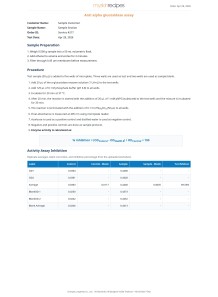
Anti alpha glucosidase assay

Anti alpha glucosidase assay
  • Product Code: 253698
Under specified conditions (pH = 6.8; T = 37 °C), α -glucosidase will catalyze the conversion of the substrate 4-nitrophenyl-α-D-glucopyranoside to α-D-glucopyranoside and p-nitrophenol, as shown below (Equation (1)). The yellow colour of the latter product is measured spectrophotometrically at 405 nm. [PNPG + α-glucosidase] → α-D-glucopyranoside + PNP (yellow)] Alpha-glucosidase inhibitors inhibit the absorption of carbohydrates from the small intestine. They competitively inhibit enzymes that convert complex nonabsorbable carbohydrates into simple absorbable carbohydrates. These enzymes include glucoamylase, sucrase, maltase, and isomaltase. By delaying carbohydrate absorption, they reduce the rise in postprandial blood glucose concentrations by about 3mmol/L. Sample Requirement: 1 g
฿2,000.00

science ชื่อตัวอย่าง

assignment คำแนะนำ

info โปรดระบุข้อกำหนดหรือเงื่อนไขเฉพาะสำหรับการทดสอบ

description ภาพรวมบริการ

Under specified conditions (pH = 6.8; T = 37 °C), α -glucosidase will catalyze the conversion of the substrate 4-nitrophenyl-α-D-glucopyranoside to α-D-glucopyranoside and p-nitrophenol, as shown below (Equation (1)). The yellow colour of the latter product is measured spectrophotometrically at 405 nm. [PNPG + α-glucosidase] → α-D-glucopyranoside + PNP (yellow)] Alpha-glucosidase inhibitors inhibit the absorption of carbohydrates from the small intestine. They competitively inhibit enzymes that convert complex nonabsorbable carbohydrates into simple absorbable carbohydrates. These enzymes include glucoamylase, sucrase, maltase, and isomaltase. By delaying carbohydrate absorption, they reduce the rise in postprandial blood glucose concentrations by about 3mmol/L. Sample Requirement: 1 g

timeline ขั้นตอนการให้บริการ

ขั้นตอน ขั้นตอน ผลลัพธ์ที่คาดหวัง
1

Dissolve 0.010...

check_circle_outline

1 mg/ml plant extract solution

2

check_circle_outline

1 mM pNPG

3

check_circle_outline

0.1 M phosphate buffer (pH 6.8)

4

check_circle_outline

0.1 N of Na2CO3

5

check_circle_outline

adding sample and control

6

check_circle_outline

Adding enzyme

7

check_circle_outline

Adding buffer

8

check_circle_outline

incubation

9

check_circle_outline

Adding substrate

10

check_circle_outline

termination of reaction

11

check_circle_outline

reading absorbance of reaction

12

check_circle_outline

control

13

check_circle_outline

calculation

Anti alpha glucosidase assay
No image available
Under specified conditions (pH = 6.8; T = 37 °C), α -glucosidase will catalyze the conversion of the substrate 4-nitrophenyl-α-D-glucopyranoside to α-D-glucopyranoside and p-nitrophenol, as shown below (Equation (1)). The yellow colour of the latter product is measured spectrophotometrically at 405 nm. [PNPG + α-glucosidase] → α-D-glucopyranoside + PNP (yellow)] Alpha-glucosidase inhibitors inhibit the absorption of carbohydrates from the small intestine. They competitively inhibit enzymes that convert complex nonabsorbable carbohydrates into simple absorbable carbohydrates. These enzymes include glucoamylase, sucrase, maltase, and isomaltase. By delaying carbohydrate absorption, they reduce the rise in postprandial blood glucose concentrations by about 3mmol/L. Sample Requirement: 1 g
Mechanism -
Appearance -
Longevity -
Strength -
Storage -
Shelf Life -
Allergen(s) -
Dosage (Range) -
Dosage (Per Day) -
Mix Method -
Heat Resistance -
Stable in pH range -
Solubility -
Product Types -
INCI -
Service Steps
Step Procedure Expected Result
1

Dissolve 0.010...

1 mg/ml plant extract solution

2

1 mM pNPG

3

0.1 M phosphate buffer (pH 6.8)

4

0.1 N of Na2CO3

5

adding sample and control

6

Adding enzyme

7

Adding buffer

8

Adding substrate

10

reading absorbance of reaction

12

calculation