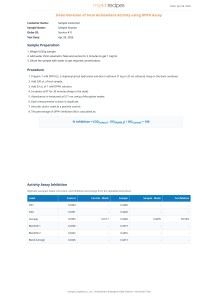
UV-VIS Antioxidant Capacity (DPPH)

  • Product Code: 30978

Analysis of Antioxidant Capacity using DPPH

฿2,490.00

science ชื่อตัวอย่าง

assignment คำแนะนำ

info โปรดระบุข้อกำหนดหรือเงื่อนไขเฉพาะสำหรับการทดสอบ

description ภาพรวมบริการ

UV-VIS Antioxidant Capacity (DPPH, 1 sample)


Analysis of Antioxidant Capacity using DPPH


Measuring antioxidant capacity using the DPPH (2,2-diphenyl-1-picrylhydrazyl) assay with UV-Vis spectrophotometry is a common method for evaluating the ability of compounds to scavenge free radicals. This assay is widely used to assess the antioxidant properties of natural products, extracts, and compounds. Here's a general protocol for performing a UV-Vis antioxidant capacity assay using the DPPH reagent:

Materials and Reagents:

DPPH reagent (2,2-diphenyl-1-picrylhydrazyl)
Antioxidant standard solution (e.g., ascorbic acid or Trolox)
Sample extracts or solutions
Methanol or ethanol (solvent)
Deionized water
Pipettes and pipette tips
Test tubes or microcentrifuge tubes
Vortex mixer or shaker
Timer or stopwatch
Lint-free tissue for cuvette cleaning


Procedure:

Prepare Antioxidant Standard Solutions:

Prepare a series of antioxidant standard solutions with known concentrations using the antioxidant of your choice (e.g., ascorbic acid or Trolox). Typically, a concentration range of 0-100 µg/mL is used for the standard solutions.


Prepare Sample Extracts:

If working with plant extracts or complex samples, prepare your sample extracts using an appropriate method (e.g., solvent extraction). Ensure that your samples are appropriately diluted to fall within the linear range of the calibration curve.


Prepare Blank Solution:

Use a cuvette and add 2 mL of the solvent (e.g., methanol or ethanol) as a blank reference for baseline correction.


Calibrate the Spectrophotometer:

Turn on the UV-Vis spectrophotometer and allow it to warm up.
Set the wavelength to the appropriate value for measuring the DPPH absorbance. The typical wavelength used is 515 nm.
Adjust the spectrophotometer's baseline using the blank solution, so that it reads zero absorbance at the chosen wavelength.


Prepare Reaction Mixtures:

In a test tube or microcentrifuge tube, mix the following components in the specified order:
1 mL of the DPPH reagent solution (typically a 0.1 mM DPPH solution in methanol)
0.5 mL of the antioxidant standard solution or sample extract
1.5 mL of methanol or ethanol (to ensure complete dissolution)
Mix well by vortexing or shaking the tube.


Incubate the Reaction Mixtures:

Allow the reaction mixtures to incubate in the dark at room temperature for 30 minutes. During this time, the DPPH radicals are scavenged by antioxidants, resulting in a color change from deep violet to pale yellow.


Measure Absorbance:

After the incubation, take a small volume (usually 1 mL) of each reaction mixture and transfer it to separate cuvettes.
Wipe the cuvettes with a lint-free tissue to remove any fingerprints or smudges.
Place each cuvette in the spectrophotometer and measure the absorbance at the chosen wavelength (515 nm).


Calculate Antioxidant Capacity:

Calculate the antioxidant capacity of the sample or standard by comparing the decrease in absorbance (scavenging of DPPH radicals) to that of the blank and using the calibration curve obtained from the standard solutions.

timeline ขั้นตอนการให้บริการ

ขั้นตอน ขั้นตอน ผลลัพธ์ที่คาดหวัง
1

Weigh 10...

check_circle_outline

A clear extract, ready for the DPPH assay.

2

Prepare 1...

check_circle_outline

A purple DPPH solution in ethanol, stable for the duration of the assay.

3

For each...

check_circle_outline

Reaction mixture containing DPPH and antioxidant sample, ready for incubation.

4

Add 230...

check_circle_outline

test sample

5

Add 20...

check_circle_outline

sample and reagent mixture and start reaction

6

Incubate at...

check_circle_outline

discoloration

7

Absorbance is...

check_circle_outline

absorbance of test reaction

8

Each measurement...

check_circle_outline

ensure test protocol

9

The percentage...

check_circle_outline

% inhibition

คุณจะได้รับรายงานสำหรับ %inhibition , absorbance at 517nm ฟิลด์เมื่อเราให้บริการนี้

UV-VIS Antioxidant Capacity (DPPH)

Analysis of Antioxidant Capacity using DPPH

UV-VIS Antioxidant Capacity (DPPH, 1 sample)


Analysis of Antioxidant Capacity using DPPH


Measuring antioxidant capacity using the DPPH (2,2-diphenyl-1-picrylhydrazyl) assay with UV-Vis spectrophotometry is a common method for evaluating the ability of compounds to scavenge free radicals. This assay is widely used to assess the antioxidant properties of natural products, extracts, and compounds. Here's a general protocol for performing a UV-Vis antioxidant capacity assay using the DPPH reagent:

Materials and Reagents:

DPPH reagent (2,2-diphenyl-1-picrylhydrazyl)
Antioxidant standard solution (e.g., ascorbic acid or Trolox)
Sample extracts or solutions
Methanol or ethanol (solvent)
Deionized water
Pipettes and pipette tips
Test tubes or microcentrifuge tubes
Vortex mixer or shaker
Timer or stopwatch
Lint-free tissue for cuvette cleaning


Procedure:

Prepare Antioxidant Standard Solutions:

Prepare a series of antioxidant standard solutions with known concentrations using the antioxidant of your choice (e.g., ascorbic acid or Trolox). Typically, a concentration range of 0-100 µg/mL is used for the standard solutions.


Prepare Sample Extracts:

If working with plant extracts or complex samples, prepare your sample extracts using an appropriate method (e.g., solvent extraction). Ensure that your samples are appropriately diluted to fall within the linear range of the calibration curve.


Prepare Blank Solution:

Use a cuvette and add 2 mL of the solvent (e.g., methanol or ethanol) as a blank reference for baseline correction.


Calibrate the Spectrophotometer:

Turn on the UV-Vis spectrophotometer and allow it to warm up.
Set the wavelength to the appropriate value for measuring the DPPH absorbance. The typical wavelength used is 515 nm.
Adjust the spectrophotometer's baseline using the blank solution, so that it reads zero absorbance at the chosen wavelength.


Prepare Reaction Mixtures:

In a test tube or microcentrifuge tube, mix the following components in the specified order:
1 mL of the DPPH reagent solution (typically a 0.1 mM DPPH solution in methanol)
0.5 mL of the antioxidant standard solution or sample extract
1.5 mL of methanol or ethanol (to ensure complete dissolution)
Mix well by vortexing or shaking the tube.


Incubate the Reaction Mixtures:

Allow the reaction mixtures to incubate in the dark at room temperature for 30 minutes. During this time, the DPPH radicals are scavenged by antioxidants, resulting in a color change from deep violet to pale yellow.


Measure Absorbance:

After the incubation, take a small volume (usually 1 mL) of each reaction mixture and transfer it to separate cuvettes.
Wipe the cuvettes with a lint-free tissue to remove any fingerprints or smudges.
Place each cuvette in the spectrophotometer and measure the absorbance at the chosen wavelength (515 nm).


Calculate Antioxidant Capacity:

Calculate the antioxidant capacity of the sample or standard by comparing the decrease in absorbance (scavenging of DPPH radicals) to that of the blank and using the calibration curve obtained from the standard solutions.

Mechanism -
Appearance -
Longevity -
Strength -
Storage -
Shelf Life -
Allergen(s) -
Dosage (Range) -
Dosage (Per Day) -
Mix Method -
Heat Resistance -
Stable in pH range -
Solubility -
Product Types -
INCI -
Service Steps
Step Procedure Expected Result
1

Weigh 10...

A clear extract, ready for the DPPH assay.

2

Prepare 1...

A purple DPPH solution in ethanol, stable for the duration of the assay.

3

For each...

Reaction mixture containing DPPH and antioxidant sample, ready for incubation.

4

Add 230...

test sample

5

Add 20...

sample and reagent mixture and start reaction

6

Incubate at...

discoloration

7

Absorbance is...

absorbance of test reaction

8

Each measurement...

ensure test protocol

9

The percentage...

% inhibition