UV-VIS Anti-Trypsic Assay

  • Product Code: 125265
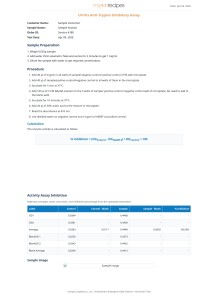
Colorimetric assay measuring inhibition of porcine trypsin hydrolysis of BAPNA substrate by absorbance at 410 nm. BAPNA is a manufactured protein substrate comprising of a color covalently bound to an amino acid. BAPNA has an amino acid with a dye molecule attached to it; enzymatic activity by trypsin breaks the bond between the amino acid and the dye molecule, coloring the clear solution yellow.
฿2,990.00

label Sample Names

info Please enter each sample name you want included for testing

assignment Instructions

info Please include any specific requirements or conditions for testing

description Sample Requirement

Liquid extract or solution 2 mL

insert_drive_file Report of Previously Tested Sample

Select a tab and click View to open the report.

timeline Service Steps

Step Procedure Expected Result
1

Add 40...

check_circle_outline

enzyme

2

Add 40...

check_circle_outline

sample

3

Incubate for...

check_circle_outline

pre-incubation of sample and enzyme

4

Add 100...

check_circle_outline

start reaction

5

Incubate for...

check_circle_outline

incubation time for reaction

6

Add 20...

check_circle_outline

stop reaction

7

Read the...

check_circle_outline

reading absorbance

8

Use distilled...

check_circle_outline

ensure test reaction

9

The enzyme...

check_circle_outline

% inhibition of assay

UV-VIS Anti-Trypsic Assay

UV-VIS Anti-Trypsic Assay

UV-VIS Anti-Trypsic Assay

Materials and Reagents

Preparation of Solutions

  1. Trypsin Solution: Dissolve trypsin in Tris-HCl buffer to a concentration of 0.01 mg/mL.
  2. Substrate Solution (BAPNA): Dissolve BAPNA in DMSO to make a 5 mg/mL stock solution. Dilute this stock solution with Tris-HCl buffer to a final concentration of 0.1 mM.
  3. Plant Extract Solution: Dissolve the plant extract in Tris-HCl buffer. Prepare different concentrations for testing (e.g., 0.1 mg/mL, 0.2 mg/mL, etc.).

Assay Procedure

  1. Blank Preparation: Mix 2.9 mL of Tris-HCl buffer with 0.1 mL of the substrate solution. This serves as a blank to zero the spectrophotometer.
  2. Control Reaction: Mix 2.8 mL of Tris-HCl buffer, 0.1 mL of substrate solution, and 0.1 mL of trypsin solution. This will measure the activity of trypsin without inhibition.
  3. Test Reaction: Mix 2.7 mL of Tris-HCl buffer, 0.1 mL of substrate solution, 0.1 mL of trypsin solution, and 0.1 mL of plant extract solution. Prepare separate test reactions for each concentration of plant extract.

Measurement

  1. Incubation: Incubate all reaction mixtures at 37°C for 10 minutes.
  2. Measurement: Measure the absorbance at 410 nm using the UV-VIS spectrophotometer. The increase in absorbance is due to the release of p-nitroaniline from the substrate by trypsin action.

Calculation of Antitryptic Activity

  1. Determine the Change in Absorbance:

    • ΔAcontrol\Delta A_{\text{control}}ΔAcontrol = Absorbance of control reaction - Absorbance of blank
    • ΔAtest\Delta A_{\text{test}}ΔAtest = Absorbance of test reaction - Absorbance of blank
  2. Inhibition Percentage:

    Inhibition (%)=(ΔAcontrol−ΔAtestΔAcontrol)×100\text{Inhibition (\%)} = \left( \frac{\Delta A_{\text{control}} - \Delta A_{\text{test}}}{\Delta A_{\text{control}}} \right) \times 100Inhibition (%)=(ΔAcontrolΔAcontrolΔAtest)×100
Mechanism -
Appearance -
Longevity -
Strength -
Storage -
Shelf Life -
Allergen(s) -
Dosage (Range) -
Dosage (Per Day) -
Mix Method -
Heat Resistance -
Stable in pH range -
Solubility -
Product Types -
INCI -
Service Steps
Step Procedure Expected Result
1

Add 40...

enzyme

2

Add 40...

sample

3

Incubate for...

pre-incubation of sample and enzyme

4

Add 100...

start reaction

5

Incubate for...

incubation time for reaction

6

Add 20...

stop reaction

7

Read the...

reading absorbance

8

Use distilled...

ensure test reaction

9

The enzyme...

% inhibition of assay