


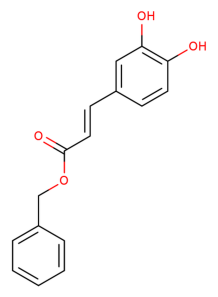
“Exact CABE/benzyl caffeate: one of the most potent CAPE analogues for inhibiting nitric oxide production; supports preclinical anti-inflammatory rationale.”
Lipophilic caffeic‑ester antioxidant; add in oil/emulsions during cool‑down; protect from air/light; start 0.05–1%.
Caffeic Acid Benzyl Ester (CABE) is an ester of caffeic acid that occurs naturally in propolis extracts. Across the caffeic‑ester class, numerous studies report strong antioxidant capacity and anti‑inflammatory activity in chemical and cell models; CABE appears alongside other esters in comparative panels.
Evidence snapshot for topical R&D: caffeic‑ester antioxidants (ROS scavenging) with class signals for anti‑inflammatory pathway modulation; antimicrobial activity reported for related esters; and benzyl caffeate specifically has shown anti‑angiogenic/apoptotic effects in endothelial models. A dermatology patent proposes benzyl caffeate for psoriasis (not clinical proof).
Formulation note & safety: caffeic acid and its esters readily oxidize in air to quinone‑type products that can increase sensitization risk. CABE (and propolis that contains it) is a known contact allergen in some individuals. Control oxygen/light exposure, use co‑antioxidants/chelators, and build in patch‑test/label vigilance.
Usage: Antioxidant support for serums, lotions/creams, gels, masks, scalp/leave‑on where permitted. Position as calming/anti‑redness support and oxidative‑stress defense in preclinical context.
Mixing method:
- Lipophilic. Pre‑dissolve in cosmetic oils/esters (e.g., medium‑chain triglycerides, lightweight emollients) or incorporate into the oil phase of an emulsion; alternatively load into lipid carriers (SLNs/ethosomes/liposomes).
- Add during cool‑down (<40°C). Minimize oxygen exposure (nitrogen blanket where possible) and pack in amber/airless containers.
- Include a co‑antioxidant system (e.g., tocopherol) and a metal chelator; avoid peroxide‑containing excipients.
- Compatibility guidance: avoid strong base; monitor color drift from oxidation; store tightly closed, dry, protected from light.
Usage rate: 0.05–1% typical prototype range (no consensus limit published). Optimize with in‑vitro irritation/sensitization testing and market regulations.
Product characteristics: Pale yellow powder/crystals; faint phenolic aroma.
Solubility: Oil‑soluble in common cosmetic esters/oils; insoluble in water. Consider lipid carriers to enhance delivery and stability.
No products
Lipophilic caffeic‑ester antioxidant; add in oil/emulsions during cool‑down; protect from air/light; start 0.05–1%.
Caffeic Acid Benzyl Ester (CABE) is an ester of caffeic acid that occurs naturally in propolis extracts. Across the caffeic‑ester class, numerous studies report strong antioxidant capacity and anti‑inflammatory activity in chemical and cell models; CABE appears alongside other esters in comparative panels.
Evidence snapshot for topical R&D: caffeic‑ester antioxidants (ROS scavenging) with class signals for anti‑inflammatory pathway modulation; antimicrobial activity reported for related esters; and benzyl caffeate specifically has shown anti‑angiogenic/apoptotic effects in endothelial models. A dermatology patent proposes benzyl caffeate for psoriasis (not clinical proof).
Formulation note & safety: caffeic acid and its esters readily oxidize in air to quinone‑type products that can increase sensitization risk. CABE (and propolis that contains it) is a known contact allergen in some individuals. Control oxygen/light exposure, use co‑antioxidants/chelators, and build in patch‑test/label vigilance.
Usage: Antioxidant support for serums, lotions/creams, gels, masks, scalp/leave‑on where permitted. Position as calming/anti‑redness support and oxidative‑stress defense in preclinical context.
Mixing method:
- Lipophilic. Pre‑dissolve in cosmetic oils/esters (e.g., medium‑chain triglycerides, lightweight emollients) or incorporate into the oil phase of an emulsion; alternatively load into lipid carriers (SLNs/ethosomes/liposomes).
- Add during cool‑down (<40°C). Minimize oxygen exposure (nitrogen blanket where possible) and pack in amber/airless containers.
- Include a co‑antioxidant system (e.g., tocopherol) and a metal chelator; avoid peroxide‑containing excipients.
- Compatibility guidance: avoid strong base; monitor color drift from oxidation; store tightly closed, dry, protected from light.
Usage rate: 0.05–1% typical prototype range (no consensus limit published). Optimize with in‑vitro irritation/sensitization testing and market regulations.
Product characteristics: Pale yellow powder/crystals; faint phenolic aroma.
Solubility: Oil‑soluble in common cosmetic esters/oils; insoluble in water. Consider lipid carriers to enhance delivery and stability.
| Mechanism | - |
| Appearance | - |
| Longevity | - |
| Strength | - |
| Long-term storage | - |
| Shelf Life | - |
| Allergen(s) | - |
| Dosage (Range) | - |
| Recommended Dosage | - |
| Dosage (Per Day) | - |
| Recommended Dosage (Per Day) | - |
| Mix Method | - |
| Heat Resistance | - |
| Stable in pH range | - |
| Solubility | - |
| Product Types | - |
| INCI | - |