


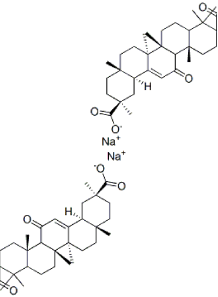
“Exact GR-SU evidence: disodium succinoyl glycyrrhetinate inhibited S. aureus, including MRSA, and modulated virulence genes in vitro; supports anti-blemish positioning but not direct human acne proof.”
Water‑soluble licorice‑derived soothing salt; supports calm/anti‑blemish in cleansers and creams.
LicoSolve™ - Disodium Succinoyl Glycyrrhetinate is a water‑soluble disodium salt of 18β‑glycyrrhetinic acid (licorice root derivative). It functions as a skin‑conditioning, soothing active and a mild surfactant/foam‑booster for cleansers and creams.
Reality check: direct human acne trials on disodium succinoyl glycyrrhetinate are limited. Acne benefits are biologically plausible but largely extrapolated from glycyrrhetinic acid data and from GR‑SU’s own antibacterial/anti‑biofilm profile. Treat anti‑blemish claims as supportive rather than stand‑alone clinical proof.
Broader licorice‑derivative evidence suggests anti‑inflammatory soothing, potential barrier/wound support, and good cosmetic safety at typical use levels. GR‑SU adds practical formulating value in mild cleanser systems by improving foam feel while maintaining comfort.
Product Description: Water‑soluble licorice‑derived soothing active with mild surfactant/foam‑boosting behavior. Suitable for sensitive‑skin routines, post‑procedure soothing concepts, and cleansers seeking a better foam/mildness balance.
| Model/System | Key Endpoints | Implication |
|---|---|---|
| Bacteria/biofilm (in vitro; GR‑SU) | Staphylococcus aureus (incl. MRSA): growth kill at higher levels; synergy with aminoglycosides. Streptococcus mutans: growth and biofilm inhibition. | Supports anti‑blemish/oral‑care adjunct roles |
| Inflammation (licorice/GA) | Anti‑inflammatory, antioxidant; 11β‑HSD inhibition may enhance local cortisol action. | Soothing/anti‑redness positioning |
| Barrier/wound (licorice derivatives) | Hydrogel and salt derivatives improved closure, re‑epithelialisation, angiogenesis in models. | Post‑procedure/barrier support (indirect) |
| Clinical redness/itch (licorice extract) | 2% licorice gel reduced erythema, edema, itch vs placebo (short‑term). | Context for calming/AD‑prone lines |
Safety: cosmetic safety assessments (covering glycyrrhetinic acid and related salts including GR‑SU) support topical use in typical leave‑on/rinse‑off levels with low irritation/sensitization and poor skin penetration. Systemic licorice effects are associated with high oral intake, not standard topical use.
Usage: Calming/anti‑redness leave‑ons (toners, gels, serums, creams), anti‑blemish supporting formulas, and gentle cleansers/shampoos. Also relevant to oral‑care concepts.
Mixing method:
- Pre‑dissolve in water, glycerin, or propylene glycol. Add to the water phase or during cool‑down for emulsions.
- Compatible with common anionic/nonionic/amphoteric surfactants; verify with strongly cationic polymers.
- Temperature: add at room temperature or during cool‑down (≤40°C). Working pH window ~4–8 depending on system.
Usage rate: 0.1–1.0%
Typical: 0.2–0.5% in leave‑ons for soothing; 0.1–0.5% in cleansers for foam/mildness support.
Product characteristics: White to off‑white powder; odorless to faint.
Solubility: Soluble in water, glycerin, and propylene glycol; not oil‑soluble.
Store tightly closed in a dry place at room temperature; avoid humidity and excessive heat. Preservative‑Free
| Test Name | Specification |
|---|---|
| Appearance | White to off‑white solid |
| Purity (HPLC), % | ≥ 98.00 |
| Water content, % | < 0.50 |
No products
Water‑soluble licorice‑derived soothing salt; supports calm/anti‑blemish in cleansers and creams.
LicoSolve™ - Disodium Succinoyl Glycyrrhetinate is a water‑soluble disodium salt of 18β‑glycyrrhetinic acid (licorice root derivative). It functions as a skin‑conditioning, soothing active and a mild surfactant/foam‑booster for cleansers and creams.
Reality check: direct human acne trials on disodium succinoyl glycyrrhetinate are limited. Acne benefits are biologically plausible but largely extrapolated from glycyrrhetinic acid data and from GR‑SU’s own antibacterial/anti‑biofilm profile. Treat anti‑blemish claims as supportive rather than stand‑alone clinical proof.
Broader licorice‑derivative evidence suggests anti‑inflammatory soothing, potential barrier/wound support, and good cosmetic safety at typical use levels. GR‑SU adds practical formulating value in mild cleanser systems by improving foam feel while maintaining comfort.
Product Description: Water‑soluble licorice‑derived soothing active with mild surfactant/foam‑boosting behavior. Suitable for sensitive‑skin routines, post‑procedure soothing concepts, and cleansers seeking a better foam/mildness balance.
| Model/System | Key Endpoints | Implication |
|---|---|---|
| Bacteria/biofilm (in vitro; GR‑SU) | Staphylococcus aureus (incl. MRSA): growth kill at higher levels; synergy with aminoglycosides. Streptococcus mutans: growth and biofilm inhibition. | Supports anti‑blemish/oral‑care adjunct roles |
| Inflammation (licorice/GA) | Anti‑inflammatory, antioxidant; 11β‑HSD inhibition may enhance local cortisol action. | Soothing/anti‑redness positioning |
| Barrier/wound (licorice derivatives) | Hydrogel and salt derivatives improved closure, re‑epithelialisation, angiogenesis in models. | Post‑procedure/barrier support (indirect) |
| Clinical redness/itch (licorice extract) | 2% licorice gel reduced erythema, edema, itch vs placebo (short‑term). | Context for calming/AD‑prone lines |
Safety: cosmetic safety assessments (covering glycyrrhetinic acid and related salts including GR‑SU) support topical use in typical leave‑on/rinse‑off levels with low irritation/sensitization and poor skin penetration. Systemic licorice effects are associated with high oral intake, not standard topical use.
Usage: Calming/anti‑redness leave‑ons (toners, gels, serums, creams), anti‑blemish supporting formulas, and gentle cleansers/shampoos. Also relevant to oral‑care concepts.
Mixing method:
- Pre‑dissolve in water, glycerin, or propylene glycol. Add to the water phase or during cool‑down for emulsions.
- Compatible with common anionic/nonionic/amphoteric surfactants; verify with strongly cationic polymers.
- Temperature: add at room temperature or during cool‑down (≤40°C). Working pH window ~4–8 depending on system.
Usage rate: 0.1–1.0%
Typical: 0.2–0.5% in leave‑ons for soothing; 0.1–0.5% in cleansers for foam/mildness support.
Product characteristics: White to off‑white powder; odorless to faint.
Solubility: Soluble in water, glycerin, and propylene glycol; not oil‑soluble.
Store tightly closed in a dry place at room temperature; avoid humidity and excessive heat. Preservative‑Free
| Mechanism | - |
| Appearance | - |
| Longevity | - |
| Strength | - |
| Storage | - |
| Shelf Life | - |
| Allergen(s) | - |
| Dosage (Range) | - |
| Recommended Dosage | - |
| Dosage (Per Day) | - |
| Recommended Dosage (Per Day) | - |
| Mix Method | - |
| Heat Resistance | - |
| Stable in pH range | - |
| Solubility | - |
| Product Types | - |
| INCI | - |