


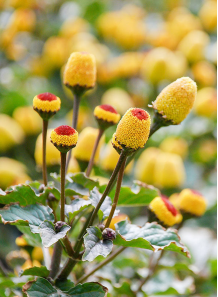
“Closest pure-spilanthol evidence: spilanthol reduced inflammatory mediators including PGE2, COX-2, TNF-α, MCP-1, and ICAM-1 via NF-κB/MAPK suppression; supports soothing/anti-redness rationale but was not a skin model.”
Spilanthol Expression Liposome (Natural Botox, Spilanthol 1.5% Water Soluble) is a cosmetic active that delivers spilanthol – the main N-alkylamide from Acmella oleracea (toothache plant, jambu, paracress) – in a water-dispersible liposomal form for expression-line smoothing and "botox-like" wrinkle-relaxing concepts.
Spilanthol is responsible for the characteristic tingling and mild numbing sensation of A. oleracea and acts on superficial neuromuscular signalling in a way that functionally resembles a much weaker, short-acting version of botulinum toxin. In vitro and patent/technical dossiers report reduced electromyographic activity of facial muscles and reversible myorelaxation at suitable extract levels, supporting its use in anti-wrinkle, expression-line and "Natural Botox" formulations.
Beyond myorelaxation, spilanthol-rich A. oleracea extracts show local-anesthetic behaviour (linked to sodium-channel blockade and TRP-channel modulation), downregulation of inflammatory mediators such as PGE2, COX-2, TNF-α, MCP-1 and ICAM-1 via NF-κB/MAPK pathways, and strong in-vitro antioxidant activity from phenolics, flavonoids and alkylamides. Preclinical work also indicates matrix- and repair-supporting effects (improved collagen organisation and pro-angiogenic responses) and a penetration-enhancing role where low levels of spilanthol can increase transdermal delivery of co-actives – all of which must be balanced with strict raw-material quality control to avoid unintentionally enhancing penetration of contaminants.
Human cosmetic studies with A. oleracea extract serums have shown measurable improvements in facial wrinkles, surface roughness and hydration over 2-week use, with good tolerability and very low/undetectable systemic spilanthol levels in dermal-absorption tests. Separate oral-mucosa work in gels and films supports its local anesthetic potential for dental applications, but this product is supplied as a cosmetic ingredient for topical formulations and not as a medicinal anesthetic.

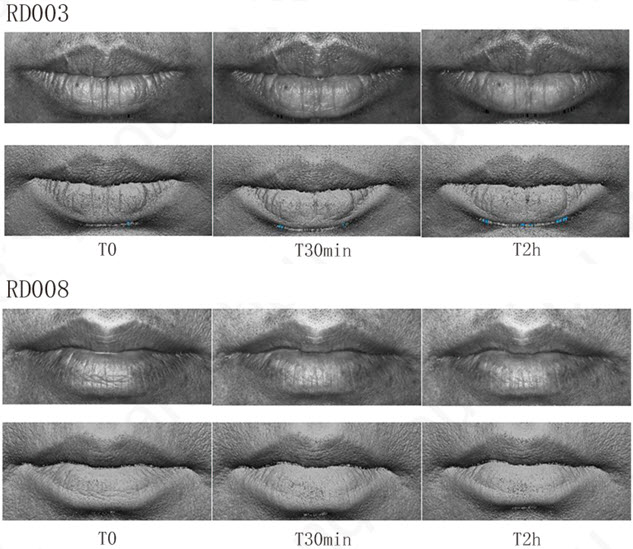
Within this non-invasive group, spilanthol-rich Acmella sits alongside the better-documented neuropeptides in terms of effect size but differs by its small, lipophilic N-alkylamide structure, clear tingling/anaesthetic sensory signal, multi-axis anti-inflammatory/antioxidant profile and its ability to enhance penetration of compatible co-actives when the formula and raw-material quality are well controlled.
| Active | Origin & type | Main mechanism | Human wrinkle data (snapshot) | Notes (pros / cons) |
|---|---|---|---|---|
| Acmella oleracea (spilanthol) | Plant extract rich in N-alkylamides (especially spilanthol). | Reduces superficial facial muscle activity and modulates ion channels; also acts as a skin-penetration enhancer. | Two facial-serum studies show about 10–15% wrinkle/roughness reductions and 10–40% hydration gains after 2 weeks, with excellent tolerability. | Botanical, multi-benefit (anti-inflammatory, antioxidant, analgesic, antimicrobial, penetration-enhancing) but with tingling; evidence volume smaller than the main peptides. |
| Argireline (Acetyl hexapeptide-8) | Synthetic hexapeptide (SNAP-25 fragment). | Reduces SNARE-complex formation and acetylcholine release in mimic muscles (topical neuromodulation). | Randomized and open studies at 5–10% often report about 10–30% wrinkle-depth reduction and sometimes up to ~50% improvement after 4 weeks. | Best-studied topical neuropeptide; consistent moderate effect but limited penetration and peptide-only mode of action. |
| SNAP-8 (Acetyl octapeptide-3) | Extended Argireline analogue (8 amino acids). | Same SNARE/acetylcholine pathway as Argireline, designed for stronger topical neuromodulation. | Manufacturer data at 10% suggest roughly 20–40% wrinkle reduction in 4 weeks (crow's feet/forehead), mainly from in-house studies. | Marketed as “stronger Argireline” but evidence is less independent; similar penetration limitations. |
| Syn-Ake | Small synthetic dipeptide inspired by Waglerin-1 (snake venom). | Antagonises nicotinic acetylcholine receptors in a Botox-like fashion at the skin surface. | In-house trials with 4% cream show around 20–50% wrinkle-smoothing over 4 weeks, but sample sizes are small. | Strong marketing story and fast-acting positioning; human evidence largely vendor-generated. |
| Leuphasyl (Pentapeptide-18) | Synthetic pentapeptide (enkephalin analogue). | Acts at neuronal receptors in a pain-modulator-like fashion to reduce acetylcholine release. | Open-label creams up to 2% report roughly 30–35% frontal and ~25–30% periorbital wrinkle reduction over 1–2 months, often in combination with Argireline. | Useful in peptide blends for deeper lines; standalone data are fewer and mostly manufacturer-led. |
| Myoxinol | Peptide-rich extract from okra (*Hibiscus esculentus*). | Reduces fibroblast/muscle-cell contractions and provides strong antioxidant protection. | About 26% reduction in crow's-feet visibility in 3 weeks at 1% cream, plus extra antioxidant benefits. | Well-aligned with “green” positioning; clinical volume still smaller than for Argireline and mainly in cosmetic settings. |
This WS grade contains spilanthol assayed at about 1.2–1.8% (nominal 1.5%) encapsulated in a liposomal, water/glycol-based system. Typical COA specifications describe it as a brownish-yellow solution with relative density around 1.00–1.30, refractive index about 1.4100–1.4500 and microbial limits of ≤500 CFU/g total aerobic count and ≤100 CFU/g molds and yeasts. At the recommended use level of 0.1–3% in the finished product this corresponds to approximately 0.0015–0.045% delivered spilanthol on skin, with most day-to-day formulas working comfortably around about 0.3–1% of this concentrate.
Usage: Expression-line and "Natural Botox" concepts in serums, eye and lip treatments, targeted wrinkle essences, firming creams/lotions and make-up/primers where quick visible smoothing and improved surface feel are desired.
Mixing method:
- Use in the aqueous phase or during cool-down of emulsions; ideal working temperatures are typically below about 40°C to help preserve the liposomal structure.
- For emulsions, add this ingredient to the water phase after main heating, or post-add to the emulsion at cool-down, with gentle to moderate stirring (avoid very high shear applied directly to the concentrate).
- Compatible with most common humectants and mild glycols; avoid very high levels of strong solvents or extreme pH which may destabilise the liposomes.
- Formulate finished products in a typical facial-care pH window around 4–7; verify stability, sensorial behaviour and any tingling intensity in each base.
Usage rate: 0.1–10% of this 1.5% spilanthol concentrate in finished products (common working range about 0.3–3%; higher levels up to 10% should be reserved for local/treatment formulas after appropriate patch testing).
At 0.1–10% of the concentrate the delivered spilanthol on skin is approximately 0.0015–0.15%, which is generally sufficient for expression-line concepts when combined with appropriate base formulation and film-formers.
Product characteristics: White to off-white powder supplied as a water-soluble liposomal grade; characteristic mild herbal/tingling-type odour.
Solubility: Designed to be readily dispersible/soluble in water and water/glycol systems; not self-soluble in pure oils. For best clarity and stability, pre-disperse into a small portion of the aqueous phase before adding to the main batch.
Storage: Store tightly closed in a cool place away from light and air; avoid prolonged exposure to temperatures above normal room temperature and protect from repeated freeze–thaw cycles.
| Test Name | Specification |
|---|---|
| Appearance and character | Brownish-yellow solution |
| Spilanthol content | 1.2%–1.8% |
| Relative density | 1.00–1.30 |
| Refractive index | 1.4100–1.4500 |
| Aerobic bacterial count (CFU/g or CFU/mL) | ≤500 |
| Molds and yeast count (CFU/g or CFU/mL) | ≤100 |
No products
Spilanthol Expression Liposome (Natural Botox, Spilanthol 1.5% Water Soluble) is a cosmetic active that delivers spilanthol – the main N-alkylamide from Acmella oleracea (toothache plant, jambu, paracress) – in a water-dispersible liposomal form for expression-line smoothing and "botox-like" wrinkle-relaxing concepts.
Spilanthol is responsible for the characteristic tingling and mild numbing sensation of A. oleracea and acts on superficial neuromuscular signalling in a way that functionally resembles a much weaker, short-acting version of botulinum toxin. In vitro and patent/technical dossiers report reduced electromyographic activity of facial muscles and reversible myorelaxation at suitable extract levels, supporting its use in anti-wrinkle, expression-line and "Natural Botox" formulations.
Beyond myorelaxation, spilanthol-rich A. oleracea extracts show local-anesthetic behaviour (linked to sodium-channel blockade and TRP-channel modulation), downregulation of inflammatory mediators such as PGE2, COX-2, TNF-α, MCP-1 and ICAM-1 via NF-κB/MAPK pathways, and strong in-vitro antioxidant activity from phenolics, flavonoids and alkylamides. Preclinical work also indicates matrix- and repair-supporting effects (improved collagen organisation and pro-angiogenic responses) and a penetration-enhancing role where low levels of spilanthol can increase transdermal delivery of co-actives – all of which must be balanced with strict raw-material quality control to avoid unintentionally enhancing penetration of contaminants.
Human cosmetic studies with A. oleracea extract serums have shown measurable improvements in facial wrinkles, surface roughness and hydration over 2-week use, with good tolerability and very low/undetectable systemic spilanthol levels in dermal-absorption tests. Separate oral-mucosa work in gels and films supports its local anesthetic potential for dental applications, but this product is supplied as a cosmetic ingredient for topical formulations and not as a medicinal anesthetic.
Within this non-invasive group, spilanthol-rich Acmella sits alongside the better-documented neuropeptides in terms of effect size but differs by its small, lipophilic N-alkylamide structure, clear tingling/anaesthetic sensory signal, multi-axis anti-inflammatory/antioxidant profile and its ability to enhance penetration of compatible co-actives when the formula and raw-material quality are well controlled.
| Active | Origin & type | Main mechanism | Human wrinkle data (snapshot) | Notes (pros / cons) |
|---|---|---|---|---|
| Acmella oleracea (spilanthol) | Plant extract rich in N-alkylamides (especially spilanthol). | Reduces superficial facial muscle activity and modulates ion channels; also acts as a skin-penetration enhancer. | Two facial-serum studies show about 10–15% wrinkle/roughness reductions and 10–40% hydration gains after 2 weeks, with excellent tolerability. | Botanical, multi-benefit (anti-inflammatory, antioxidant, analgesic, antimicrobial, penetration-enhancing) but with tingling; evidence volume smaller than the main peptides. |
| Argireline (Acetyl hexapeptide-8) | Synthetic hexapeptide (SNAP-25 fragment). | Reduces SNARE-complex formation and acetylcholine release in mimic muscles (topical neuromodulation). | Randomized and open studies at 5–10% often report about 10–30% wrinkle-depth reduction and sometimes up to ~50% improvement after 4 weeks. | Best-studied topical neuropeptide; consistent moderate effect but limited penetration and peptide-only mode of action. |
| SNAP-8 (Acetyl octapeptide-3) | Extended Argireline analogue (8 amino acids). | Same SNARE/acetylcholine pathway as Argireline, designed for stronger topical neuromodulation. | Manufacturer data at 10% suggest roughly 20–40% wrinkle reduction in 4 weeks (crow's feet/forehead), mainly from in-house studies. | Marketed as “stronger Argireline” but evidence is less independent; similar penetration limitations. |
| Syn-Ake | Small synthetic dipeptide inspired by Waglerin-1 (snake venom). | Antagonises nicotinic acetylcholine receptors in a Botox-like fashion at the skin surface. | In-house trials with 4% cream show around 20–50% wrinkle-smoothing over 4 weeks, but sample sizes are small. | Strong marketing story and fast-acting positioning; human evidence largely vendor-generated. |
| Leuphasyl (Pentapeptide-18) | Synthetic pentapeptide (enkephalin analogue). | Acts at neuronal receptors in a pain-modulator-like fashion to reduce acetylcholine release. | Open-label creams up to 2% report roughly 30–35% frontal and ~25–30% periorbital wrinkle reduction over 1–2 months, often in combination with Argireline. | Useful in peptide blends for deeper lines; standalone data are fewer and mostly manufacturer-led. |
| Myoxinol | Peptide-rich extract from okra (*Hibiscus esculentus*). | Reduces fibroblast/muscle-cell contractions and provides strong antioxidant protection. | About 26% reduction in crow's-feet visibility in 3 weeks at 1% cream, plus extra antioxidant benefits. | Well-aligned with “green” positioning; clinical volume still smaller than for Argireline and mainly in cosmetic settings. |
This WS grade contains spilanthol assayed at about 1.2–1.8% (nominal 1.5%) encapsulated in a liposomal, water/glycol-based system. Typical COA specifications describe it as a brownish-yellow solution with relative density around 1.00–1.30, refractive index about 1.4100–1.4500 and microbial limits of ≤500 CFU/g total aerobic count and ≤100 CFU/g molds and yeasts. At the recommended use level of 0.1–3% in the finished product this corresponds to approximately 0.0015–0.045% delivered spilanthol on skin, with most day-to-day formulas working comfortably around about 0.3–1% of this concentrate.
Usage: Expression-line and "Natural Botox" concepts in serums, eye and lip treatments, targeted wrinkle essences, firming creams/lotions and make-up/primers where quick visible smoothing and improved surface feel are desired.
Mixing method:
- Use in the aqueous phase or during cool-down of emulsions; ideal working temperatures are typically below about 40°C to help preserve the liposomal structure.
- For emulsions, add this ingredient to the water phase after main heating, or post-add to the emulsion at cool-down, with gentle to moderate stirring (avoid very high shear applied directly to the concentrate).
- Compatible with most common humectants and mild glycols; avoid very high levels of strong solvents or extreme pH which may destabilise the liposomes.
- Formulate finished products in a typical facial-care pH window around 4–7; verify stability, sensorial behaviour and any tingling intensity in each base.
Usage rate: 0.1–10% of this 1.5% spilanthol concentrate in finished products (common working range about 0.3–3%; higher levels up to 10% should be reserved for local/treatment formulas after appropriate patch testing).
At 0.1–10% of the concentrate the delivered spilanthol on skin is approximately 0.0015–0.15%, which is generally sufficient for expression-line concepts when combined with appropriate base formulation and film-formers.
Product characteristics: White to off-white powder supplied as a water-soluble liposomal grade; characteristic mild herbal/tingling-type odour.
Solubility: Designed to be readily dispersible/soluble in water and water/glycol systems; not self-soluble in pure oils. For best clarity and stability, pre-disperse into a small portion of the aqueous phase before adding to the main batch.
Storage: Store tightly closed in a cool place away from light and air; avoid prolonged exposure to temperatures above normal room temperature and protect from repeated freeze–thaw cycles.
| Mechanism | - |
| Appearance | - |
| Longevity | - |
| Strength | - |
| Storage | - |
| Shelf Life | - |
| Allergen(s) | - |
| Dosage (Range) | - |
| Recommended Dosage | - |
| Dosage (Per Day) | - |
| Recommended Dosage (Per Day) | - |
| Mix Method | - |
| Heat Resistance | - |
| Stable in pH range | - |
| Solubility | - |
| Product Types | - |
| INCI | - |