


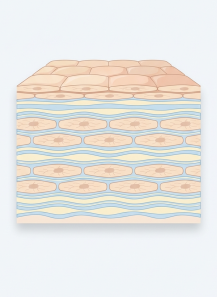
“Closest NMF-system evidence: a moisturizer formulated to mimic skin natural moisturizing systems significantly increased skin hydration and reduced TEWL versus baseline/placebo.”
NMF-mimetic blend of amino acids + PCA + lactate designed to increase stratum-corneum water binding and support a smoother, less dehydration-lined skin feel.
SkinIntex™ (NMF For Skin Integrity) is a 5-component blend designed to mimic key parts of the skin’s Natural Moisturizing Factor (NMF) system.
NMF is a pool of small, water-soluble and highly hygroscopic molecules located mainly inside stratum-corneum corneocytes. A major physiological source is filaggrin breakdown during terminal differentiation, yielding free amino acids and key derivatives such as pyrrolidone carboxylic acid (PCA) and urocanic acid (UCA).
In cosmetic “anti-aging” practice, improving stratum-corneum water binding and barrier performance is a practical biophysical lever: better hydration increases corneocyte/keratin matrix flexibility, reduces roughness, and can make fine lines that are exaggerated by dehydration appear less visible.
Product Description: SkinIntex™ combines serine, calcium lactate (lactate + calcium), PCA, arginine, and histidine to reproduce multiple functional dimensions of NMF: direct osmolyte water binding, NMF-related precursor pathways (arginine → urea; histidine → UCA), and barrier-supporting signaling context (calcium biology and lactate-associated barrier lipid support depending on formulation conditions).
- Serine: hygroscopic amino acid in the natural NMF pool; also biochemically upstream of ceramide synthesis (serine palmitoyltransferase pathway) in epidermal biology.
- PCA: canonical filaggrin-derived NMF component; behaves as a highly polar solute that supports water binding and can contribute to “plasticizing” mobility within the stratum-corneum matrix.
- Calcium lactate: provides lactate (recognized NMF component) and calcium ions (central to epidermal differentiation/barrier homeostasis). As a salt, it is not an “AHA peel” unless the formulation is designed to yield free acid at skin-relevant pH.
- Arginine: hygroscopic amino acid and a precursor to stratum-corneum urea via arginase-1 (urea is a major NMF humectant).
- Histidine: hygroscopic amino acid and precursor of urocanic acid; participates in the filaggrin-to-NMF pathway that contributes to the stratum-corneum acid mantle and barrier enzyme environment.
| Component | NMF / barrier relevance | Formulation note |
|---|---|---|
| Serine | Free amino-acid osmolyte; supports corneocyte water binding and keratin flexibility | Water phase / humectant system balancing |
| PCA | Filaggrin-derived NMF derivative; strong hygroscopic polar solute | Vehicle matters; pair with suitable emollients/occlusion |
| Calcium lactate | Lactate as NMF component + calcium signaling context for barrier homeostasis | Salt form; not a low-pH exfoliant by default |
| Arginine | Amino-acid humectant; precursor to endogenous urea in stratum corneum | Compatible with most leave-on systems; monitor ionic strength |
| Histidine | Amino-acid osmolyte; precursor to UCA and supports acid-mantle context | Maintain skin-relevant pH for best sensory and compatibility |
Note: Filaggrin/NMF-related UV biology is not a substitute for sunscreen. UV filters remain the primary evidence-based lever for photoaging prevention.
Usage: Suitable for hydration-focused and anti-wrinkle/anti-aging use in leave-on skincare such as creams, lotions, clear gels, serums, masks, and barrier-support products (including sensitive-skin concepts when overall formula is well balanced).
Mixing method:
- Pre-dissolve in water or a water+glycol premix (e.g., water/glycerin/propylene glycol), then add to the main batch.
- Add during cool-down when the batch is below 40°C to minimize thermal stress and preserve formula stability.
- Keep pH in a skin-relevant window (typical target pH 4–7). Monitor ionic strength and compatibility with strongly cationic polymers/high-electrolyte systems.
Usage rate: 0.5–5%
- Typical starting point: 1–3% depending on desired moisturization feel and total humectant load.
Product characteristics: White to off-white crystalline powder; odorless; hygroscopic.
Solubility: Soluble in water and glycols; not oil soluble.
Storage: Store tightly closed in a cool, dry place. Protect from moisture/humidity (use desiccant when possible).
| Test Name | Specification |
|---|---|
| Appearance | White powder |
| Total Amino Acids | 70% Min |
| Solubility Test (Water, 3%) | Clear solution |
| Heavy Metal | 20ppm Max |
No products
NMF-mimetic blend of amino acids + PCA + lactate designed to increase stratum-corneum water binding and support a smoother, less dehydration-lined skin feel.
SkinIntex™ (NMF For Skin Integrity) is a 5-component blend designed to mimic key parts of the skin’s Natural Moisturizing Factor (NMF) system.
NMF is a pool of small, water-soluble and highly hygroscopic molecules located mainly inside stratum-corneum corneocytes. A major physiological source is filaggrin breakdown during terminal differentiation, yielding free amino acids and key derivatives such as pyrrolidone carboxylic acid (PCA) and urocanic acid (UCA).
In cosmetic “anti-aging” practice, improving stratum-corneum water binding and barrier performance is a practical biophysical lever: better hydration increases corneocyte/keratin matrix flexibility, reduces roughness, and can make fine lines that are exaggerated by dehydration appear less visible.
Product Description: SkinIntex™ combines serine, calcium lactate (lactate + calcium), PCA, arginine, and histidine to reproduce multiple functional dimensions of NMF: direct osmolyte water binding, NMF-related precursor pathways (arginine → urea; histidine → UCA), and barrier-supporting signaling context (calcium biology and lactate-associated barrier lipid support depending on formulation conditions).
- Serine: hygroscopic amino acid in the natural NMF pool; also biochemically upstream of ceramide synthesis (serine palmitoyltransferase pathway) in epidermal biology.
- PCA: canonical filaggrin-derived NMF component; behaves as a highly polar solute that supports water binding and can contribute to “plasticizing” mobility within the stratum-corneum matrix.
- Calcium lactate: provides lactate (recognized NMF component) and calcium ions (central to epidermal differentiation/barrier homeostasis). As a salt, it is not an “AHA peel” unless the formulation is designed to yield free acid at skin-relevant pH.
- Arginine: hygroscopic amino acid and a precursor to stratum-corneum urea via arginase-1 (urea is a major NMF humectant).
- Histidine: hygroscopic amino acid and precursor of urocanic acid; participates in the filaggrin-to-NMF pathway that contributes to the stratum-corneum acid mantle and barrier enzyme environment.
| Component | NMF / barrier relevance | Formulation note |
|---|---|---|
| Serine | Free amino-acid osmolyte; supports corneocyte water binding and keratin flexibility | Water phase / humectant system balancing |
| PCA | Filaggrin-derived NMF derivative; strong hygroscopic polar solute | Vehicle matters; pair with suitable emollients/occlusion |
| Calcium lactate | Lactate as NMF component + calcium signaling context for barrier homeostasis | Salt form; not a low-pH exfoliant by default |
| Arginine | Amino-acid humectant; precursor to endogenous urea in stratum corneum | Compatible with most leave-on systems; monitor ionic strength |
| Histidine | Amino-acid osmolyte; precursor to UCA and supports acid-mantle context | Maintain skin-relevant pH for best sensory and compatibility |
Note: Filaggrin/NMF-related UV biology is not a substitute for sunscreen. UV filters remain the primary evidence-based lever for photoaging prevention.
Usage: Suitable for hydration-focused and anti-wrinkle/anti-aging use in leave-on skincare such as creams, lotions, clear gels, serums, masks, and barrier-support products (including sensitive-skin concepts when overall formula is well balanced).
Mixing method:
- Pre-dissolve in water or a water+glycol premix (e.g., water/glycerin/propylene glycol), then add to the main batch.
- Add during cool-down when the batch is below 40°C to minimize thermal stress and preserve formula stability.
- Keep pH in a skin-relevant window (typical target pH 4–7). Monitor ionic strength and compatibility with strongly cationic polymers/high-electrolyte systems.
Usage rate: 0.5–5%
- Typical starting point: 1–3% depending on desired moisturization feel and total humectant load.
Product characteristics: White to off-white crystalline powder; odorless; hygroscopic.
Solubility: Soluble in water and glycols; not oil soluble.
Storage: Store tightly closed in a cool, dry place. Protect from moisture/humidity (use desiccant when possible).
| Mechanism | - |
| Appearance | - |
| Longevity | - |
| Strength | - |
| Long-term storage | - |
| Shelf Life | - |
| Allergen(s) | - |
| Dosage (Range) | - |
| Recommended Dosage | - |
| Dosage (Per Day) | - |
| Recommended Dosage (Per Day) | - |
| Mix Method | - |
| Heat Resistance | - |
| Stable in pH range | - |
| Solubility | - |
| Product Types | - |
| INCI | - |