


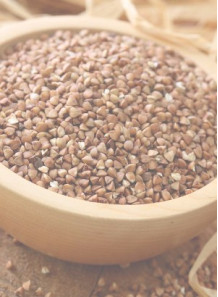
“Closest ingredient-family evidence: topical soybean phytosterols improved recovery of the damaged stratum corneum barrier in human volunteers.”
Contains a high proportion of Phytosterols. (Beta-Sitosterol approximately 70%, Campestrol approximately 17%, Delta 5-Avenastrol approximately 6%, Stigmasterol approximately 2%)
Buckwheat Wax contains a high percentage of Phytosterols. (Beta-Sitosterol approximately 70%, Campestrol approximately 17%, Delta 5-Avenastrol approximately 6%, Stigmasterol approximately 2%)
Buckwheat Wax is also obtained from extraction. Supercritical CO2 in which no solvent of any kind is used in the extraction process. to obtain a Solvent-free extract
From the test, it was found that Buckwheat Wax can act on the skin as follows:
1. Moisturizing Effect (Moisturize the skin)
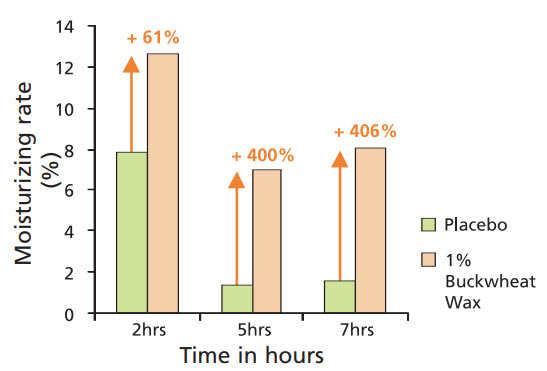
2. Anti-puffiness Effect (reduce puffy eyes)
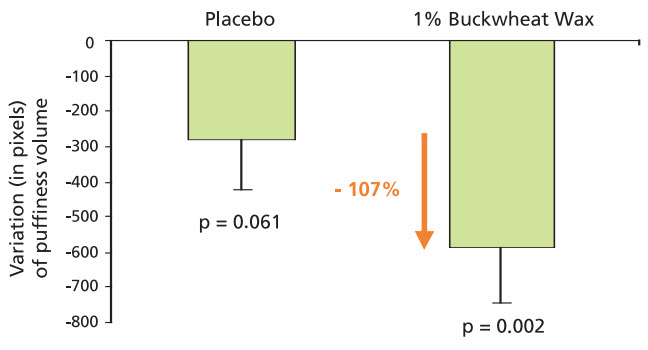
Use: For products to reduce wrinkles, reduce dark circles around the eyes.
Mixing method: Distributed in the formula by using heat of 60 degrees to help spread
Usage rate: 0.5-3% recommend 1-2%
Product characteristics: light thick cream
Solubility: Can be dispersed in the formula (lotion, cream)
INCI Name : Caprylic/capric triglyceride (and) Hydrogenated vegetable oil (and) Polygonum fagopyrum seed extract
Examples of products that use buckwheat wax as an ingredient
LANCOME Advanced Genifique Eye Cream
La Prairie Skin Caviar Luxe Eye Lift Cream
LA MER The Eye Concentrate
L'occitane Divine Eyes
Nu Skin tru face idealeyes
| Test Name | Specification |
|---|---|
| Aspect | Wax |
| Colour | Pale yellow to pale green |
| Odour | Characteristics |
| Acid Value (mg KOH/g) | 290-320 |
| Peroxide Value (meq O2/kg) | 10 Max |
| Iodine Value (g I2/100g) | 10 Max |
| Insaponifiable Value | 0.2% Min |
| Melting Point | 50-58 |
| TLC of insaponifiable | Presence of sterols |
| Total mesophilic aerobic germs | Less than 100 germs/g |
| Yeast and mould | Less than 100 germs/g |
| Pseudomonas spp. | Absence in 1g |
| Staphylococcus aureus | Absence in 1g |
| Candida albicans | Absence in 1g |
| Enterobactery | Absence in 1g |
No products
Contains a high proportion of Phytosterols. (Beta-Sitosterol approximately 70%, Campestrol approximately 17%, Delta 5-Avenastrol approximately 6%, Stigmasterol approximately 2%)
Buckwheat Wax contains a high percentage of Phytosterols. (Beta-Sitosterol approximately 70%, Campestrol approximately 17%, Delta 5-Avenastrol approximately 6%, Stigmasterol approximately 2%)
Buckwheat Wax is also obtained from extraction. Supercritical CO2 in which no solvent of any kind is used in the extraction process. to obtain a Solvent-free extract
From the test, it was found that Buckwheat Wax can act on the skin as follows:
1. Moisturizing Effect (Moisturize the skin)
2. Anti-puffiness Effect (reduce puffy eyes)
Use: For products to reduce wrinkles, reduce dark circles around the eyes.
Mixing method: Distributed in the formula by using heat of 60 degrees to help spread
Usage rate: 0.5-3% recommend 1-2%
Product characteristics: light thick cream
Solubility: Can be dispersed in the formula (lotion, cream)
INCI Name : Caprylic/capric triglyceride (and) Hydrogenated vegetable oil (and) Polygonum fagopyrum seed extract
Examples of products that use buckwheat wax as an ingredient
LANCOME Advanced Genifique Eye Cream
La Prairie Skin Caviar Luxe Eye Lift Cream
LA MER The Eye Concentrate
L'occitane Divine Eyes
Nu Skin tru face idealeyes
| Mechanism | - |
| Appearance | - |
| Longevity | - |
| Strength | - |
| Long-term storage | - |
| Shelf Life | - |
| Allergen(s) | - |
| Dosage (Range) | - |
| Recommended Dosage | - |
| Dosage (Per Day) | - |
| Recommended Dosage (Per Day) | - |
| Mix Method | - |
| Heat Resistance | - |
| Stable in pH range | - |
| Solubility | - |
| Product Types | - |
| INCI | - |