


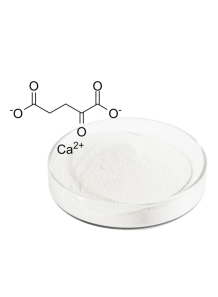
Calcium alpha‑ketoglutarate (Ca‑AKG) — dietary supplement salt of AKG; studied for aging biology and bone metabolism; typical research dose around 1 g/day (SR).
Calcium alpha-ketoglutarate (Ca-AKG) ≥98% purity is a calcium salt of alpha‑ketoglutarate (AKG), a TCA‑cycle metabolite studied for aging biology and bone metabolism. It is a white to off‑white powder suitable for dietary supplement use.
| Benefit | Typical study dose* | Key human findings | High-quality sources |
|---|---|---|---|
| Healthy aging biomarkers | ~1 g/day (SR) for 6–8 months | Uncontrolled Rejuvant® user study reported ~8‑year reduction in DNA‑methylation age; exploratory and not placebo‑controlled. | PMC |
| Frailty/healthspan (animal) | Dietary Ca‑AKG in middle‑aged mice | Extended lifespan, reduced frailty scores, ↓ inflammatory cytokines (e.g., IL‑6). | Cell Metab |
| Bone metabolism | 6 g/day for 6 months (postmenopausal) | Lowered bone resorption marker (CTX); BMD change small/non‑significant over 6 months. | PubMed |
| Exercise/muscle | Varies by salt (AKG blends) | Human data mixed and often with other AKG salts (e.g., arginine‑AKG); translate cautiously. | MDPI |
*Doses shown are typical in studies; products and formulations differ. Pending RCT (“ABLE”) is testing 1 g/day sustained‑release for 6 months.
| Test Name | Specification |
|---|---|
| Appearance | White to off-white powder |
| Purity | ≥98% |
| Calcium (Ca2+, on dried basis) | 18–21% |
| Water | ≤7.0% |
| pH (6.0–8.0) | 6.0–8.0 |
| Loss on drying | ≤1.0% |
| Lead (Pb) | ≤0.1 ppm |
| Mercury (Hg) | ≤0.1 ppm |
| Cadmium (Cd) | ≤0.2 ppm |
| Arsenic (As) | ≤0.1 ppm |
| Total microbial count | ≤500 CFU/g |
| Coliform | ≤0.92 MPN/g |
| Mold and yeast | <50 CFU/g |
| Staphylococcus aureus | 0/25 g |
| Salmonella | 0/25 g |
No products
Calcium alpha‑ketoglutarate (Ca‑AKG) — dietary supplement salt of AKG; studied for aging biology and bone metabolism; typical research dose around 1 g/day (SR).
Calcium alpha-ketoglutarate (Ca-AKG) ≥98% purity is a calcium salt of alpha‑ketoglutarate (AKG), a TCA‑cycle metabolite studied for aging biology and bone metabolism. It is a white to off‑white powder suitable for dietary supplement use.
| Benefit | Typical study dose* | Key human findings | High-quality sources |
|---|---|---|---|
| Healthy aging biomarkers | ~1 g/day (SR) for 6–8 months | Uncontrolled Rejuvant® user study reported ~8‑year reduction in DNA‑methylation age; exploratory and not placebo‑controlled. | PMC |
| Frailty/healthspan (animal) | Dietary Ca‑AKG in middle‑aged mice | Extended lifespan, reduced frailty scores, ↓ inflammatory cytokines (e.g., IL‑6). | Cell Metab |
| Bone metabolism | 6 g/day for 6 months (postmenopausal) | Lowered bone resorption marker (CTX); BMD change small/non‑significant over 6 months. | PubMed |
| Exercise/muscle | Varies by salt (AKG blends) | Human data mixed and often with other AKG salts (e.g., arginine‑AKG); translate cautiously. | MDPI |
*Doses shown are typical in studies; products and formulations differ. Pending RCT (“ABLE”) is testing 1 g/day sustained‑release for 6 months.
| Mechanism | - |
| Appearance | - |
| Longevity | - |
| Strength | - |
| Long-term storage | - |
| Shelf Life | - |
| Allergen(s) | - |
| Dosage (Range) | - |
| Recommended Dosage | - |
| Dosage (Per Day) | - |
| Recommended Dosage (Per Day) | - |
| Mix Method | - |
| Heat Resistance | - |
| Stable in pH range | - |
| Solubility | - |
| Product Types | - |
| INCI | - |