


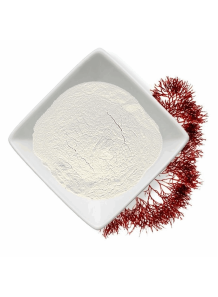
Carrageenan (Low Gel Strength, Opaque Gel) is a food-grade carrageenan powder for technical food formulation work. It is used as lower-strength opaque carrageenan for economical thickening and stabilization. The grade is intended for formulators who need controlled gel strength, viscosity, clarity profile, and water-binding behavior in finished food systems.
Carrageenan is a red-seaweed polysaccharide hydrocolloid used mainly as a gelling agent, thickener, stabilizer, and water-binding ingredient. Gel behavior is strongly system-dependent: potassium ions usually strengthen kappa-type gels, calcium can modify elasticity, and milk proteins can interact with carrageenan to improve suspension and body. For clear products, control hydration, insoluble particles, sugar/acid balance, and filtration/dispersion quality because clarity is affected by the whole formula, not only the carrageenan grade.
| Best fit | cost-effective opaque stabilization, body, suspension, and water binding |
| Jelly and dessert systems | Use for water jelly, fruit jelly, pudding/flan, dairy dessert, and drinkable jelly. Select this grade by required gel strength, clarity, and texture. |
| Protein/mineral systems | Carrageenan performance depends on potassium/calcium salts, milk proteins, pH, sugar, and solids. Pilot the exact food matrix before scale-up. |
| Meat / plant-based systems | Useful for water binding, gel network support, and sliceable texture in sausage, ham, plant-based meat, and seafood analogues. |
| Typical finished-food use | Start around 0.1-1.0% in finished food, then adjust by gel target, ions, sugar/solids, and processing shear. For serving-design calculations where a daily intake reference is needed, use 500-3000 mg/day as the working range. |
Premix the powder with sugar, maltodextrin, or another dry carrier before adding to water to reduce clumping. Add under strong agitation and heat until fully hydrated; many food systems hydrate effectively around 70-85°C, then set during cooling. For milk, meat, and high-mineral systems, add gradually and validate ionic strength because salts can accelerate gel formation.
Typical finished-food range: 0.1-1.0%. Low levels build suspension/body; higher levels create firmer gels. Use pilot batches to define the exact level because gel strength changes with potassium/calcium, pH, sugar, solids, heat history, and shear.
Physical form: pale white to yellowish powder. Odor: mild seaweed/neutral hydrocolloid odor. Solubility: disperses and hydrates in hot water; forms gels or viscous systems depending on ions and formulation conditions.
Store tightly closed at room temperature, dry, and protected from humidity. Reseal immediately after opening. Shelf life: 18 months under suitable dry storage.
| Test Name | Specification |
|---|---|
| Color and luster | Pale white or yellowish to brownish yellow |
| Form | Powder or granule |
| Sulphate (SO4, w/%) | 15-40 |
| Viscosity (Pa.s, 1.5%, 75C) | 0.005 Min |
| Loss on drying (w/%, 105C, 4h) | 12.0 Max |
| Total ash (w/%, 550C, 4h) | 15-40 |
| Acid insoluble ash (w/%) | 1 Max |
| Acid insoluble matter (w/%) | 15 Max |
| pH (1%) | 8-11 |
| Lead (Pb) (mg/kg) | 5 Max |
| Arsenic (As) (mg/kg) | 3 Max |
| Cadmium (Cd) (mg/kg) | 2 Max |
| Mercury (Hg) (mg/kg) | 1 Max |
| Gel Strength (1.5% + 0.2% KCl, 20C) (g/cm2, TA.XT) | Report result |
| Total Plate Count (CFU/g) | 5000 Max |
| E. coli (MPN/g) | 3 Max |
| Salmonella (1g) | Negative in 1g |
No products
Carrageenan (Low Gel Strength, Opaque Gel) is a food-grade carrageenan powder for technical food formulation work. It is used as lower-strength opaque carrageenan for economical thickening and stabilization. The grade is intended for formulators who need controlled gel strength, viscosity, clarity profile, and water-binding behavior in finished food systems.
Carrageenan is a red-seaweed polysaccharide hydrocolloid used mainly as a gelling agent, thickener, stabilizer, and water-binding ingredient. Gel behavior is strongly system-dependent: potassium ions usually strengthen kappa-type gels, calcium can modify elasticity, and milk proteins can interact with carrageenan to improve suspension and body. For clear products, control hydration, insoluble particles, sugar/acid balance, and filtration/dispersion quality because clarity is affected by the whole formula, not only the carrageenan grade.
| Best fit | cost-effective opaque stabilization, body, suspension, and water binding |
| Jelly and dessert systems | Use for water jelly, fruit jelly, pudding/flan, dairy dessert, and drinkable jelly. Select this grade by required gel strength, clarity, and texture. |
| Protein/mineral systems | Carrageenan performance depends on potassium/calcium salts, milk proteins, pH, sugar, and solids. Pilot the exact food matrix before scale-up. |
| Meat / plant-based systems | Useful for water binding, gel network support, and sliceable texture in sausage, ham, plant-based meat, and seafood analogues. |
| Typical finished-food use | Start around 0.1-1.0% in finished food, then adjust by gel target, ions, sugar/solids, and processing shear. For serving-design calculations where a daily intake reference is needed, use 500-3000 mg/day as the working range. |
Premix the powder with sugar, maltodextrin, or another dry carrier before adding to water to reduce clumping. Add under strong agitation and heat until fully hydrated; many food systems hydrate effectively around 70-85°C, then set during cooling. For milk, meat, and high-mineral systems, add gradually and validate ionic strength because salts can accelerate gel formation.
Typical finished-food range: 0.1-1.0%. Low levels build suspension/body; higher levels create firmer gels. Use pilot batches to define the exact level because gel strength changes with potassium/calcium, pH, sugar, solids, heat history, and shear.
Physical form: pale white to yellowish powder. Odor: mild seaweed/neutral hydrocolloid odor. Solubility: disperses and hydrates in hot water; forms gels or viscous systems depending on ions and formulation conditions.
Store tightly closed at room temperature, dry, and protected from humidity. Reseal immediately after opening. Shelf life: 18 months under suitable dry storage.
| Mechanism | - |
| Appearance | - |
| Longevity | - |
| Strength | - |
| Long-term storage | - |
| Shelf Life | - |
| Allergen(s) | - |
| Dosage (Range) | - |
| Recommended Dosage | - |
| Dosage (Per Day) | - |
| Recommended Dosage (Per Day) | - |
| Mix Method | - |
| Heat Resistance | - |
| Stable in pH range | - |
| Solubility | - |
| Product Types | - |
| INCI | - |