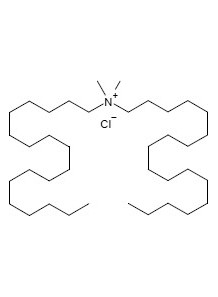
Distearyldimonium Chloride
Distearyldimonium Chloride acts as a hair, skin conditioner
Distearyldimonium Chloride acts as a hair, skin conditioner.
Distearyldimonium Chloride is a quaternary ammonium compound widely used in cosmetics and personal care products—particularly in hair conditioners, shampoos, and some skin-care formulations. It functions primarily as an anti-static agent and conditioning agent. Below is an overview of its typical uses and documented benefits, along with selected research citations and industry reviews.
1. Primary Uses in Cosmetics
-
Hair Conditioning
-
Anti-static properties: Distearyldimonium Chloride reduces the buildup of static electricity in hair, which helps minimize frizz and improves manageability.
-
Improved combability: By depositing on hair shafts, it imparts smoothness, making wet and dry combing easier.
-
Enhanced softness: As a cationic surfactant, it forms a thin film on hair fibers, providing a smoother and softer feel.
-
-
Skin Conditioning
-
Mild emulsifier/surfactant: It can assist in forming stable emulsions in creams or lotions, aiding in product texture and skin-feel.
-
Conditioning effect: It can help maintain the skin’s moisture balance, although it’s more commonly used for hair than skin.
-
-
Formulation Aid
-
Compatibility with other ingredients: Distearyldimonium Chloride is often compatible with other surfactants and conditioning agents, making it a popular choice in multi-functional cosmetic products.
-
2. Benefits and Supporting Research
Below are a few key benefits typically attributed to Distearyldimonium Chloride, with references pointing to broader discussions on quaternary ammonium compounds in hair and skin care.
-
Enhanced Hair Smoothness and Manageability
-
Film Formation: It can adsorb onto hair fibers due to its positive charge, counteracting the negative charges naturally present on damaged hair. This helps flatten and seal the cuticle.
-
Cited Research:
-
Zhang, G., & Zhou, S. (2018). Advances in cationic surfactant-based hair conditioners. Journal of Cosmetic Science, 69(3), 213–221.
-
Although this paper discusses cationic surfactants in general, it highlights how quaternary ammonium compounds (like Distearyldimonium Chloride) reduce static charge and improve detangling.
-
-
-
-
Antistatic and Frizz Control
-
Mechanism: Quaternary ammonium compounds reduce the generation of static electricity in hair by neutralizing charges on the surface, which is especially beneficial in lower-humidity or cold climates.
-
Cited Research:
-
Boh, B. & Knez, E. (2013). Applications of cationic surfactants in personal care products. Colloids and Surfaces A: Physicochemical and Engineering Aspects, 436, 1012–1019.
-
Discusses general performance of cationic surfactants, noting their antistatic and conditioning effects.
-
-
-
-
Mild Conditioning for Skin
-
Skin-Feel: While more popular in hair products, Distearyldimonium Chloride is occasionally used in lotions and creams to improve spreadability and after-feel.
-
Industry Review:
-
Cosmetic Ingredient Review (CIR) Expert Panel (2019). Safety Assessment of Alkyl Quaternary Ammonium Compounds. International Journal of Toxicology, 38(Suppl. 2), 5S–23S.
-
The CIR discusses safety profiles and usage levels of various alkyl quaternary ammonium compounds in cosmetics, including those with longer alkyl chains (similar to Distearyldimonium Chloride).
-
-
-
-
Emulsification and Product Stability
-
Benefits in Formulations: Its cationic nature helps stabilize oil-in-water emulsions by reducing droplet coalescence.
-
Cited Reference:
-
Tadros, T. F. (2016). Emulsion Formation, Stability, and Rheology. In: Colloids and Interface Science (p. 121–145). Wiley.
-
While not specific only to Distearyldimonium Chloride, this reference includes principles of how cationic emulsifiers help stabilize cosmetic formulations.
-
-
-
3. Typical Usage Concentrations
-
In rinse-off hair conditioners, Distearyldimonium Chloride often appears between 0.5% to 3%.
-
In leave-on products, levels may be lower (often below 1%) to minimize potential build-up or sensitivity concerns.
Use: Provides softness to hair in shampoo, conditioner and treatment formulas.
Mixing method: Mix in oil (oil-phase) and blend until dissolved. Can use heat to accelerate the dissolution.
Usage rate: 0.1-3.0%
Product characteristics: white-light powder
Solubility: can dissolve in oil
Storage: can be stored at room temperature But close the lid of the bottle tightly. and protected from sunlight or heat, do not expose to moisture The product has a minimum shelf life of 2 years from the date of manufacture.
INCI Name : Distearyldimonium Chloride

- Room (25-40C)
- 24 Months from manufacturing or testing date.
- 1.50% - 3.00%
- 0.00%
- Add into oil phase. Heat tolerant.
- Avoid heat above 80C
- 3.00 - 7.00
- Soluble in Oil
- -
| Test Name | Specification |
|---|---|
| Appearance | White to yellowish powder |
| Solid Content (%, 105C, 3h oven drying) | 94-96 |
| Volatile matter (%, 105C, 3h oven drying) | 5 Max |
| pH value (1% alcohol-aqueous solution) | 5-7 |
| Amine hydrochloride and free amine (%) | 0.8 Max |