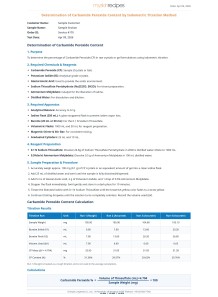
Determination of Carbamide Peroxide Content by Iodometric Titration Method

  • Product Code: 31997
Iodometric titration method determines the carbamide peroxide (CP) content in a sample (crystals or gel) by generating iodine in an acidic medium containing potassium iodide and a catalyst (ammonium molybdate). The liberated iodine is titrated with sodium thiosulfate, and the CP content is calculated from the volume of titrant used. Carbamide peroxide is widely used in dental, cosmetic, and pharmaceutical formulations as a bleaching and antiseptic agent. Accurate quantification ensures product efficacy, safety, and regulatory compliance. Under acidic conditions, carbamide peroxide oxidizes iodide to iodine. The amount of iodine generated is stoichiometrically proportional to the CP in the sample. Titration of iodine with standardized sodium thiosulfate provides a reliable measure of CP con
฿2,000.00

science Sample Names

assignment Instructions

info Please include any specific requirements or conditions for testing

description Service Overview

Iodometric titration method determines the carbamide peroxide (CP) content in a sample (crystals or gel) by generating iodine in an acidic medium containing potassium iodide and a catalyst (ammonium molybdate). The liberated iodine is titrated with sodium thiosulfate, and the CP content is calculated from the volume of titrant used. Carbamide peroxide is widely used in dental, cosmetic, and pharmaceutical formulations as a bleaching and antiseptic agent. Accurate quantification ensures product efficacy, safety, and regulatory compliance. Under acidic conditions, carbamide peroxide oxidizes iodide to iodine. The amount of iodine generated is stoichiometrically proportional to the CP in the sample. Titration of iodine with standardized sodium thiosulfate provides a reliable measure of CP content based on well-established redox chemistry. Sample Requirement: Sample Mass= 0.1g (per titration) Replication: Quadruplicate Total Sample Required: 0.4g

timeline Service Steps

Step Procedure Expected Result
info Service steps will be provided upon request
Determination of Carbamide Peroxide Content by Iodometric Titration Method
Iodometric titration method determines the carbamide peroxide (CP) content in a sample (crystals or gel) by generating iodine in an acidic medium containing potassium iodide and a catalyst (ammonium molybdate). The liberated iodine is titrated with sodium thiosulfate, and the CP content is calculated from the volume of titrant used. Carbamide peroxide is widely used in dental, cosmetic, and pharmaceutical formulations as a bleaching and antiseptic agent. Accurate quantification ensures product efficacy, safety, and regulatory compliance. Under acidic conditions, carbamide peroxide oxidizes iodide to iodine. The amount of iodine generated is stoichiometrically proportional to the CP in the sample. Titration of iodine with standardized sodium thiosulfate provides a reliable measure of CP con
Iodometric titration method determines the carbamide peroxide (CP) content in a sample (crystals or gel) by generating iodine in an acidic medium containing potassium iodide and a catalyst (ammonium molybdate). The liberated iodine is titrated with sodium thiosulfate, and the CP content is calculated from the volume of titrant used. Carbamide peroxide is widely used in dental, cosmetic, and pharmaceutical formulations as a bleaching and antiseptic agent. Accurate quantification ensures product efficacy, safety, and regulatory compliance. Under acidic conditions, carbamide peroxide oxidizes iodide to iodine. The amount of iodine generated is stoichiometrically proportional to the CP in the sample. Titration of iodine with standardized sodium thiosulfate provides a reliable measure of CP content based on well-established redox chemistry. Sample Requirement: Sample Mass= 0.1g (per titration) Replication: Quadruplicate Total Sample Required: 0.4g
Mechanism -
Appearance -
Longevity -
Strength -
Storage -
Shelf Life -
Allergen(s) -
Dosage (Range) -
Dosage (Per Day) -
Mix Method -
Heat Resistance -
Stable in pH range -
Solubility -
Product Types -
INCI -