


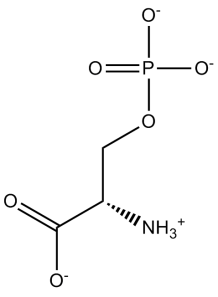
phosphorylated form of the amino-acid L-serine; DL-O-Phospho-DL-serine is the racemic mixture. Both carry a phosphate ester that gives them a high affinity for calcium ions and for group-III metabotropic glutamate receptors (mGluR4/6/7/8).
| Mechanism | Key findings | Model |
|---|---|---|
| Bone adhesive & cement modifier | Phosphoserine-modified calcium-phosphate cements (PM-CPC) show 3- to 10-fold higher adhesive strength to wet bone than commercial CPCs, while remaining resorbable. mdpi.compmc.ncbi.nlm.nih.gov | Rat femur, rabbit tibia, ex-vivo human trabecular cores |
| Enhanced osteointegration & remodelling | Addition of 10-15 wt % P-serine accelerates osteoblast proliferation, increases new-bone volume, and speeds full cement resorption to <12 months. researchgate.net | Sheep critical-size defect |
| Dual “bone + cartilage” fixation | A 2024 study combined PM-CPC with a phosphoserine-gelatin hydrogel to glue osteochondral fragments securely in an ex-vivo bovine knee, suggesting a one-step alternative to screws or pins. frontiersin.org | |
| Atomic-level mineral templating | X-ray crystallography shows P-serine coordinates Ca²⁺ and PO₄³⁻ in a geometry similar to osteopontin and bone sialoprotein, rationalising its strong affinity for hydroxyapatite. pubs.acs.org |
Take-home – By substituting or supplementing conventional bone cements, O-Phospho-L-serine can improve fixation, speed remodelling and potentially reduce hardware–related complications.
| Mechanism | Key findings | Model |
|---|---|---|
| mGluR4 agonism (pre-synaptic) | L-SOP (100 µM) cut glutamate release in rat substantia nigra slices by 33 %, reversed akinesia in a reserpine PD model and protected dopaminergic neurons from 6-OHDA toxicity. pubmed.ncbi.nlm.nih.gov | Rodent Parkinson’s models |
| Oxidative-stress resistance | mGluR4 activation by L-SOP reduced JNK/p38 phosphorylation, suppressed caspase-3 cleavage and rescued neural stem cells from H₂O₂-induced death. pmc.ncbi.nlm.nih.gov | Murine NSC culture |
| Excitotoxicity blockade & neurogenesis | In mixed cortical cultures, L-SOP lessened NMDA-mediated excitotoxicity and promoted neuronal differentiation via mTOR signalling. jneurosci.orgtocris.com |
Implications – The compound is being explored as a lead or probe for Parkinson’s disease, stroke and neuro-repair strategies that hinge on dampening glutamate excitotoxicity while fostering neural regeneration.
The calcium-sensing receptor (CaSR) integrates amino-acid and phosphate signals to control parathyroid hormone release. Although direct CaSR studies have focused on L-phenylalanine and phosphate, phosphoserine’s dual “amino-acid + phosphate” nature makes it a plausible endogenous co-agonist, and it is used routinely in structural CaSR assays. elifesciences.org
Translational interest: secondary hyperparathyroidism drugs now target CaSR’s amino-acid pocket; phosphoserine analogues are being screened as low-cost calcimimetics.
Composition – 50 % L-, 50 % D-enantiomer.
Current use – Biochemical standard for kinase/phosphatase assays; adhesive component in experimental cements; tool compound for mGluR4 pharmacology.
Health relevance – Because only the L-enantiomer is bioactive at most receptors and in bone mineralisation, the racemate shows about half the potency of pure O-Phospho-L-serine in the above applications. No specific in-vivo benefit unique to the D-form has been reported.
| Aspect | Comment |
|---|---|
| Bioavailability | Highly polar; oral uptake is unknown. In adhesive/cement uses, it is applied locally and becomes incorporated into mineral. |
| Dosing | Pre-clinical neuro studies inject 0.3–3 µg per substantia nigra or 10–50 mg kg⁻¹ i.p.; bone‐cement work uses 5–20 wt %. |
| Toxicology | No systemic toxicity seen in rat and rabbit bone studies up to 12 months. mdpi.com |
| Regulatory status | Research chemical; not GRAS, not Novel Food; would be regulated as a medical-device additive (for cements) or investigational drug (neurology). |
No products
phosphorylated form of the amino-acid L-serine; DL-O-Phospho-DL-serine is the racemic mixture. Both carry a phosphate ester that gives them a high affinity for calcium ions and for group-III metabotropic glutamate receptors (mGluR4/6/7/8).
| Mechanism | Key findings | Model |
|---|---|---|
| Bone adhesive & cement modifier | Phosphoserine-modified calcium-phosphate cements (PM-CPC) show 3- to 10-fold higher adhesive strength to wet bone than commercial CPCs, while remaining resorbable. mdpi.compmc.ncbi.nlm.nih.gov | Rat femur, rabbit tibia, ex-vivo human trabecular cores |
| Enhanced osteointegration & remodelling | Addition of 10-15 wt % P-serine accelerates osteoblast proliferation, increases new-bone volume, and speeds full cement resorption to <12 months. researchgate.net | Sheep critical-size defect |
| Dual “bone + cartilage” fixation | A 2024 study combined PM-CPC with a phosphoserine-gelatin hydrogel to glue osteochondral fragments securely in an ex-vivo bovine knee, suggesting a one-step alternative to screws or pins. frontiersin.org | |
| Atomic-level mineral templating | X-ray crystallography shows P-serine coordinates Ca²⁺ and PO₄³⁻ in a geometry similar to osteopontin and bone sialoprotein, rationalising its strong affinity for hydroxyapatite. pubs.acs.org |
Take-home – By substituting or supplementing conventional bone cements, O-Phospho-L-serine can improve fixation, speed remodelling and potentially reduce hardware–related complications.
| Mechanism | Key findings | Model |
|---|---|---|
| mGluR4 agonism (pre-synaptic) | L-SOP (100 µM) cut glutamate release in rat substantia nigra slices by 33 %, reversed akinesia in a reserpine PD model and protected dopaminergic neurons from 6-OHDA toxicity. pubmed.ncbi.nlm.nih.gov | Rodent Parkinson’s models |
| Oxidative-stress resistance | mGluR4 activation by L-SOP reduced JNK/p38 phosphorylation, suppressed caspase-3 cleavage and rescued neural stem cells from H₂O₂-induced death. pmc.ncbi.nlm.nih.gov | Murine NSC culture |
| Excitotoxicity blockade & neurogenesis | In mixed cortical cultures, L-SOP lessened NMDA-mediated excitotoxicity and promoted neuronal differentiation via mTOR signalling. jneurosci.orgtocris.com |
Implications – The compound is being explored as a lead or probe for Parkinson’s disease, stroke and neuro-repair strategies that hinge on dampening glutamate excitotoxicity while fostering neural regeneration.
The calcium-sensing receptor (CaSR) integrates amino-acid and phosphate signals to control parathyroid hormone release. Although direct CaSR studies have focused on L-phenylalanine and phosphate, phosphoserine’s dual “amino-acid + phosphate” nature makes it a plausible endogenous co-agonist, and it is used routinely in structural CaSR assays. elifesciences.org
Translational interest: secondary hyperparathyroidism drugs now target CaSR’s amino-acid pocket; phosphoserine analogues are being screened as low-cost calcimimetics.
Composition – 50 % L-, 50 % D-enantiomer.
Current use – Biochemical standard for kinase/phosphatase assays; adhesive component in experimental cements; tool compound for mGluR4 pharmacology.
Health relevance – Because only the L-enantiomer is bioactive at most receptors and in bone mineralisation, the racemate shows about half the potency of pure O-Phospho-L-serine in the above applications. No specific in-vivo benefit unique to the D-form has been reported.
| Aspect | Comment |
|---|---|
| Bioavailability | Highly polar; oral uptake is unknown. In adhesive/cement uses, it is applied locally and becomes incorporated into mineral. |
| Dosing | Pre-clinical neuro studies inject 0.3–3 µg per substantia nigra or 10–50 mg kg⁻¹ i.p.; bone‐cement work uses 5–20 wt %. |
| Toxicology | No systemic toxicity seen in rat and rabbit bone studies up to 12 months. mdpi.com |
| Regulatory status | Research chemical; not GRAS, not Novel Food; would be regulated as a medical-device additive (for cements) or investigational drug (neurology). |
| Mechanism | - |
| Appearance | - |
| Longevity | - |
| Strength | - |
| Storage | - |
| Shelf Life | - |
| Allergen(s) | - |
| Dosage (Range) | - |
| Recommended Dosage | - |
| Dosage (Per Day) | - |
| Recommended Dosage (Per Day) | - |
| Mix Method | - |
| Heat Resistance | - |
| Stable in pH range | - |
| Solubility | - |
| Product Types | - |
| INCI | - |