
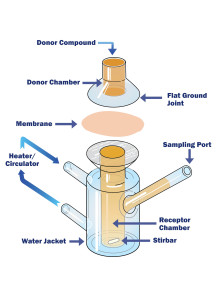
Intestine Absorption (Franz Cell, Porcine Intestine, Krebs-Ringer, 1 Time Point)

  • Product Code: 125440

Intestine permeability analysis service with Franz Cell using porcine small intestine with Krebs-Ringer HEPES buffer.

฿3,950.00

science Sample Names

assignment Instructions

info Please include any specific requirements or conditions for testing

description Service Overview

Intestine Absorption (Franz Cell, Porcine Intestine, Krebs-Ringer)

Materials Needed:

  • Franz diffusion cells
  • Porcine intestine (fresh or properly stored)
  • Krebs-Ringer buffer (either HEPES or sodium bicarbonate-buffered, depending on setup)
  • Donor and receptor compartments for Franz cells
  • Magnetic stirrers
  • Syringes and needles
  • pH meter
  • Incubator or water bath (if needed for maintaining temperature)
  • Analytical instruments (e.g., HPLC, spectrophotometer) for sample analysis
  • Absorption compound (test substance)

Preparation:

  1. Prepare Krebs-Ringer Buffer:

    • For HEPES-buffered: Dissolve the appropriate amounts of NaCl, KCl, CaCl₂, MgSO₄, NaH₂PO₄, glucose, and HEPES in distilled water. Adjust pH to 7.4.
    • For sodium bicarbonate-buffered: Prepare similarly but use NaHCO₃ instead of HEPES, and adjust pH with a CO₂ environment if necessary.
  2. Prepare Porcine Intestine:

    • Obtain fresh porcine intestines from a suitable source.
    • Clean the intestine to remove any contents and mucosal debris.
    • Cut the intestine into appropriate sections for mounting on the Franz cell.
  3. Mount the Intestinal Tissue:

    • Carefully mount a section of the intestine between the donor and receptor compartments of the Franz cell. Ensure no leaks and that the tissue is securely in place.

Experiment Setup:

  1. Fill Receptor Compartment:

    • Fill the receptor compartment with the Krebs-Ringer buffer, ensuring that it is well-mixed and aerated. This compartment will mimic the blood side of the intestine.
    • Place a magnetic stir bar in the receptor compartment for continuous mixing.
  2. Add Test Compound to Donor Compartment:

    • Apply the test compound (the substance you want to study for absorption) to the donor compartment. This compartment represents the lumen side of the intestine.
    • The compound should be in a suitable solvent or vehicle that does not damage the tissue.
  3. Maintain Experimental Conditions:

    • Place the Franz cells in an incubator or water bath to maintain physiological temperature (usually around 37°C).
    • Ensure continuous stirring of the receptor compartment to simulate blood flow and to prevent boundary layer formation.

Sampling:

  1. Sample Collection:

    • At predetermined time intervals (e.g., every 30 minutes or hourly), withdraw small aliquots from the receptor compartment using a syringe.
    • Replace the withdrawn volume with fresh Krebs-Ringer buffer to maintain constant volume.
  2. Analyze Samples:

    • Analyze the collected samples using appropriate analytical techniques (e.g., HPLC, UV-spectrophotometry) to determine the concentration of the test compound.
    • Plot the concentration of the test compound in the receptor compartment over time to assess the absorption rate.

timeline Service Steps

Step Procedure Expected Result
info Service steps will be provided upon request

Cart

No products

Subtotal: 0.00
Total 0.00 THB
Intestine Absorption (Franz Cell, Porcine Intestine, Krebs-Ringer, 1 Time Point)

Intestine permeability analysis service with Franz Cell using porcine small intestine with Krebs-Ringer HEPES buffer.

Intestine Absorption (Franz Cell, Porcine Intestine, Krebs-Ringer)

Materials Needed:

Preparation:

  1. Prepare Krebs-Ringer Buffer:

    • For HEPES-buffered: Dissolve the appropriate amounts of NaCl, KCl, CaCl₂, MgSO₄, NaH₂PO₄, glucose, and HEPES in distilled water. Adjust pH to 7.4.
    • For sodium bicarbonate-buffered: Prepare similarly but use NaHCO₃ instead of HEPES, and adjust pH with a CO₂ environment if necessary.
  2. Prepare Porcine Intestine:

    • Obtain fresh porcine intestines from a suitable source.
    • Clean the intestine to remove any contents and mucosal debris.
    • Cut the intestine into appropriate sections for mounting on the Franz cell.
  3. Mount the Intestinal Tissue:

    • Carefully mount a section of the intestine between the donor and receptor compartments of the Franz cell. Ensure no leaks and that the tissue is securely in place.

Experiment Setup:

  1. Fill Receptor Compartment:

    • Fill the receptor compartment with the Krebs-Ringer buffer, ensuring that it is well-mixed and aerated. This compartment will mimic the blood side of the intestine.
    • Place a magnetic stir bar in the receptor compartment for continuous mixing.
  2. Add Test Compound to Donor Compartment:

    • Apply the test compound (the substance you want to study for absorption) to the donor compartment. This compartment represents the lumen side of the intestine.
    • The compound should be in a suitable solvent or vehicle that does not damage the tissue.
  3. Maintain Experimental Conditions:

    • Place the Franz cells in an incubator or water bath to maintain physiological temperature (usually around 37°C).
    • Ensure continuous stirring of the receptor compartment to simulate blood flow and to prevent boundary layer formation.

Sampling:

  1. Sample Collection:

    • At predetermined time intervals (e.g., every 30 minutes or hourly), withdraw small aliquots from the receptor compartment using a syringe.
    • Replace the withdrawn volume with fresh Krebs-Ringer buffer to maintain constant volume.
  2. Analyze Samples:

    • Analyze the collected samples using appropriate analytical techniques (e.g., HPLC, UV-spectrophotometry) to determine the concentration of the test compound.
    • Plot the concentration of the test compound in the receptor compartment over time to assess the absorption rate.
Mechanism -
Appearance -
Longevity -
Strength -
Storage -
Shelf Life -
Allergen(s) -
Dosage (Range) -
Dosage (Per Day) -
Mix Method -
Heat Resistance -
Stable in pH range -
Solubility -
Product Types -
INCI -