


“Closest amino-sulfonic acid evidence, not direct homotaurine: taurine transporter and taurine accumulation in human epidermis support keratinocyte hydration and osmoprotection.”
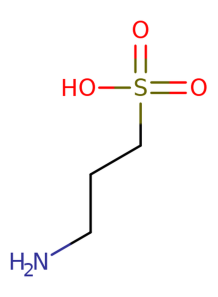
Homotaurine (3-Amino-1-propanesulfonic acid, 3-APS) is a small amino sulfonic acid used in cosmetics as an osmoprotective, neuro-soothing active for fragile, mature and sensitive skin.
Chemically, it is an amino sulfonic acid analog of Taurine (2-aminoethanesulfonic acid) and GABA (gamma-aminobutyric acid), differing by an extra carbon in its three-carbon propyl backbone. This extra carbon subtly changes its conformational flexibility and interaction with cellular transporters and receptors. Homotaurine is naturally found in certain red seaweeds that must tolerate large salinity swings; cosmetics leverage this biomimetic strategy to help skin cells cope with osmotic and environmental stress.
Within the skin, Homotaurine behaves as a compatible solute and cellular "homeostatic regulator". Keratinocytes can transport it into the cytosol, where it binds and organizes water, helping maintain cell volume and turgor even as the surface microenvironment dries. By preventing cell shrinkage and osmotic shock, it supports cytoskeletal organization and provides the hydrated, spacious environment needed for mitochondria, endoplasmic reticulum and other organelles to function efficiently.
Beyond osmoprotection, Homotaurine is a known agonist of GABA receptors. In the context of the neuro-immuno-cutaneous system, this GABA-mimetic behaviour can help calm over-excited cutaneous nerve endings and modulate the release of inflammatory neuropeptides, contributing to a soothing effect and reducing the "sting" often felt with active skincare on thin, fragile or aged skin. Literature on Homotaurine also highlights its ability to interact with amyloid and other misfolded proteins, suggesting a general cytoprotective role alongside taurine-like antioxidant effects on membrane lipids.
Product Description: Multi-functional amino sulfonic acid active acting as a cellular homeostatic regulator. Homotaurine helps keratinocytes maintain water balance and cell volume under osmotic stress, while its GABA-mimetic activity supports neuro-soothing and comfort in fragile, mature or sensitive skin. These combined effects complement calcium-driven signalling and barrier-repair actives, helping ensure that stimulation remains controlled rather than overwhelming for aged skin. It fits well in anti-ageing, anti-fatigue and sensitive-skin concepts.
Usage: Leave-on facial serums, essences, ampoules, light creams and gel-creams, especially for mature, fragile or redness-prone skin. Suitable for eye-area formulas and post-procedure soothing products where comfort and barrier support are critical. Can be combined with niacinamide, panthenol, ceramides, cholesterol/fatty acids and anti-oxidants in advanced anti-ageing systems.
Mixing method:
- Pre-dissolve Homotaurine completely in the aqueous phase (water or water plus humectants) with moderate stirring; it is highly water-soluble and does not require high shear.
- Add during the cool-down stage where possible and keep the batch temperature typically below 40°C after addition to preserve activity and minimise degradation.
- In systems with low water content or high oil/silicone levels, prepare a concentrated aqueous or aqueous/glycol solution of Homotaurine and incorporate it as part of the water phase or as a fine dispersed aqueous reservoir; adjust preservative system accordingly.
Usage rate: 0.05–1% in leave-on and rinse-off formulations, with 0.2–0.5% common in facial serums and eye-area products targeting fragile or mature skin.
Product characteristics: White to off-white crystalline powder; essentially odorless; highly hygroscopic; freely soluble in water and common cosmetic humectants (glycerin, glycols).
Solubility: Freely soluble in water and many glycols; insoluble in oils and silicones. Formulate in the aqueous phase or as an aqueous concentrate when used in emulsions or hybrid systems.
Synthetic amino sulfonate; non-animal origin.
| Test Name | Specification |
|---|---|
| Appearance | White to off-white powder or crystals |
| Carbon, % | 25 Min to 26.8 Max |
| Infrared spectrum | Conforms to Structure |
| Melting point, °C | 285 Min to 295 Max |
| Nitrogen, % | 9.7 Min to 10.5 Max |
| Purity (HPLC), % | 97 Min to 100 Max |
| Solubility in H2O | Colorless to faint yellow, clear (50 mg/mL, H2O) |
| Sulfur (S), % | 22.2 Min to 23.9 Max |
No products
Homotaurine (3-Amino-1-propanesulfonic acid, 3-APS) is a small amino sulfonic acid used in cosmetics as an osmoprotective, neuro-soothing active for fragile, mature and sensitive skin.
Chemically, it is an amino sulfonic acid analog of Taurine (2-aminoethanesulfonic acid) and GABA (gamma-aminobutyric acid), differing by an extra carbon in its three-carbon propyl backbone. This extra carbon subtly changes its conformational flexibility and interaction with cellular transporters and receptors. Homotaurine is naturally found in certain red seaweeds that must tolerate large salinity swings; cosmetics leverage this biomimetic strategy to help skin cells cope with osmotic and environmental stress.
Within the skin, Homotaurine behaves as a compatible solute and cellular "homeostatic regulator". Keratinocytes can transport it into the cytosol, where it binds and organizes water, helping maintain cell volume and turgor even as the surface microenvironment dries. By preventing cell shrinkage and osmotic shock, it supports cytoskeletal organization and provides the hydrated, spacious environment needed for mitochondria, endoplasmic reticulum and other organelles to function efficiently.
Beyond osmoprotection, Homotaurine is a known agonist of GABA receptors. In the context of the neuro-immuno-cutaneous system, this GABA-mimetic behaviour can help calm over-excited cutaneous nerve endings and modulate the release of inflammatory neuropeptides, contributing to a soothing effect and reducing the "sting" often felt with active skincare on thin, fragile or aged skin. Literature on Homotaurine also highlights its ability to interact with amyloid and other misfolded proteins, suggesting a general cytoprotective role alongside taurine-like antioxidant effects on membrane lipids.
Product Description: Multi-functional amino sulfonic acid active acting as a cellular homeostatic regulator. Homotaurine helps keratinocytes maintain water balance and cell volume under osmotic stress, while its GABA-mimetic activity supports neuro-soothing and comfort in fragile, mature or sensitive skin. These combined effects complement calcium-driven signalling and barrier-repair actives, helping ensure that stimulation remains controlled rather than overwhelming for aged skin. It fits well in anti-ageing, anti-fatigue and sensitive-skin concepts.
Usage: Leave-on facial serums, essences, ampoules, light creams and gel-creams, especially for mature, fragile or redness-prone skin. Suitable for eye-area formulas and post-procedure soothing products where comfort and barrier support are critical. Can be combined with niacinamide, panthenol, ceramides, cholesterol/fatty acids and anti-oxidants in advanced anti-ageing systems.
Mixing method:
- Pre-dissolve Homotaurine completely in the aqueous phase (water or water plus humectants) with moderate stirring; it is highly water-soluble and does not require high shear.
- Add during the cool-down stage where possible and keep the batch temperature typically below 40°C after addition to preserve activity and minimise degradation.
- In systems with low water content or high oil/silicone levels, prepare a concentrated aqueous or aqueous/glycol solution of Homotaurine and incorporate it as part of the water phase or as a fine dispersed aqueous reservoir; adjust preservative system accordingly.
Usage rate: 0.05–1% in leave-on and rinse-off formulations, with 0.2–0.5% common in facial serums and eye-area products targeting fragile or mature skin.
Product characteristics: White to off-white crystalline powder; essentially odorless; highly hygroscopic; freely soluble in water and common cosmetic humectants (glycerin, glycols).
Solubility: Freely soluble in water and many glycols; insoluble in oils and silicones. Formulate in the aqueous phase or as an aqueous concentrate when used in emulsions or hybrid systems.
Synthetic amino sulfonate; non-animal origin.
| Mechanism | - |
| Appearance | - |
| Longevity | - |
| Strength | - |
| Long-term storage | - |
| Shelf Life | - |
| Allergen(s) | - |
| Dosage (Range) | - |
| Recommended Dosage | - |
| Dosage (Per Day) | - |
| Recommended Dosage (Per Day) | - |
| Mix Method | - |
| Heat Resistance | - |
| Stable in pH range | - |
| Solubility | - |
| Product Types | - |
| INCI | - |