


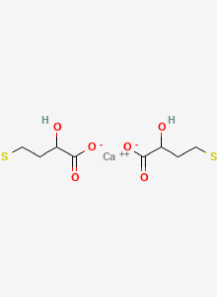
“Closest receptor-mechanism evidence: CaSR mediates Ca2+-driven epidermal differentiation and barrier-related keratinocyte function; supports the Ca2+ delivery rationale, not the exact complex.”
Chelated calcium–methionine complex active for mature skin, delivering Ca2+ and methionine together to support epidermal differentiation, density and barrier function.
Calcium hydroxymethionine is a chelated calcium–amino acid complex designed as a restructuring active for mature and chronologically aged skin, targeting the epidermal calcium gradient and protein synthesis in parallel.
In aged epidermis the normal calcium gradient tends to flatten, weakening the differentiation signal and contributing to thinning, fragility and slower barrier recovery. Calcium hydroxymethionine delivers bioavailable Ca2+ together with methionine in a single molecule so that the ionic signal and the structural building blocks arrive to keratinocytes at the same time.
By chelating calcium to an alpha-hydroxymethionine ligand, this active improves aqueous solubility and partitioning compared with simple inorganic salts (such as calcium chloride or calcium carbonate), helping it migrate towards the viable granular layer before releasing Ca2+ and methionine inside the cell. This dual-delivery design underpins the Essenskin-style concept of acting as a "biological architect" for epidermal density.
Product Description: Calcium hydroxymethionine is a small-molecule complex of calcium and a derivative of the essential amino acid methionine (alpha-hydroxymethionine). Once it reaches keratinocytes, the calcium component can bind to calcium-sensing receptors (CaSR) and help re-establish a more youthful calcium gradient, while the methionine moiety feeds protein synthesis and sulfur metabolism. Downstream, this signal supports expression of transglutaminase-1, desmosomal proteins and lipid-processing enzymes that build the cornified envelope, tighten cell–cell adhesion and promote organized lamellar lipid secretion. In properly designed leave-on systems this translates into support for epidermal thickness, cohesion and barrier function in photo-aged or hormonally aged skin.
Usage: Recommended for anti-age facial serums, emulsions, eye/neck treatments and barrier-support moisturizers targeting thinning, fragile or dull skin. Also suitable as a supporting active in post-procedure soothing formulas once re-epithelialisation has occurred (non-occlusive, cosmetic products only). Can be combined with barrier lipids, humectants, gentle exfoliants and peptides where additional regeneration or texture benefits are desired.
Mixing method:
- Use in the water phase or cool-down phase of emulsions; disperse in a portion of deionized water under gentle stirring until completely dissolved.
- Target finished product pH in the mildly acidic range (~5.0–6.0) to balance calcium availability, methionine stability and skin compatibility; avoid strongly alkaline environments that may favour precipitation or unwanted reactions.
- Avoid simultaneous high levels of strong chelators (for example very high EDTA dosage) that can strip Ca2+ from the complex; evaluate compatibility individually when formulating with anionic gelling agents, phosphate buffers or high electrolyte loads.
Usage rate: 0.2–1% in finished formulations, depending on target intensity and the presence of other restructuring actives. For typical anti-age facial creams and serums, 0.3–0.5% is a practical starting range, with higher levels reserved for concentrated booster concepts.
Product characteristics: White to off-white, fine, hygroscopic, water-soluble solid with mild characteristic odour. Supplied as a technical cosmetic raw material for professional formulation work.
Solubility: Freely soluble in water; essentially insoluble in oils and non-polar solvents. Compatible with common cosmetic humectants (such as glycerin and glycols); requires an appropriate emulsification strategy for oil-rich systems as it resides in the aqueous phase.
Storage: Store tightly closed in the original container, protected from moisture, heat and direct light. Keep in a cool, dry place and use quickly after opening to minimise caking or loss of flow. Under suitable storage conditions, a typical cosmetic shelf life is up to 24 months.
Preservative-free active; microbiological control must be provided by the finished formulation.
| Test Name | Specification |
|---|---|
| APPEARANCE | WHITE TO OFF WHITE SOLID |
| PURITY(%) | 97 Min |
No products
Chelated calcium–methionine complex active for mature skin, delivering Ca2+ and methionine together to support epidermal differentiation, density and barrier function.
Calcium hydroxymethionine is a chelated calcium–amino acid complex designed as a restructuring active for mature and chronologically aged skin, targeting the epidermal calcium gradient and protein synthesis in parallel.
In aged epidermis the normal calcium gradient tends to flatten, weakening the differentiation signal and contributing to thinning, fragility and slower barrier recovery. Calcium hydroxymethionine delivers bioavailable Ca2+ together with methionine in a single molecule so that the ionic signal and the structural building blocks arrive to keratinocytes at the same time.
By chelating calcium to an alpha-hydroxymethionine ligand, this active improves aqueous solubility and partitioning compared with simple inorganic salts (such as calcium chloride or calcium carbonate), helping it migrate towards the viable granular layer before releasing Ca2+ and methionine inside the cell. This dual-delivery design underpins the Essenskin-style concept of acting as a "biological architect" for epidermal density.
Product Description: Calcium hydroxymethionine is a small-molecule complex of calcium and a derivative of the essential amino acid methionine (alpha-hydroxymethionine). Once it reaches keratinocytes, the calcium component can bind to calcium-sensing receptors (CaSR) and help re-establish a more youthful calcium gradient, while the methionine moiety feeds protein synthesis and sulfur metabolism. Downstream, this signal supports expression of transglutaminase-1, desmosomal proteins and lipid-processing enzymes that build the cornified envelope, tighten cell–cell adhesion and promote organized lamellar lipid secretion. In properly designed leave-on systems this translates into support for epidermal thickness, cohesion and barrier function in photo-aged or hormonally aged skin.
Usage: Recommended for anti-age facial serums, emulsions, eye/neck treatments and barrier-support moisturizers targeting thinning, fragile or dull skin. Also suitable as a supporting active in post-procedure soothing formulas once re-epithelialisation has occurred (non-occlusive, cosmetic products only). Can be combined with barrier lipids, humectants, gentle exfoliants and peptides where additional regeneration or texture benefits are desired.
Mixing method:
- Use in the water phase or cool-down phase of emulsions; disperse in a portion of deionized water under gentle stirring until completely dissolved.
- Target finished product pH in the mildly acidic range (~5.0–6.0) to balance calcium availability, methionine stability and skin compatibility; avoid strongly alkaline environments that may favour precipitation or unwanted reactions.
- Avoid simultaneous high levels of strong chelators (for example very high EDTA dosage) that can strip Ca2+ from the complex; evaluate compatibility individually when formulating with anionic gelling agents, phosphate buffers or high electrolyte loads.
Usage rate: 0.2–1% in finished formulations, depending on target intensity and the presence of other restructuring actives. For typical anti-age facial creams and serums, 0.3–0.5% is a practical starting range, with higher levels reserved for concentrated booster concepts.
Product characteristics: White to off-white, fine, hygroscopic, water-soluble solid with mild characteristic odour. Supplied as a technical cosmetic raw material for professional formulation work.
Solubility: Freely soluble in water; essentially insoluble in oils and non-polar solvents. Compatible with common cosmetic humectants (such as glycerin and glycols); requires an appropriate emulsification strategy for oil-rich systems as it resides in the aqueous phase.
Storage: Store tightly closed in the original container, protected from moisture, heat and direct light. Keep in a cool, dry place and use quickly after opening to minimise caking or loss of flow. Under suitable storage conditions, a typical cosmetic shelf life is up to 24 months.
Preservative-free active; microbiological control must be provided by the finished formulation.
| Mechanism | - |
| Appearance | - |
| Longevity | - |
| Strength | - |
| Long-term storage | - |
| Shelf Life | - |
| Allergen(s) | - |
| Dosage (Range) | - |
| Recommended Dosage | - |
| Dosage (Per Day) | - |
| Recommended Dosage (Per Day) | - |
| Mix Method | - |
| Heat Resistance | - |
| Stable in pH range | - |
| Solubility | - |
| Product Types | - |
| INCI | - |