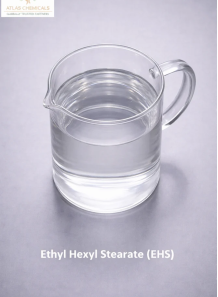
LipidSoft™ 868 (Ethylhexyl Stearate) is a low‑viscosity, hydrophobic emollient ester (INCI: Ethylhexyl Stearate; legacy synonym: Octyl Stearate) used to improve slip, spreadability, and payoff in oil‑phase and anhydrous cosmetic systems.
Because it is essentially water‑insoluble and low‑volatility, it stays in the oil phase and contributes a smooth, lubricious after‑feel without the high drag typical of waxy or high‑viscosity emollients.
In real‑world use surveys, Ethylhexyl Stearate is often used as a meaningful oil‑phase component (not just a minor additive), including high levels in leave‑on color cosmetics when a medium‑spreading ester is desired.
Product Description: Ethylhexyl Stearate is an ester of 2‑ethylhexanol and stearic acid. In formulations it primarily acts as a skin‑conditioning emollient, a texture modifier/plasticizing oil, and a carrier for lipophilic materials.
- Emolliency mechanism: deposits a thin hydrophobic film that reduces friction (slip) and softens the sensory profile of structuring waxes/gel networks.
- Texture tuning: low‑to‑medium viscosity helps dilute heavy oils and reduce drag; useful for balancing firmness vs. payoff in sticks (lip/eye).
- Carrier/solvent role: supports solubilization of lipophilic actives and fragrance components (verify solubility limits in your specific oil blend).
- Pigment wetting (supporting role): can improve dispersion feel and payoff, but very high pigment loads may still require dedicated dispersants and/or milling.
- Safety context (high level): industry safety reviews of alkyl esters report safe use when formulated to be non‑irritating; HRIPTs on finished products containing high Ethylhexyl Stearate levels did not show sensitization.
- Typical physicochemical profile (supplier/SDS‑type values; may vary by grade): melting/freezing typically <10°C; flash point ~210°C; kinematic viscosity ~15 mm²/s at 25°C; extremely low water solubility (<0.05 mg/L at 20°C).
Usage: Lip products (lipstick/lip balm/lip gloss), eye products (liners/pencils), foundations/concealers (as part of emollient blend), and skincare emulsions/anhydrous balms where a lubricious, medium‑spreading ester is needed.
Mixing method:
- Add to the oil phase; compatible with common cosmetic oils/esters. For sticks/hot‑pour systems, co‑heat with waxes and structuring agents and mix until uniform.
- In emulsions (O/W or W/O), include in the oil phase; because it is low viscosity, it can reduce bulk viscosity—adjust rheology/structuring as needed.
- In organoclay gels (e.g., hectorite systems), low polarity oils may reduce clay activation efficiency unless a suitable polar activator system is used.
Usage rate: 1–40% (typical 3–20% depending on format). Color cosmetics (lip/eye) may use higher levels when Ethylhexyl Stearate is part of the main mobile‑oil fraction.
Product characteristics: Clear to pale yellow oily liquid; low‑to‑medium viscosity; faint odor or nearly odorless.
Solubility: Practically insoluble in water; soluble/miscible in oils, esters, and many lipophilic solvents. Suitable as an oil‑phase diluent and fragrance/active carrier (confirm compatibility experimentally).
Storage: Store tightly closed at room temperature, away from moisture/contamination. May become hazy or thicken at low temperature; returns to a clear liquid upon warming.