


“Closest natural wax-family evidence: beeswax acts as an occlusive/emollient barrier that can reduce TEWL, lock hydration, and soften skin.”
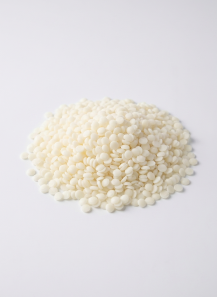
Sumac Wax (Rhus Succedanea Fruit Wax, Japan Wax) is a 100% natural, vegetable-derived soft wax supplied as off-white pellets for cosmetic formulation. It works as a soft structuring wax, emollient, texture modifier, and consistency agent for formulas that need smoother glide, better pay-off, and a more flexible wax network.
This double-refined grade is selected for a lower acid value profile, making it especially useful in pencil and stick systems where a cleaner surface appearance and reduced blooming are important.
Sumac Wax is ideal when the formula needs softness, flexibility, and a smoother application feel. In sticks and pencils, it helps the product glide more comfortably and release color more easily. In O/W emulsions, it enriches the oil phase and gives the finished texture a softer, more elegant feel when paired with the right emulsifier and rheology system.
Because this is a soft wax, combine it with harder waxes such as candelilla wax, carnauba wax, sunflower wax, rice bran wax, or suitable synthetic/ester waxes when high mold strength, hot-climate stability, or strong stick hardness is required.
Appearance: off-white pellets; soft natural wax; slight characteristic wax odor.
Solubility: insoluble in water. Melt into oils, esters, hydrocarbons, and other lipophilic phases; dispersible in emulsions after proper oil-phase melting and emulsification.
Storage: store tightly closed at room temperature, protected from heat, light, and contamination.
| Test Name | Specification |
|---|---|
| Appearance | Off white pellets |
| Melting Point | 48-56 C |
| Acid Value | 5-25 mg KOH/g |
| Saponification Value | 180-220 mg KOH/g |
| Peroxide Value | <=5.0 meq/kg |
No products
Sumac Wax (Rhus Succedanea Fruit Wax, Japan Wax) is a 100% natural, vegetable-derived soft wax supplied as off-white pellets for cosmetic formulation. It works as a soft structuring wax, emollient, texture modifier, and consistency agent for formulas that need smoother glide, better pay-off, and a more flexible wax network.
This double-refined grade is selected for a lower acid value profile, making it especially useful in pencil and stick systems where a cleaner surface appearance and reduced blooming are important.
Sumac Wax is ideal when the formula needs softness, flexibility, and a smoother application feel. In sticks and pencils, it helps the product glide more comfortably and release color more easily. In O/W emulsions, it enriches the oil phase and gives the finished texture a softer, more elegant feel when paired with the right emulsifier and rheology system.
Because this is a soft wax, combine it with harder waxes such as candelilla wax, carnauba wax, sunflower wax, rice bran wax, or suitable synthetic/ester waxes when high mold strength, hot-climate stability, or strong stick hardness is required.
Appearance: off-white pellets; soft natural wax; slight characteristic wax odor.
Solubility: insoluble in water. Melt into oils, esters, hydrocarbons, and other lipophilic phases; dispersible in emulsions after proper oil-phase melting and emulsification.
Storage: store tightly closed at room temperature, protected from heat, light, and contamination.
| Mechanism | - |
| Appearance | - |
| Longevity | - |
| Strength | - |
| Storage | - |
| Shelf Life | - |
| Allergen(s) | - |
| Dosage (Range) | - |
| Recommended Dosage | - |
| Dosage (Per Day) | - |
| Recommended Dosage (Per Day) | - |
| Mix Method | - |
| Heat Resistance | - |
| Stable in pH range | - |
| Solubility | - |
| Product Types | - |
| INCI | - |