


“Closest cleanser-technology evidence: amino-acid-based surfactants are discussed as milder cleansing systems that can reduce dryness/irritation versus harsher surfactants; not direct PCA Ethyl Cocoyl Arginate clinical evidence.”
A multifunctional amino-acid based cationic surfactant derived from arginine, PCA and coconut fatty acids, providing mild cleansing, antistatic conditioning and preservative-helper antimicrobial activity for skin, hair and oral-hygiene formulations.
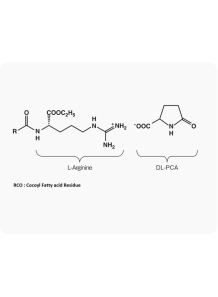
PCA Ethyl Cocoyl Arginate is an amino-acid based cationic surfactant derived from L-arginine, pyrrolidone carboxylic acid (PCA) and coconut-derived fatty acids. It is designed as a multifunctional cosmetic ingredient that combines mild cleansing, conditioning and antimicrobial support rather than acting as a classic targeted active such as retinol or niacinamide.
Cosmetic ingredient registries describe PCA Ethyl Cocoyl Arginate as an antistatic, moisturizing and surfactant-cleansing agent. In practice it is used at low levels in skin cleansers, shampoos, scalp products and oral-hygiene formulas to improve foam behavior, reduce harshness, support hydration and help control microbial growth in the product and on the surface during contact.
Compared with traditional cationic surfactants, PCA Ethyl Cocoyl Arginate shows a favorable safety and environmental profile. Neutral red staining (NR50) tests on human epidermal keratinocytes report markedly higher NR50 values than sodium lauryl sulfate and quaternary ammonium surfactants, indicating lower cell toxicity and greater mildness at equivalent concentrations. Biodegradability tests under Japanese Chemical Substances Control Law conditions show high decomposition (>60% at 14 days), in contrast to essentially non-biodegradable benchmark quats.
Product Description: PCA Ethyl Cocoyl Arginate is a cationic surfactant and conditioning agent that adsorbs onto keratin surfaces to reduce static, improve combability and leave a smoother feel on hair and skin. Because the molecule is partly built from PCA (a natural moisturizing factor component) and L-arginine, it can help support water retention and a softer after-feel compared with harsh anionic-only systems. Technical evaluations show that low levels of PCA Ethyl Cocoyl Arginate in shampoos or tonics improve hair resilience (elastic recovery) and reduce flyaway/static charge more effectively than typical quaternary conditioners at similar use levels.
In vitro antimicrobial testing (minimum inhibitory concentration, MIC) demonstrates activity against a broad panel of microorganisms, including Staphylococcus aureus, Propionibacterium acnes, oral streptococci and yeasts. This profile makes PCA Ethyl Cocoyl Arginate suitable as a preservative helper or partial preservative replacement in well-designed systems, especially in rinse-off and short-contact products. It should, however, be regarded as a cosmetic-hygiene aid rather than a stand-alone treatment for infections or inflammatory skin diseases.
PCA Ethyl Cocoyl Arginate belongs to the same arginate-surfactant family as ethyl lauroyl arginate HCl, which is well studied as a food and cosmetic preservative. Data on that analogue support the concept of low mammalian toxicity and broad-spectrum antimicrobial action at cosmetic use levels. For PCA Ethyl Cocoyl Arginate itself, manufacturer and ingredient-database data consistently describe very low skin and eye irritation at recommended concentrations, together with rapid biodegradability. Overall, the ingredient is best positioned as a functional, formulation-friendly surfactant with conditioning and antimicrobial benefits rather than a high-impact clinical active.
Usage: Multifunctional cationic surfactant for:
- Facial and body cleansers, micellar waters and make-up removers that aim for mild but effective cleansing with less stripping feel.
- Shampoos, conditioners, leave-on hair or scalp tonics where antistatic control, smoother feel and improved hair resilience are desired.
- Sun-care cleansers and after-sun washes where gentle cleansing and hygiene support are required after UV exposure.
- Oral-hygiene products such as toothpastes and mouthwashes (where regulations permit), leveraging its antimicrobial and surface-conditioning profile.
- Hybrid hygiene products (e.g. deodorizing washes) where an antimicrobial helper is needed to support the main preservative system.
Mixing method:
- Water-based and surfactant systems: Pre-dissolve PCA Ethyl Cocoyl Arginate in a portion of water or water/glycol (for example glycerin or propylene glycol) under moderate stirring, then add into the main aqueous or surfactant phase. Avoid adding as a dry powder directly onto concentrated surfactant pastes.
- Cleansers and shampoos: Add in the final stages of surfactant-phase preparation or during cool-down (<40°C) to minimize unnecessary heat exposure. Check clarity, viscosity and foaming; adjust anionic/cationic balance if visible turbidity or precipitation occurs.
- Leave-on skin or scalp products: Dissolve in the water phase and add during cool-down, typically at pH around 4.5–6.5. Maintain a cationic-friendly pH window to keep the molecule protonated and functionally active.
- Oral-hygiene formats: Incorporate into the aqueous phase or surfactant blend under good stirring. Respect local regulatory limits and ensure the total preservative system remains compliant and micro-biologically robust.
- Compatibility: Because PCA Ethyl Cocoyl Arginate is cationic, avoid very high levels of strong anionic surfactants or anionic polymers at low ionic strength, which can form insoluble complexes. In typical cleanser bases it can be combined successfully when levels are kept within the usual cosmetic range and the salt/system balance is optimized.
Usage rate: 0.05–0.8% depending on application (lower levels ~0.05–0.3% for leave-on skin and scalp products; up to ~0.5–0.8% in rinse-off cleansers and oral-hygiene systems where regulations permit).
Product characteristics: Clear to slightly hazy, low- to medium-viscosity liquid; colourless to pale yellow; mild characteristic odor typical of amino-acid surfactants.
Solubility: Freely soluble in water and common cosmetic glycols; readily incorporated into anionic/nonionic surfactant bases; practically insoluble in pure oils and waxes (use water or water/glycol phases for delivery).
Storage: Store tightly closed in a cool, dry place away from direct light and strong oxidizing or reducing agents. Avoid prolonged exposure to temperatures above 40°C and re-seal promptly after use to limit moisture and microbial contamination.
| Test Name | Specification |
|---|---|
| Appearance | White to pale yellow powder |
| Odor | Characteristic odor |
| Loss on drying (%) | ≤5.0 |
| Lead (ppm) | ≤10 |
| Arsenic (ppm) | ≤10 |
No products
A multifunctional amino-acid based cationic surfactant derived from arginine, PCA and coconut fatty acids, providing mild cleansing, antistatic conditioning and preservative-helper antimicrobial activity for skin, hair and oral-hygiene formulations.
PCA Ethyl Cocoyl Arginate is an amino-acid based cationic surfactant derived from L-arginine, pyrrolidone carboxylic acid (PCA) and coconut-derived fatty acids. It is designed as a multifunctional cosmetic ingredient that combines mild cleansing, conditioning and antimicrobial support rather than acting as a classic targeted active such as retinol or niacinamide.
Cosmetic ingredient registries describe PCA Ethyl Cocoyl Arginate as an antistatic, moisturizing and surfactant-cleansing agent. In practice it is used at low levels in skin cleansers, shampoos, scalp products and oral-hygiene formulas to improve foam behavior, reduce harshness, support hydration and help control microbial growth in the product and on the surface during contact.
Compared with traditional cationic surfactants, PCA Ethyl Cocoyl Arginate shows a favorable safety and environmental profile. Neutral red staining (NR50) tests on human epidermal keratinocytes report markedly higher NR50 values than sodium lauryl sulfate and quaternary ammonium surfactants, indicating lower cell toxicity and greater mildness at equivalent concentrations. Biodegradability tests under Japanese Chemical Substances Control Law conditions show high decomposition (>60% at 14 days), in contrast to essentially non-biodegradable benchmark quats.
Product Description: PCA Ethyl Cocoyl Arginate is a cationic surfactant and conditioning agent that adsorbs onto keratin surfaces to reduce static, improve combability and leave a smoother feel on hair and skin. Because the molecule is partly built from PCA (a natural moisturizing factor component) and L-arginine, it can help support water retention and a softer after-feel compared with harsh anionic-only systems. Technical evaluations show that low levels of PCA Ethyl Cocoyl Arginate in shampoos or tonics improve hair resilience (elastic recovery) and reduce flyaway/static charge more effectively than typical quaternary conditioners at similar use levels.
In vitro antimicrobial testing (minimum inhibitory concentration, MIC) demonstrates activity against a broad panel of microorganisms, including Staphylococcus aureus, Propionibacterium acnes, oral streptococci and yeasts. This profile makes PCA Ethyl Cocoyl Arginate suitable as a preservative helper or partial preservative replacement in well-designed systems, especially in rinse-off and short-contact products. It should, however, be regarded as a cosmetic-hygiene aid rather than a stand-alone treatment for infections or inflammatory skin diseases.
PCA Ethyl Cocoyl Arginate belongs to the same arginate-surfactant family as ethyl lauroyl arginate HCl, which is well studied as a food and cosmetic preservative. Data on that analogue support the concept of low mammalian toxicity and broad-spectrum antimicrobial action at cosmetic use levels. For PCA Ethyl Cocoyl Arginate itself, manufacturer and ingredient-database data consistently describe very low skin and eye irritation at recommended concentrations, together with rapid biodegradability. Overall, the ingredient is best positioned as a functional, formulation-friendly surfactant with conditioning and antimicrobial benefits rather than a high-impact clinical active.
Usage: Multifunctional cationic surfactant for:
- Facial and body cleansers, micellar waters and make-up removers that aim for mild but effective cleansing with less stripping feel.
- Shampoos, conditioners, leave-on hair or scalp tonics where antistatic control, smoother feel and improved hair resilience are desired.
- Sun-care cleansers and after-sun washes where gentle cleansing and hygiene support are required after UV exposure.
- Oral-hygiene products such as toothpastes and mouthwashes (where regulations permit), leveraging its antimicrobial and surface-conditioning profile.
- Hybrid hygiene products (e.g. deodorizing washes) where an antimicrobial helper is needed to support the main preservative system.
Mixing method:
- Water-based and surfactant systems: Pre-dissolve PCA Ethyl Cocoyl Arginate in a portion of water or water/glycol (for example glycerin or propylene glycol) under moderate stirring, then add into the main aqueous or surfactant phase. Avoid adding as a dry powder directly onto concentrated surfactant pastes.
- Cleansers and shampoos: Add in the final stages of surfactant-phase preparation or during cool-down (<40°C) to minimize unnecessary heat exposure. Check clarity, viscosity and foaming; adjust anionic/cationic balance if visible turbidity or precipitation occurs.
- Leave-on skin or scalp products: Dissolve in the water phase and add during cool-down, typically at pH around 4.5–6.5. Maintain a cationic-friendly pH window to keep the molecule protonated and functionally active.
- Oral-hygiene formats: Incorporate into the aqueous phase or surfactant blend under good stirring. Respect local regulatory limits and ensure the total preservative system remains compliant and micro-biologically robust.
- Compatibility: Because PCA Ethyl Cocoyl Arginate is cationic, avoid very high levels of strong anionic surfactants or anionic polymers at low ionic strength, which can form insoluble complexes. In typical cleanser bases it can be combined successfully when levels are kept within the usual cosmetic range and the salt/system balance is optimized.
Usage rate: 0.05–0.8% depending on application (lower levels ~0.05–0.3% for leave-on skin and scalp products; up to ~0.5–0.8% in rinse-off cleansers and oral-hygiene systems where regulations permit).
Product characteristics: Clear to slightly hazy, low- to medium-viscosity liquid; colourless to pale yellow; mild characteristic odor typical of amino-acid surfactants.
Solubility: Freely soluble in water and common cosmetic glycols; readily incorporated into anionic/nonionic surfactant bases; practically insoluble in pure oils and waxes (use water or water/glycol phases for delivery).
Storage: Store tightly closed in a cool, dry place away from direct light and strong oxidizing or reducing agents. Avoid prolonged exposure to temperatures above 40°C and re-seal promptly after use to limit moisture and microbial contamination.
| Mechanism | - |
| Appearance | - |
| Longevity | - |
| Strength | - |
| Long-term storage | - |
| Shelf Life | - |
| Allergen(s) | - |
| Dosage (Range) | - |
| Recommended Dosage | - |
| Dosage (Per Day) | - |
| Recommended Dosage (Per Day) | - |
| Mix Method | - |
| Heat Resistance | - |
| Stable in pH range | - |
| Solubility | - |
| Product Types | - |
| INCI | - |