


“Exact Heterophyllin B evidence: reduced pyroptosis and oxidative stress in an injury model; supports general anti-inflammatory antioxidant biology, not skin-specific clinical evidence.”
CycloRetinol (Heterophyllin B, Pure Peptide) is a pure cyclic octapeptide active associated with Pseudostellaria heterophylla, designed for modern soothing, recovery, well-aging, and gentle brightening skincare concepts.
Physical form: This product is supplied as a freeze-dried powder.
This ingredient gives brands a fresh retinol-alternative story without positioning it as a retinoid copy. It is best used when the formula needs a high-value peptide active for stressed-looking skin, oxidative-stress care, barrier-support routines, and a smoother, more even-looking complexion.
Product Description: Heterophyllin B is especially attractive for premium formulas because it combines a distinctive cyclic peptide identity with calm-skin, antioxidant-stress, and tone-refining directions. It fits the current demand for well-aging actives that feel advanced, gentle, and suitable for daily-use leave-on products.
| Formula story | How to use the active |
|---|---|
| CycloRetinol-style well-aging | Use for gentle retinol-alternative concepts that focus on smoother-looking, healthier-looking skin without claiming retinoid equivalence. |
| Soothing and recovery | Position for stressed-looking skin, post-stress recovery masks, barrier-support serums, and comfort-focused gel creams. |
| Gentle brightening | Fits tone-evening and dullness-care products using soft brightening language rather than aggressive whitening claims. |
Development work around Heterophyllin B includes inflammatory-stress, oxidative-stress, and tyrosinase-modulation directions, making it a useful active for brands that want a differentiated peptide story beyond common signal peptides.
Usage: Soothing serums, recovery gels, gel-creams for sensitivity-prone skin, barrier-support creams, gentle brightening serums, hydrogel masks, sheet-mask essences, and well-aging leave-on products.
Mixing method:
- Dissolve in the water phase or a small buffered aqueous concentrate at room temperature.
- Add during final processing or cool-down, preferably below 40°C, and avoid prolonged heat exposure.
- Keep the finished formula in a mild buffered range, about pH 4.5-6.5.
- For emulsions, pre-dissolve in the aqueous phase before emulsification or post-add into the water phase during cool-down.
- If stronger delivery is desired, use carrier engineering such as liposomal or vesicular systems.
Usage rate: 0.01-0.10%. Typical pilot work can start around 0.03-0.05% in leave-on systems. Because this SKU is a pure peptide, the ingredient percentage equals delivered active percentage in the finished formula.
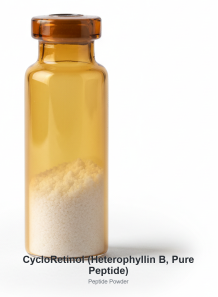
Product characteristics: white to off-white powder; low-odor to odorless peptide material.
Solubility: Soluble in water or buffered aqueous concentrates. Not intended for direct oil-phase dissolution.
Storage: Store tightly closed under dry, refrigerated conditions away from heat, light, and unnecessary moisture exposure.
No products
CycloRetinol (Heterophyllin B, Pure Peptide) is a pure cyclic octapeptide active associated with Pseudostellaria heterophylla, designed for modern soothing, recovery, well-aging, and gentle brightening skincare concepts.
Physical form: This product is supplied as a freeze-dried powder.
This ingredient gives brands a fresh retinol-alternative story without positioning it as a retinoid copy. It is best used when the formula needs a high-value peptide active for stressed-looking skin, oxidative-stress care, barrier-support routines, and a smoother, more even-looking complexion.
Product Description: Heterophyllin B is especially attractive for premium formulas because it combines a distinctive cyclic peptide identity with calm-skin, antioxidant-stress, and tone-refining directions. It fits the current demand for well-aging actives that feel advanced, gentle, and suitable for daily-use leave-on products.
| Formula story | How to use the active |
|---|---|
| CycloRetinol-style well-aging | Use for gentle retinol-alternative concepts that focus on smoother-looking, healthier-looking skin without claiming retinoid equivalence. |
| Soothing and recovery | Position for stressed-looking skin, post-stress recovery masks, barrier-support serums, and comfort-focused gel creams. |
| Gentle brightening | Fits tone-evening and dullness-care products using soft brightening language rather than aggressive whitening claims. |
Development work around Heterophyllin B includes inflammatory-stress, oxidative-stress, and tyrosinase-modulation directions, making it a useful active for brands that want a differentiated peptide story beyond common signal peptides.
Usage: Soothing serums, recovery gels, gel-creams for sensitivity-prone skin, barrier-support creams, gentle brightening serums, hydrogel masks, sheet-mask essences, and well-aging leave-on products.
Mixing method:
- Dissolve in the water phase or a small buffered aqueous concentrate at room temperature.
- Add during final processing or cool-down, preferably below 40°C, and avoid prolonged heat exposure.
- Keep the finished formula in a mild buffered range, about pH 4.5-6.5.
- For emulsions, pre-dissolve in the aqueous phase before emulsification or post-add into the water phase during cool-down.
- If stronger delivery is desired, use carrier engineering such as liposomal or vesicular systems.
Usage rate: 0.01-0.10%. Typical pilot work can start around 0.03-0.05% in leave-on systems. Because this SKU is a pure peptide, the ingredient percentage equals delivered active percentage in the finished formula.
Product characteristics: white to off-white powder; low-odor to odorless peptide material.
Solubility: Soluble in water or buffered aqueous concentrates. Not intended for direct oil-phase dissolution.
Storage: Store tightly closed under dry, refrigerated conditions away from heat, light, and unnecessary moisture exposure.
| Mechanism | - |
| Appearance | - |
| Longevity | - |
| Strength | - |
| Storage | - |
| Shelf Life | - |
| Allergen(s) | - |
| Dosage (Range) | - |
| Recommended Dosage | - |
| Dosage (Per Day) | - |
| Recommended Dosage (Per Day) | - |
| Mix Method | - |
| Heat Resistance | - |
| Stable in pH range | - |
| Solubility | - |
| Product Types | - |
| INCI | - |