


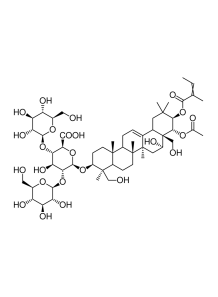
“Direct human evidence: topical 2% escin gel reduced pressure tenderness in experimentally induced hematoma, supporting use for bruise/impact-related skin discomfort appearance.”
High-purity escin (aescin) saponin active from horse chestnut, used in leave-on gel/serum formulas to support the appearance of puffiness and microcirculation-associated skin appearance; add during cool-down.
Pure-Escin™ is a high-purity (≥98%) escin (aescin) active — a mixture of triterpene saponins naturally found in horse chestnut (Aesculus hippocastanum).
Escin has a long history of topical use in gel systems where it is studied for supporting the appearance of bruising/impact-related discomfort and for improving skin microcirculation markers in vein-related conditions. In cosmetics, this evidence is used as a technical rationale for formulas targeting the look of puffiness/swelling and microcirculation-associated skin appearance.
Important nuance: several human studies used combination gels (escin with other actives such as heparin and salicylates), so the observed outcomes cannot be attributed to escin alone with full certainty.
Product Description:
Escin is an amphiphilic saponin complex; in topical systems it is discussed for anti-inflammatory and anti-edema mechanisms, including modulation of vascular permeability (technical rationale for reducing the appearance of swelling).
Human topical research examples include:
- A double-blind randomized trial in an experimentally induced hematoma model reported improved tenderness to pressure with a 2% escin gel versus placebo (PMID 8255928).
- Acute sports/blunt injury studies reported better pressure-evoked tenderness outcomes for gels containing escin (1–2%) in combination with other actives versus placebo (PMID 12055112; PMID 11531036).
- In chronic venous insufficiency/venous hypertension, topical gels containing escin with essential phospholipids reported significant improvements in microcirculation-related measures after 2 weeks (PMID 15156249; PMID 15156250).
| Human System | Endpoints Reported | Cosmetic Relevance |
|---|---|---|
| Experimental hematoma model (topical gel) | Tenderness to pressure (2% escin gel vs placebo) | Support the look/feel of impact-related skin discomfort |
| Blunt impact injuries (combination gels) | Pressure-evoked tenderness; time to symptom relief | Rationale for post-activity body gels; interpret as combination evidence |
| Venous insufficiency/venous hypertension (combination gels) | Microcirculation markers (e.g., laser-Doppler skin flux; transcutaneous PO₂) | Rationale for leg-care products targeting microcirculation-associated appearance |
Usage: Leave-on gels/serums/creams and body-care formulas for the appearance of puffiness/swelling and microcirculation-associated skin appearance (e.g., leg-care gels, post-activity body gels).
Mixing method:
- Pre-disperse in propylene glycol, butylene glycol, or ethoxydiglycol, then add to the formula during cool-down.
- Alternatively dissolve/solubilize in a suitable hydroalcoholic phase or with a nonionic solubilizer system; expect possible opalescence depending on system and electrolyte load.
- Add below 40°C and formulate within a skin-compatible pH range; avoid extreme pH to reduce degradation risk.
Usage rate: 0.1–2%
With ≥98% assay, 0.1–2% of this material delivers approximately 0.098–1.96% escin.
Product characteristics: Off-white to pale yellow powder; faint characteristic odor.
Solubility: Limited solubility in pure water; better solubility/dispersibility in glycols and hydroalcoholic systems and can be solubilized with nonionic surfactants. Optimize with your base and check clarity/stability.
Storage: Store tightly closed in a cool, dry place and protect from moisture.
No products
High-purity escin (aescin) saponin active from horse chestnut, used in leave-on gel/serum formulas to support the appearance of puffiness and microcirculation-associated skin appearance; add during cool-down.
Pure-Escin™ is a high-purity (≥98%) escin (aescin) active — a mixture of triterpene saponins naturally found in horse chestnut (Aesculus hippocastanum).
Escin has a long history of topical use in gel systems where it is studied for supporting the appearance of bruising/impact-related discomfort and for improving skin microcirculation markers in vein-related conditions. In cosmetics, this evidence is used as a technical rationale for formulas targeting the look of puffiness/swelling and microcirculation-associated skin appearance.
Important nuance: several human studies used combination gels (escin with other actives such as heparin and salicylates), so the observed outcomes cannot be attributed to escin alone with full certainty.
Product Description:
Escin is an amphiphilic saponin complex; in topical systems it is discussed for anti-inflammatory and anti-edema mechanisms, including modulation of vascular permeability (technical rationale for reducing the appearance of swelling).
Human topical research examples include:
- A double-blind randomized trial in an experimentally induced hematoma model reported improved tenderness to pressure with a 2% escin gel versus placebo (PMID 8255928).
- Acute sports/blunt injury studies reported better pressure-evoked tenderness outcomes for gels containing escin (1–2%) in combination with other actives versus placebo (PMID 12055112; PMID 11531036).
- In chronic venous insufficiency/venous hypertension, topical gels containing escin with essential phospholipids reported significant improvements in microcirculation-related measures after 2 weeks (PMID 15156249; PMID 15156250).
| Human System | Endpoints Reported | Cosmetic Relevance |
|---|---|---|
| Experimental hematoma model (topical gel) | Tenderness to pressure (2% escin gel vs placebo) | Support the look/feel of impact-related skin discomfort |
| Blunt impact injuries (combination gels) | Pressure-evoked tenderness; time to symptom relief | Rationale for post-activity body gels; interpret as combination evidence |
| Venous insufficiency/venous hypertension (combination gels) | Microcirculation markers (e.g., laser-Doppler skin flux; transcutaneous PO₂) | Rationale for leg-care products targeting microcirculation-associated appearance |
Usage: Leave-on gels/serums/creams and body-care formulas for the appearance of puffiness/swelling and microcirculation-associated skin appearance (e.g., leg-care gels, post-activity body gels).
Mixing method:
- Pre-disperse in propylene glycol, butylene glycol, or ethoxydiglycol, then add to the formula during cool-down.
- Alternatively dissolve/solubilize in a suitable hydroalcoholic phase or with a nonionic solubilizer system; expect possible opalescence depending on system and electrolyte load.
- Add below 40°C and formulate within a skin-compatible pH range; avoid extreme pH to reduce degradation risk.
Usage rate: 0.1–2%
With ≥98% assay, 0.1–2% of this material delivers approximately 0.098–1.96% escin.
Product characteristics: Off-white to pale yellow powder; faint characteristic odor.
Solubility: Limited solubility in pure water; better solubility/dispersibility in glycols and hydroalcoholic systems and can be solubilized with nonionic surfactants. Optimize with your base and check clarity/stability.
Storage: Store tightly closed in a cool, dry place and protect from moisture.
| Mechanism | - |
| Appearance | - |
| Longevity | - |
| Strength | - |
| Long-term storage | - |
| Shelf Life | - |
| Allergen(s) | - |
| Dosage (Range) | - |
| Recommended Dosage | - |
| Dosage (Per Day) | - |
| Recommended Dosage (Per Day) | - |
| Mix Method | - |
| Heat Resistance | - |
| Stable in pH range | - |
| Solubility | - |
| Product Types | - |
| INCI | - |