


“Direct human cosmetic evidence: 0.5% paeoniflorin-containing formulation reduced facial wrinkle appearance after 8 weeks in 20 volunteers; also showed UVB DNA-damage protection in keratinocyte models.”
Pure-Paeoniflorin™ is a high‑purity paeoniflorin powder (98% assay) intended for professional cosmetic formulators who want research‑supported signals for tone‑evening, photoaging moderation, and inflammation‑related skin comfort.
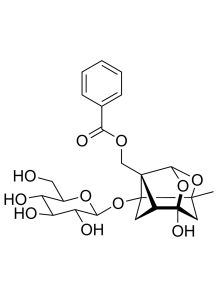
Paeoniflorin (PF) is a plant‑derived monoterpene glycoside most associated with Paeonia lactiflora (white peony) research. For topical use, the evidence base is mainly preclinical (cell/skin models and animal studies), with limited small human cosmetic data.
Key direct topical signals reported in the literature include an 8‑week 0.5% paeoniflorin‑containing cosmetic study (20 volunteers) for wrinkle appearance, depigmenting activity in a reconstructed pigmented human epidermis model, and anti‑inflammatory effects in topical psoriasis‑like mouse models (NF‑κB‑related signaling and K17‑associated markers). Practical performance depends strongly on delivery because PF is water‑soluble but can be challenging to transport across the stratum corneum without suitable formulation strategies.
Product Description: Paeoniflorin is studied as a multi‑pathway modulator relevant to skin aging, discoloration, and inflammation‑linked conditions. Reported endpoints span UVB‑related DNA damage control in keratinocyte experiments, wrinkle metrics in a small cosmetic human study, melanin reduction in a 3D human skin‑equivalent model, and reduced psoriasis‑like changes in mouse skin with suppression of inflammatory signaling. Additional topical/local models report supportive signals for wound repair biology (fibroblast proliferation, re‑epithelialization/angiogenesis markers) when PF is delivered repeatedly or via engineered hydrogels.
| Model/System | Key Endpoints | Implication |
|---|---|---|
| Human cosmetic study (8 weeks) | 0.5% PF‑containing formulation; reported reduction in facial wrinkle appearance (small n) | Anti‑wrinkle / photoaging signal (limited clinical) |
| Reconstructed pigmented human epidermis (3D) | Reduced melanin levels vs control (reported ~20–30% depending on setup) | Tone‑evening / depigmenting signal (model‑based) |
| Topical psoriasis‑like mouse models + keratinocytes | Improved inflammatory skin changes; NF‑κB‑related signaling; K17‑associated marker changes | Soothing / anti‑redness concept support (preclinical) |
Usage: Leave‑on serums, gel‑creams, lotions, masks, and spot care where formulators want research‑linked signals for brightening support, anti‑photoaging/wrinkle appearance, and skin‑comfort/soothing positioning.
Mixing method:
- Pre‑dissolve into water or water‑glycol (e.g., propanediol/propylene glycol) to make a clear dosing solution, then add during cool‑down (≤40°C) with moderate stirring.
- For higher on‑skin performance, consider delivery strategies commonly studied for PF (vesicles/transethosomes/hydrogels); avoid DIY microneedle methods.
- Formulate within a moderate pH window when possible and validate stability in your base; keep the system protected from excessive heat and prolonged high‑shear when unnecessary.
Usage rate: 0.1–1.0% (typical ~0.5%) for leave‑on products, adjusted to base type and tolerance.
Delivered‑active mapping (98% assay): 0.5% use → ~0.49% paeoniflorin delivered; 1.0% → ~0.98%.
Product characteristics: White to off‑white crystalline powder; odorless to faint.
Solubility: Water‑soluble and compatible with common aqueous co‑solvents (glycols). Note: water solubility does not automatically translate to high skin permeation; delivery optimization can be important for real‑world results.
Storage: Store tightly closed in a cool, dry place protected from light and moisture. Use desiccant where appropriate.
No products
Pure-Paeoniflorin™ is a high‑purity paeoniflorin powder (98% assay) intended for professional cosmetic formulators who want research‑supported signals for tone‑evening, photoaging moderation, and inflammation‑related skin comfort.
Paeoniflorin (PF) is a plant‑derived monoterpene glycoside most associated with Paeonia lactiflora (white peony) research. For topical use, the evidence base is mainly preclinical (cell/skin models and animal studies), with limited small human cosmetic data.
Key direct topical signals reported in the literature include an 8‑week 0.5% paeoniflorin‑containing cosmetic study (20 volunteers) for wrinkle appearance, depigmenting activity in a reconstructed pigmented human epidermis model, and anti‑inflammatory effects in topical psoriasis‑like mouse models (NF‑κB‑related signaling and K17‑associated markers). Practical performance depends strongly on delivery because PF is water‑soluble but can be challenging to transport across the stratum corneum without suitable formulation strategies.
Product Description: Paeoniflorin is studied as a multi‑pathway modulator relevant to skin aging, discoloration, and inflammation‑linked conditions. Reported endpoints span UVB‑related DNA damage control in keratinocyte experiments, wrinkle metrics in a small cosmetic human study, melanin reduction in a 3D human skin‑equivalent model, and reduced psoriasis‑like changes in mouse skin with suppression of inflammatory signaling. Additional topical/local models report supportive signals for wound repair biology (fibroblast proliferation, re‑epithelialization/angiogenesis markers) when PF is delivered repeatedly or via engineered hydrogels.
| Model/System | Key Endpoints | Implication |
|---|---|---|
| Human cosmetic study (8 weeks) | 0.5% PF‑containing formulation; reported reduction in facial wrinkle appearance (small n) | Anti‑wrinkle / photoaging signal (limited clinical) |
| Reconstructed pigmented human epidermis (3D) | Reduced melanin levels vs control (reported ~20–30% depending on setup) | Tone‑evening / depigmenting signal (model‑based) |
| Topical psoriasis‑like mouse models + keratinocytes | Improved inflammatory skin changes; NF‑κB‑related signaling; K17‑associated marker changes | Soothing / anti‑redness concept support (preclinical) |
Usage: Leave‑on serums, gel‑creams, lotions, masks, and spot care where formulators want research‑linked signals for brightening support, anti‑photoaging/wrinkle appearance, and skin‑comfort/soothing positioning.
Mixing method:
- Pre‑dissolve into water or water‑glycol (e.g., propanediol/propylene glycol) to make a clear dosing solution, then add during cool‑down (≤40°C) with moderate stirring.
- For higher on‑skin performance, consider delivery strategies commonly studied for PF (vesicles/transethosomes/hydrogels); avoid DIY microneedle methods.
- Formulate within a moderate pH window when possible and validate stability in your base; keep the system protected from excessive heat and prolonged high‑shear when unnecessary.
Usage rate: 0.1–1.0% (typical ~0.5%) for leave‑on products, adjusted to base type and tolerance.
Delivered‑active mapping (98% assay): 0.5% use → ~0.49% paeoniflorin delivered; 1.0% → ~0.98%.
Product characteristics: White to off‑white crystalline powder; odorless to faint.
Solubility: Water‑soluble and compatible with common aqueous co‑solvents (glycols). Note: water solubility does not automatically translate to high skin permeation; delivery optimization can be important for real‑world results.
Storage: Store tightly closed in a cool, dry place protected from light and moisture. Use desiccant where appropriate.
| Mechanism | - |
| Appearance | - |
| Longevity | - |
| Strength | - |
| Long-term storage | - |
| Shelf Life | - |
| Allergen(s) | - |
| Dosage (Range) | - |
| Recommended Dosage | - |
| Dosage (Per Day) | - |
| Recommended Dosage (Per Day) | - |
| Mix Method | - |
| Heat Resistance | - |
| Stable in pH range | - |
| Solubility | - |
| Product Types | - |
| INCI | - |