


“Verbascoside reduced scratching, lesion severity, and inflammatory cytokine signals in an atopic-dermatitis-like mouse model; soothing evidence is preclinical.”
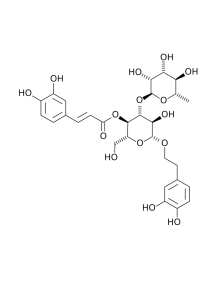
Pure-Verbascoside™ is a cosmetic active raw material consisting of verbascoside (acteoside), a plant phenylethanoid (phenylpropanoid) glycoside used for advanced antioxidant, soothing, and photoprotection-support positioning in topical formulations.
Across in‑vitro and preclinical models, verbascoside shows strong superoxide/ROS scavenging, modulation of skin inflammatory signaling (chemokines/cytokines), and support for matrix preservation (MMP/collagen balance) under UV stress. These mechanisms support use-cases such as photoaging moderation, stressed-skin calming, and tone/clarity support, while recognizing that most efficacy evidence is non‑clinical (cells and animal models).
Formulation note: verbascoside is described as highly hydrophilic, so its performance depends strongly on the vehicle (water phase, glycols, and delivery systems). For best robustness, add in cool‑down (<40°C), minimize prolonged heat/light/air exposure, and validate stability/compatibility in your exact base.
Related usage context (non‑exhaustive)
Often positioned in antioxidant serums/lotions, post‑sun and photoprotection‑support products, calming/anti‑redness skincare, and brightening routines (when supported by overall formula design and testing).
Product Description: Verbascoside (acteoside) is studied in dermo‑cosmetic contexts for both direct antioxidant capacity and biological modulation in skin‑relevant cells. In a dermo‑cosmetic formulation/stability study (Molecules, 2011), verbascoside demonstrated superoxide scavenging activity and was evaluated for stability in topical preparation conditions. In keratinocyte systems, phenylethanoid glycosides including verbascoside were reported to down‑regulate key inflammatory chemokines (e.g., IL‑8, MCP‑1, IP‑10) at gene/protein levels, supporting a plausible “calming” positioning (Journal of Ethnopharmacology, 2012; Antioxidants & Redox Signaling, 2012). In UVB‑stressed dermal fibroblasts, acteoside was associated with reduced photoaging‑linked mediators such as MMPs and IL‑6 and with support of procollagen/type‑I collagen markers (Photochemistry and Photobiology, 2018), consistent with a matrix‑preservation narrative. Additional work reports melanogenesis/tyrosinase pathway suppression in B16 melanoma cells (Journal of Pharmacy and Pharmacology, 2011), supporting a biochemical brightening rationale (not a substitute for controlled human hyperpigmentation studies).
| Model/System | Key Endpoints (Representative) | Implication |
|---|---|---|
| Dermo‑cosmetic antioxidant testing | Superoxide/ROS scavenging; stability in topical vehicles | Antioxidant positioning; vehicle matters |
| Human keratinocyte models | ↓ IL‑8; ↓ MCP‑1; ↓ IP‑10 (chemokine modulation) | Soothing/anti‑redness plausibility |
| UVB‑stressed dermal fibroblasts | ↓ MMPs/IL‑6; ↑ procollagen‑related markers | Photoaging moderation via matrix preservation |
| Melanogenesis cell models | ↓ tyrosinase activity; ↓ melanin synthesis signaling | Biochemical brightening rationale |
Usage: Cosmetic active for:
- Antioxidant serums, lotions, and emulsions targeting oxidative stress from UV/pollution
- Calming/anti‑redness skincare where chemokine/cytokine moderation is desired
- Photoprotection‑support routines (note: not a UV filter; finished products still require proper sunscreen)
- Brightening/tone‑clarity products when supported by formula design and evaluation
Mixing method:
- Pre‑dissolve in the water phase or a polar co‑solvent system (e.g., water + glycols) before combining with the bulk.
- Add during cool‑down (<40°C) to reduce thermal stress; avoid prolonged high heat and strong light.
- For anhydrous systems, consider delivery approaches (encapsulation/dispersion) rather than direct addition.
- Confirm stability and compatibility (color/odor/assay where available) with co‑actives and preservatives in your finished base.
Usage rate: 0.1–1.0% in the finished formula (typical ~0.3–0.5%), subject to stability, skin tolerance, and regulatory requirements.
Because this SKU is intended as a single‑active raw material, the delivered‑active in the finished product equals the percentage used (e.g., 0.5% use → ~0.5% verbascoside delivered).
Product characteristics: Off‑white to pale yellow powder; faint characteristic odor (may vary by batch).
Solubility: Soluble in water and other polar solvents; practically insoluble in non‑polar oils. Vehicle selection strongly influences delivery and observed performance.
For external use in cosmetic formulations by trained personnel only; not a finished cosmetic. Always perform appropriate safety and patch testing on the final product before consumer use.
No products
Pure-Verbascoside™ is a cosmetic active raw material consisting of verbascoside (acteoside), a plant phenylethanoid (phenylpropanoid) glycoside used for advanced antioxidant, soothing, and photoprotection-support positioning in topical formulations.
Across in‑vitro and preclinical models, verbascoside shows strong superoxide/ROS scavenging, modulation of skin inflammatory signaling (chemokines/cytokines), and support for matrix preservation (MMP/collagen balance) under UV stress. These mechanisms support use-cases such as photoaging moderation, stressed-skin calming, and tone/clarity support, while recognizing that most efficacy evidence is non‑clinical (cells and animal models).
Formulation note: verbascoside is described as highly hydrophilic, so its performance depends strongly on the vehicle (water phase, glycols, and delivery systems). For best robustness, add in cool‑down (<40°C), minimize prolonged heat/light/air exposure, and validate stability/compatibility in your exact base.
Related usage context (non‑exhaustive)
Often positioned in antioxidant serums/lotions, post‑sun and photoprotection‑support products, calming/anti‑redness skincare, and brightening routines (when supported by overall formula design and testing).
Product Description: Verbascoside (acteoside) is studied in dermo‑cosmetic contexts for both direct antioxidant capacity and biological modulation in skin‑relevant cells. In a dermo‑cosmetic formulation/stability study (Molecules, 2011), verbascoside demonstrated superoxide scavenging activity and was evaluated for stability in topical preparation conditions. In keratinocyte systems, phenylethanoid glycosides including verbascoside were reported to down‑regulate key inflammatory chemokines (e.g., IL‑8, MCP‑1, IP‑10) at gene/protein levels, supporting a plausible “calming” positioning (Journal of Ethnopharmacology, 2012; Antioxidants & Redox Signaling, 2012). In UVB‑stressed dermal fibroblasts, acteoside was associated with reduced photoaging‑linked mediators such as MMPs and IL‑6 and with support of procollagen/type‑I collagen markers (Photochemistry and Photobiology, 2018), consistent with a matrix‑preservation narrative. Additional work reports melanogenesis/tyrosinase pathway suppression in B16 melanoma cells (Journal of Pharmacy and Pharmacology, 2011), supporting a biochemical brightening rationale (not a substitute for controlled human hyperpigmentation studies).
| Model/System | Key Endpoints (Representative) | Implication |
|---|---|---|
| Dermo‑cosmetic antioxidant testing | Superoxide/ROS scavenging; stability in topical vehicles | Antioxidant positioning; vehicle matters |
| Human keratinocyte models | ↓ IL‑8; ↓ MCP‑1; ↓ IP‑10 (chemokine modulation) | Soothing/anti‑redness plausibility |
| UVB‑stressed dermal fibroblasts | ↓ MMPs/IL‑6; ↑ procollagen‑related markers | Photoaging moderation via matrix preservation |
| Melanogenesis cell models | ↓ tyrosinase activity; ↓ melanin synthesis signaling | Biochemical brightening rationale |
Usage: Cosmetic active for:
- Antioxidant serums, lotions, and emulsions targeting oxidative stress from UV/pollution
- Calming/anti‑redness skincare where chemokine/cytokine moderation is desired
- Photoprotection‑support routines (note: not a UV filter; finished products still require proper sunscreen)
- Brightening/tone‑clarity products when supported by formula design and evaluation
Mixing method:
- Pre‑dissolve in the water phase or a polar co‑solvent system (e.g., water + glycols) before combining with the bulk.
- Add during cool‑down (<40°C) to reduce thermal stress; avoid prolonged high heat and strong light.
- For anhydrous systems, consider delivery approaches (encapsulation/dispersion) rather than direct addition.
- Confirm stability and compatibility (color/odor/assay where available) with co‑actives and preservatives in your finished base.
Usage rate: 0.1–1.0% in the finished formula (typical ~0.3–0.5%), subject to stability, skin tolerance, and regulatory requirements.
Because this SKU is intended as a single‑active raw material, the delivered‑active in the finished product equals the percentage used (e.g., 0.5% use → ~0.5% verbascoside delivered).
Product characteristics: Off‑white to pale yellow powder; faint characteristic odor (may vary by batch).
Solubility: Soluble in water and other polar solvents; practically insoluble in non‑polar oils. Vehicle selection strongly influences delivery and observed performance.
For external use in cosmetic formulations by trained personnel only; not a finished cosmetic. Always perform appropriate safety and patch testing on the final product before consumer use.
| Mechanism | - |
| Appearance | - |
| Longevity | - |
| Strength | - |
| Long-term storage | - |
| Shelf Life | - |
| Allergen(s) | - |
| Dosage (Range) | - |
| Recommended Dosage | - |
| Dosage (Per Day) | - |
| Recommended Dosage (Per Day) | - |
| Mix Method | - |
| Heat Resistance | - |
| Stable in pH range | - |
| Solubility | - |
| Product Types | - |
| INCI | - |