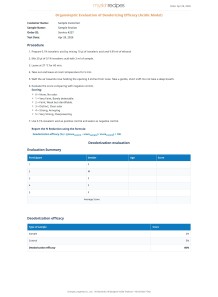
Organoleptic Evaluation of Deodorizing Efficacy (Acidic Model)

Organoleptic Evaluation of Deodorizing Efficacy (Acidic Model)
  • Product Code: 253758
The method evaluates the efficacy of the test sample in suppressing the vaporization of Short-Chain Fatty Acids (SCFAs), specifically Isovaleric Acid, which acts as a chemical marker for human axillary (armpit) and foot malodor. f the sample contains alcohols (ethanol) or enzymes from fermentation, the isovaleric acid may chemically react during the 37°C incubation to form an ester (e.g., Ethyl Isovalerate), which typically has a pleasant, fruity aroma rather than a malodor. Sample Requirement: 5 g
฿2,000.00

science Sample Names

assignment Instructions

info Please include any specific requirements or conditions for testing

description Service Overview

The method evaluates the efficacy of the test sample in suppressing the vaporization of Short-Chain Fatty Acids (SCFAs), specifically Isovaleric Acid, which acts as a chemical marker for human axillary (armpit) and foot malodor. f the sample contains alcohols (ethanol) or enzymes from fermentation, the isovaleric acid may chemically react during the 37°C incubation to form an ester (e.g., Ethyl Isovalerate), which typically has a pleasant, fruity aroma rather than a malodor. Sample Requirement: 5 g

timeline Service Steps

Step Procedure Expected Result
1

Prepare 0.1%...

check_circle_outline

0.1% isovaleric acid

2

Mix 20...

check_circle_outline

mixture of sample and isovaleric acid

3

Leave ...

check_circle_outline

incubation

4

Take out...

check_circle_outline

incubation

5

Waft the...

check_circle_outline

to check the smell

6

Evaluate the...

check_circle_outline

evaluation

7

Report the...

check_circle_outline

≥ 50%

Organoleptic Evaluation of Deodorizing Efficacy (Acidic Model)
No image available
The method evaluates the efficacy of the test sample in suppressing the vaporization of Short-Chain Fatty Acids (SCFAs), specifically Isovaleric Acid, which acts as a chemical marker for human axillary (armpit) and foot malodor. f the sample contains alcohols (ethanol) or enzymes from fermentation, the isovaleric acid may chemically react during the 37°C incubation to form an ester (e.g., Ethyl Isovalerate), which typically has a pleasant, fruity aroma rather than a malodor. Sample Requirement: 5 g
Mechanism -
Appearance -
Longevity -
Strength -
Storage -
Shelf Life -
Allergen(s) -
Dosage (Range) -
Dosage (Per Day) -
Mix Method -
Heat Resistance -
Stable in pH range -
Solubility -
Product Types -
INCI -
Service Steps
Step Procedure Expected Result
1

Prepare 0.1%...

0.1% isovaleric acid

2

Mix 20...

mixture of sample and isovaleric acid

3

Leave ...

incubation

4

Take out...

incubation

5

Waft the...

to check the smell

6

Evaluate the...

evaluation

7

Report the...

≥ 50%