


“Direct fisetin evidence: topical fisetin reduced UVB-induced erythema, TEWL, wrinkle formation, epidermal hyperplasia, MMP-1/MMP-2, COX-2, IL-6, and NF-κB in hairless mice.”
Pure-Fisetin (UV-Damage Repair) is a high-purity fisetin powder for topical cosmetic development. Fisetin is a plant flavonoid used in photoprotection, inflammatory-stress control, and healthy-aging skin concepts, with the strongest topical support currently coming from preclinical skin models rather than large human cosmetic trials.
Across UV-stressed fibroblast, keratinocyte, organotypic skin, and mouse models, fisetin repeatedly shows lower ROS-linked inflammatory signaling together with lower expression of matrix-degrading enzymes such as MMP-1, MMP-3, and MMP-9. That makes it technically relevant for formulas positioned around UV-stress support, wrinkle-prevention support, and preservation of dermal matrix quality.
This SKU is the pure active rather than a diluted concentrate, so the ingredient use level equals delivered fisetin on skin. The main formulation challenge is solubility: fisetin is poorly water-soluble and is usually handled through glycol, ethoxydiglycol, ethanol, carrier-loaded systems, or controlled dispersion strategies while protecting the system from heat, oxygen, light, and excessive alkalinity.
Product Description: Fisetin fits best as a performance-first antioxidant active for anti-photoaging formulas, after-sun care, stressed-skin serums, repair lotions, and anti-aging emulsions. The strongest topical-relevant data come from mechanistic skin studies rather than consumer clinical trials. In UVB-irradiated human skin fibroblasts, fisetin suppressed MAPK/AP-1 signaling and lowered UV-induced MMP expression, which matters because MMP upregulation accelerates collagen degradation and wrinkle formation. A newer UVA-focused study in human dermal fibroblasts and keratinocytes also reported lower MMP-1 and MMP-3 via modulation of the NOX/ROS/MAPK axis. Mouse photodamage work likewise reported lower wrinkle formation and lower collagen-degradation signaling after repeated UV exposure.
Beyond photodamage, fisetin is relevant to inflammaging and senescence-oriented skin concepts. A recent preclinical study reported selective reduction of senescent dermal fibroblasts with attenuation of SASP-related signaling, which supports healthy-aging skin use when positioned with cosmetic support language rather than treatment-style claims. Separate inflammatory skin models suggest modulation of PI3K/Akt/mTOR, MAPK, and related inflammatory mediators, supporting calming or anti-redness support language for cosmetic use without crossing into disease-treatment claims.
Pigmentation use should remain cautious. Some studies suggest down-regulation of melanogenesis-related signaling, while other models have shown the opposite direction. For that reason, fisetin is stronger as an antioxidant and photoaging-support active than as a primary brightening claim ingredient unless the finished formula has its own supporting test data.
From a formulation standpoint, free fisetin should usually be treated as one of three formats: a low-load true solution in a solvent-rich carrier, a carrier-loaded active using systems such as cyclodextrin or lipid/nanoemulsion technology, or a deliberate fine suspension / dispersion in an opaque serum, gel, lotion, or cream. It is not a reliable direct-add water-phase ingredient, and attempts to force a clear water-rich system at higher loading usually increase precipitation and crystal-growth risk.
| Model/System | Key Endpoints | Implication |
|---|---|---|
| UVB fibroblast models | Lower MAPK/AP-1 signaling and lower MMP-1/3/9 | Support for matrix preservation and anti-photoaging concepts |
| UVA fibroblast / keratinocyte models | Lower NOX/ROS/MAPK signaling and lower MMP-1/3 | Oxidative-stress and inflammatory-stress moderation |
| Senescent dermal fibroblasts | Lower senescent-cell burden and lower SASP-related signals | Healthy-aging skin support angle |
| Inflammatory skin models | PI3K/Akt/mTOR and MAPK modulation | Calming support for stressed or irritation-prone skin |
Usage: Antioxidant serums, anti-aging creams, repair lotions, after-sun products, UV-stress support gels, and sunscreen-support formulas where fisetin is used as an auxiliary anti-photoaging active rather than as the UV filter itself. Clear serums are realistic only at low load or with pre-solubilized / carrier-loaded fisetin; opaque emulsions and milky gels are more forgiving.
Mixing method:
- Build the base first, then prepare a separate fisetin concentrate or pre-dispersion. Pre-dissolve in ethoxydiglycol, suitable glycols, or a glycol/ethanol co-solvent system when a clear or low-grit result is required. Stay with cosmetic-acceptable solvent routes such as ethoxydiglycol, suitable glycols, or controlled hydroalcoholic systems rather than trying to force the material with non-cosmetic laboratory solvents.
- Add fisetin in late cool-down, preferably below 40°C, after the emulsion or gel structure is already formed and after most pH adjustment is complete. Avoid localized alkaline pockets and prolonged hot holding because fisetin degrades faster with heat, oxygen, and rising pH.
- If the target level exceeds the solvent capacity of the formula, do not force a clear aqueous solution. Switch to cyclodextrin / lipid / nanoemulsion-style carrier loading or use a deliberate fine suspension in an opaque serum, gel, lotion, or cream instead.
- Minimize oxygen and light exposure during finishing and filling. Prefer UV-blocking or opaque packs, low headspace, and airless formats when practical. Stability work should check shade drift, crystal formation, precipitation, and clarity after room, heat, cold, and light stress.
Usage rate: 0.01-0.2%
As a practical development guide, 0.01-0.05% is the easiest range for clear or near-clear systems, 0.05-0.1% is a practical screening window for many emulsions and gels, and 0.1-0.2% is better reserved for opaque or carrier-loaded systems. Because this SKU is the pure active, the ingredient percentage equals delivered fisetin. Above about 0.2%, precipitation, crystal growth, color, and storage-stability risks rise quickly in standard cosmetic bases.
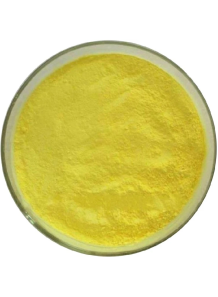
Product characteristics: Yellow fine powder with faint characteristic odor.
Solubility: Practically insoluble in water and only modestly held by simple hydroalcoholic systems. Better handled through glycols, ethoxydiglycol, ethanol, carrier-loaded delivery systems, or controlled fine dispersion into cream or gel bases when a suspension format is acceptable.
Storage: Store tightly closed in a cool, dry place protected from humidity, air, and light. Minimize repeated warm-up / cool-down cycles after opening and avoid long bulk hold time once fisetin has been incorporated into a water-containing formula.
| Test Name | Specification |
|---|---|
| Appearance | Yellow powder |
| Purity(HPLC) Area Normalization Method | ≥98.0% |
| Purity(HPLC) External Standard | ≥80.0% |
| Sieve Analysis | 100% pass 60 mesh |
| Loss on Drying | ≤5.0% |
| Lead Pb | ≤2 ppm |
| Mercury Hg | ≤0.1ppm |
| Cadmium Cd | ≤1 ppm |
| Arsenic As | ≤3ppm |
| Total microbial count (GB4789) | ≤1000CFU/g |
| Mold and yeast | ≤100CFU/g |
| E.Coli | Negative |
| Salmonella | Negative |
No products
Pure-Fisetin (UV-Damage Repair) is a high-purity fisetin powder for topical cosmetic development. Fisetin is a plant flavonoid used in photoprotection, inflammatory-stress control, and healthy-aging skin concepts, with the strongest topical support currently coming from preclinical skin models rather than large human cosmetic trials.
Across UV-stressed fibroblast, keratinocyte, organotypic skin, and mouse models, fisetin repeatedly shows lower ROS-linked inflammatory signaling together with lower expression of matrix-degrading enzymes such as MMP-1, MMP-3, and MMP-9. That makes it technically relevant for formulas positioned around UV-stress support, wrinkle-prevention support, and preservation of dermal matrix quality.
This SKU is the pure active rather than a diluted concentrate, so the ingredient use level equals delivered fisetin on skin. The main formulation challenge is solubility: fisetin is poorly water-soluble and is usually handled through glycol, ethoxydiglycol, ethanol, carrier-loaded systems, or controlled dispersion strategies while protecting the system from heat, oxygen, light, and excessive alkalinity.
Product Description: Fisetin fits best as a performance-first antioxidant active for anti-photoaging formulas, after-sun care, stressed-skin serums, repair lotions, and anti-aging emulsions. The strongest topical-relevant data come from mechanistic skin studies rather than consumer clinical trials. In UVB-irradiated human skin fibroblasts, fisetin suppressed MAPK/AP-1 signaling and lowered UV-induced MMP expression, which matters because MMP upregulation accelerates collagen degradation and wrinkle formation. A newer UVA-focused study in human dermal fibroblasts and keratinocytes also reported lower MMP-1 and MMP-3 via modulation of the NOX/ROS/MAPK axis. Mouse photodamage work likewise reported lower wrinkle formation and lower collagen-degradation signaling after repeated UV exposure.
Beyond photodamage, fisetin is relevant to inflammaging and senescence-oriented skin concepts. A recent preclinical study reported selective reduction of senescent dermal fibroblasts with attenuation of SASP-related signaling, which supports healthy-aging skin use when positioned with cosmetic support language rather than treatment-style claims. Separate inflammatory skin models suggest modulation of PI3K/Akt/mTOR, MAPK, and related inflammatory mediators, supporting calming or anti-redness support language for cosmetic use without crossing into disease-treatment claims.
Pigmentation use should remain cautious. Some studies suggest down-regulation of melanogenesis-related signaling, while other models have shown the opposite direction. For that reason, fisetin is stronger as an antioxidant and photoaging-support active than as a primary brightening claim ingredient unless the finished formula has its own supporting test data.
From a formulation standpoint, free fisetin should usually be treated as one of three formats: a low-load true solution in a solvent-rich carrier, a carrier-loaded active using systems such as cyclodextrin or lipid/nanoemulsion technology, or a deliberate fine suspension / dispersion in an opaque serum, gel, lotion, or cream. It is not a reliable direct-add water-phase ingredient, and attempts to force a clear water-rich system at higher loading usually increase precipitation and crystal-growth risk.
| Model/System | Key Endpoints | Implication |
|---|---|---|
| UVB fibroblast models | Lower MAPK/AP-1 signaling and lower MMP-1/3/9 | Support for matrix preservation and anti-photoaging concepts |
| UVA fibroblast / keratinocyte models | Lower NOX/ROS/MAPK signaling and lower MMP-1/3 | Oxidative-stress and inflammatory-stress moderation |
| Senescent dermal fibroblasts | Lower senescent-cell burden and lower SASP-related signals | Healthy-aging skin support angle |
| Inflammatory skin models | PI3K/Akt/mTOR and MAPK modulation | Calming support for stressed or irritation-prone skin |
Usage: Antioxidant serums, anti-aging creams, repair lotions, after-sun products, UV-stress support gels, and sunscreen-support formulas where fisetin is used as an auxiliary anti-photoaging active rather than as the UV filter itself. Clear serums are realistic only at low load or with pre-solubilized / carrier-loaded fisetin; opaque emulsions and milky gels are more forgiving.
Mixing method:
- Build the base first, then prepare a separate fisetin concentrate or pre-dispersion. Pre-dissolve in ethoxydiglycol, suitable glycols, or a glycol/ethanol co-solvent system when a clear or low-grit result is required. Stay with cosmetic-acceptable solvent routes such as ethoxydiglycol, suitable glycols, or controlled hydroalcoholic systems rather than trying to force the material with non-cosmetic laboratory solvents.
- Add fisetin in late cool-down, preferably below 40°C, after the emulsion or gel structure is already formed and after most pH adjustment is complete. Avoid localized alkaline pockets and prolonged hot holding because fisetin degrades faster with heat, oxygen, and rising pH.
- If the target level exceeds the solvent capacity of the formula, do not force a clear aqueous solution. Switch to cyclodextrin / lipid / nanoemulsion-style carrier loading or use a deliberate fine suspension in an opaque serum, gel, lotion, or cream instead.
- Minimize oxygen and light exposure during finishing and filling. Prefer UV-blocking or opaque packs, low headspace, and airless formats when practical. Stability work should check shade drift, crystal formation, precipitation, and clarity after room, heat, cold, and light stress.
Usage rate: 0.01-0.2%
As a practical development guide, 0.01-0.05% is the easiest range for clear or near-clear systems, 0.05-0.1% is a practical screening window for many emulsions and gels, and 0.1-0.2% is better reserved for opaque or carrier-loaded systems. Because this SKU is the pure active, the ingredient percentage equals delivered fisetin. Above about 0.2%, precipitation, crystal growth, color, and storage-stability risks rise quickly in standard cosmetic bases.
Product characteristics: Yellow fine powder with faint characteristic odor.
Solubility: Practically insoluble in water and only modestly held by simple hydroalcoholic systems. Better handled through glycols, ethoxydiglycol, ethanol, carrier-loaded delivery systems, or controlled fine dispersion into cream or gel bases when a suspension format is acceptable.
Storage: Store tightly closed in a cool, dry place protected from humidity, air, and light. Minimize repeated warm-up / cool-down cycles after opening and avoid long bulk hold time once fisetin has been incorporated into a water-containing formula.
| Mechanism | - |
| Appearance | - |
| Longevity | - |
| Strength | - |
| Storage | - |
| Shelf Life | - |
| Allergen(s) | - |
| Dosage (Range) | - |
| Recommended Dosage | - |
| Dosage (Per Day) | - |
| Recommended Dosage (Per Day) | - |
| Mix Method | - |
| Heat Resistance | - |
| Stable in pH range | - |
| Solubility | - |
| Product Types | - |
| INCI | - |