


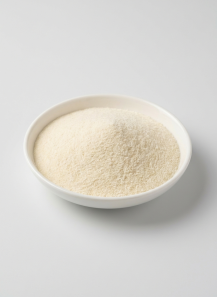
Agar Agar (Low Melting Gel 65C, Melt In Mouth) is a specialty food-grade hydrocolloid for soft gel systems where the target texture is quick setting, spoonable, and easy to break down in the mouth. This grade is designed for lower-temperature processing than conventional agar: it can hydrate and form gel around 65°C in less than 10 minutes under suitable mixing conditions, while normal agar commonly requires boiling-level heating above 95°C and longer hold time to dissolve fully.
Use this grade when the formula needs agar-type gel structure without the hard, brittle bite of standard high-gel-strength agar. It is especially useful for instant melting pudding, soft jelly cups, dairy-style desserts, plant-based pudding, fruit water gels, dessert fillings, confectionery gels with a softer bite, and texture-modified food concepts.
| Formulation goal | Starting use level | Expected technical effect | Process notes |
|---|---|---|---|
| Melt-in-mouth pudding | 0.2-0.4% | Weak-to-medium gel that breaks cleanly during eating | Preblend with sugar or dry solids before hydration |
| Soft spoonable dessert gel | 0.4-0.7% | Smooth gel body with less brittle agar bite | Heat the aqueous phase to about 65°C and mix until fully hydrated |
| Firmer jelly or molded gel | 0.7-1.0% | Stronger gel with improved handling and cutting | Validate setting time, gel strength, syneresis, and serving texture |
Levels are starting points for finished food systems. Actual dosage depends on water availability, sugar level, pH, minerals, proteins, total solids, shear, heating profile, and cooling rate.
| Test Name | Specification |
|---|---|
| Appearance | Off white to yellowish powder |
| Odour | odourless |
| Moisture, w/% | ≤22 |
| Total ash, w/% | ≤5.0 |
| Insoluble matter, w% | ≤1.0 |
| Gel strength (1.5%), g/cm² | - |
| Starch | No blue |
| Gelatin | No turbidity |
| Pb, mg/kg | ≤3.0 |
| As, mg/kg | ≤3.0 |
| Packing | 1×25 kg/bag |
No products
Agar Agar (Low Melting Gel 65C, Melt In Mouth) is a specialty food-grade hydrocolloid for soft gel systems where the target texture is quick setting, spoonable, and easy to break down in the mouth. This grade is designed for lower-temperature processing than conventional agar: it can hydrate and form gel around 65°C in less than 10 minutes under suitable mixing conditions, while normal agar commonly requires boiling-level heating above 95°C and longer hold time to dissolve fully.
Use this grade when the formula needs agar-type gel structure without the hard, brittle bite of standard high-gel-strength agar. It is especially useful for instant melting pudding, soft jelly cups, dairy-style desserts, plant-based pudding, fruit water gels, dessert fillings, confectionery gels with a softer bite, and texture-modified food concepts.
| Formulation goal | Starting use level | Expected technical effect | Process notes |
|---|---|---|---|
| Melt-in-mouth pudding | 0.2-0.4% | Weak-to-medium gel that breaks cleanly during eating | Preblend with sugar or dry solids before hydration |
| Soft spoonable dessert gel | 0.4-0.7% | Smooth gel body with less brittle agar bite | Heat the aqueous phase to about 65°C and mix until fully hydrated |
| Firmer jelly or molded gel | 0.7-1.0% | Stronger gel with improved handling and cutting | Validate setting time, gel strength, syneresis, and serving texture |
Levels are starting points for finished food systems. Actual dosage depends on water availability, sugar level, pH, minerals, proteins, total solids, shear, heating profile, and cooling rate.
| Mechanism | - |
| Appearance | - |
| Longevity | - |
| Strength | - |
| Storage | - |
| Shelf Life | - |
| Allergen(s) | - |
| Dosage (Range) | - |
| Recommended Dosage | - |
| Dosage (Per Day) | - |
| Recommended Dosage (Per Day) | - |
| Mix Method | - |
| Heat Resistance | - |
| Stable in pH range | - |
| Solubility | - |
| Product Types | - |
| INCI | - |