


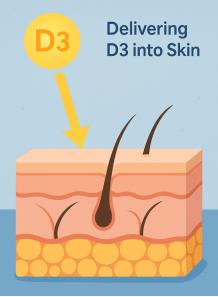
“Direct topical 7-DHC + vitamin D3 cream evidence: improved xerosis-related hydration, TEWL, pruritus and skin-barrier measures in elderly women; not specific to this water-soluble commercial material.”
7-dehydrocholesterol is a type that can be directly dissolved in water, which is a precursor of the skin in creating Vitamin D3.
Pre-D3™ (7-dehydrocholesterol Water Soluble)
7-dehydrocholesterol is a type that can be directly dissolved in water, which is a precursor of the skin in creating Vitamin D3.
| Key benefit | What the research shows | Representative study (text citation) |
|---|---|---|
| Improves skin hydration and barrier in xerosis | Daily use of a 7-DHC + vitamin D₃ cream for 4 weeks raised corneometer hydration values, lowered transepidermal water loss, eased pruritus and was well-tolerated in elderly women with dry, itchy skin. | Yahya YF et al., “Efficiency of 7-dehydrocholesterol vitamin-D₃ complex cream for xerosis and pruritus in elderly women,” J Gen Proced Dermatol Venereol Indones 8(1), 2024. (scholarhub.ui.ac.id) |
| Raises systemic vitamin D status through the skin | A randomized pilot trial showed that an aloe-based cream delivering 5 000 IU vitamin D₃ + 7-DHC daily lifted mean serum 25-hydroxy-vitamin D from 12 ng mL⁻¹ to 38 ng mL⁻¹ after 3 months without safety issues. | Sadat-Ali M et al., “Topical Delivery of Vitamin D₃: A Randomized Controlled Pilot Study,” Int J Biomed Sci 10(1), 2014. (pmc.ncbi.nlm.nih.gov) |
| Supports keratinocyte differentiation, antimicrobial peptide expression and overall barrier homeostasis | UVB-driven conversion of epidermal 7-DHC to vitamin D₃ and its active metabolites in a human skin-equivalent model generated 1α,25-dihydroxy-vitamin D₃ that regulates cornified-envelope proteins and innate-immune peptides (LL-37, β-defensin-2). | Lehmann B et al., “UVB-induced conversion of 7-dehydrocholesterol to 1α,25-dihydroxyvitamin D₃ in an in vitro human skin equivalent,” J Invest Dermatol 117(5), 2001. (pubmed.ncbi.nlm.nih.gov) |
| Acts as an intrinsic narrow-band UVB filter while permitting controlled vitamin D synthesis | 7-DHC shows three absorption maxima at 270, 280 and 295 nm, scavenging DNA-damaging photons and plateauing after ~15 % conversion, thereby balancing photoprotection with vitamin D production. | Arnold F et al., “Metabolism of Vitamin D in Skin: Benefits for Skin-Care Applications,” Cosmetics & Toiletries 2013. (cosmeticsandtoiletries.com) |
| Contributes to anti-inflammatory and wound-healing effects via local vitamin D metabolites | Topical calcitriol (generated downstream of 7-DHC) reduces keratinocyte hyper-proliferation in plaque psoriasis and accelerates re-epithelialisation in surgical wounds. | Linus Pauling Institute, “Vitamin D and Skin Health” (review), Oregon State University Micronutrient Information Center, 2016. (lpi.oregonstate.edu) |
| Formulation caveat – pro-oxidant under UVA | Substituting membrane cholesterol with 7-DHC in keratinocytes amplified UVA-induced reactive oxygen species and PGE₂ via NADPH-oxidase and mitochondrial pathways; antioxidants are therefore recommended in 7-DHC–rich topicals. | Valencia A et al., “7-Dehydrocholesterol enhances UVA-induced oxidative stress in keratinocytes,” Free Radic Biol Med 41(11), 2006. (pubmed.ncbi.nlm.nih.gov) |
Practical formulation tips
Combine 7-DHC with lipid-compatible antioxidants (eg, tocopherol, silymarin) to counteract UVA-triggered ROS.
Encapsulate in light-protected, oxygen-controlled delivery systems (liposomes, polymeric nanocapsules) to maintain stability until application.
Pair with broad-spectrum UV filters that spare the 290–305 nm window, allowing photoconversion to vitamin D₃ while shielding deeper UVA.
Optimal skin concentration ranges in commercial creams are 0.05 – 0.2 % (of pure 7-dehydrocholesterol), balancing efficacy with oxidative safety.
How to use: Ingredients in moisturizers for sensitive skin, dry skin, premature aging skin, premature aging skin.
Mixing method: Mix the oil part in the formula. Avoid heat exceeding 40C.
Usage rate: 0.1-3%
Product characteristics: Light-colored clear liquid
Solubility: Soluble in water.
Storage method: Shelf life: 24 months. Please store in a refrigerator at 6 °C -8 °C. Mixed cosmetics should be stored in the refrigerator.
INCI Name : Water, Cyclodextrin, 7-dehydrocholesterol, Glycerin, Phenoxyethanol, Chlorphenesin
| Test Name | Specification |
|---|---|
| Appearance | Light colored liquid |
| Odor | Characteristics |
| Content of 7-Dehydrocholesterol (w/w%) | 4.5-5.5 |
| Total Plate Count | ≤ 100 CFU/g |
| Yeast & Mold | ≤ 10 CFU/g |
| E. coli | Negative/g |
| Salmonella | Negative/25g |
No products
7-dehydrocholesterol is a type that can be directly dissolved in water, which is a precursor of the skin in creating Vitamin D3.
Pre-D3™ (7-dehydrocholesterol Water Soluble)
7-dehydrocholesterol is a type that can be directly dissolved in water, which is a precursor of the skin in creating Vitamin D3.
| Key benefit | What the research shows | Representative study (text citation) |
|---|---|---|
| Improves skin hydration and barrier in xerosis | Daily use of a 7-DHC + vitamin D₃ cream for 4 weeks raised corneometer hydration values, lowered transepidermal water loss, eased pruritus and was well-tolerated in elderly women with dry, itchy skin. | Yahya YF et al., “Efficiency of 7-dehydrocholesterol vitamin-D₃ complex cream for xerosis and pruritus in elderly women,” J Gen Proced Dermatol Venereol Indones 8(1), 2024. (scholarhub.ui.ac.id) |
| Raises systemic vitamin D status through the skin | A randomized pilot trial showed that an aloe-based cream delivering 5 000 IU vitamin D₃ + 7-DHC daily lifted mean serum 25-hydroxy-vitamin D from 12 ng mL⁻¹ to 38 ng mL⁻¹ after 3 months without safety issues. | Sadat-Ali M et al., “Topical Delivery of Vitamin D₃: A Randomized Controlled Pilot Study,” Int J Biomed Sci 10(1), 2014. (pmc.ncbi.nlm.nih.gov) |
| Supports keratinocyte differentiation, antimicrobial peptide expression and overall barrier homeostasis | UVB-driven conversion of epidermal 7-DHC to vitamin D₃ and its active metabolites in a human skin-equivalent model generated 1α,25-dihydroxy-vitamin D₃ that regulates cornified-envelope proteins and innate-immune peptides (LL-37, β-defensin-2). | Lehmann B et al., “UVB-induced conversion of 7-dehydrocholesterol to 1α,25-dihydroxyvitamin D₃ in an in vitro human skin equivalent,” J Invest Dermatol 117(5), 2001. (pubmed.ncbi.nlm.nih.gov) |
| Acts as an intrinsic narrow-band UVB filter while permitting controlled vitamin D synthesis | 7-DHC shows three absorption maxima at 270, 280 and 295 nm, scavenging DNA-damaging photons and plateauing after ~15 % conversion, thereby balancing photoprotection with vitamin D production. | Arnold F et al., “Metabolism of Vitamin D in Skin: Benefits for Skin-Care Applications,” Cosmetics & Toiletries 2013. (cosmeticsandtoiletries.com) |
| Contributes to anti-inflammatory and wound-healing effects via local vitamin D metabolites | Topical calcitriol (generated downstream of 7-DHC) reduces keratinocyte hyper-proliferation in plaque psoriasis and accelerates re-epithelialisation in surgical wounds. | Linus Pauling Institute, “Vitamin D and Skin Health” (review), Oregon State University Micronutrient Information Center, 2016. (lpi.oregonstate.edu) |
| Formulation caveat – pro-oxidant under UVA | Substituting membrane cholesterol with 7-DHC in keratinocytes amplified UVA-induced reactive oxygen species and PGE₂ via NADPH-oxidase and mitochondrial pathways; antioxidants are therefore recommended in 7-DHC–rich topicals. | Valencia A et al., “7-Dehydrocholesterol enhances UVA-induced oxidative stress in keratinocytes,” Free Radic Biol Med 41(11), 2006. (pubmed.ncbi.nlm.nih.gov) |
Practical formulation tips
Combine 7-DHC with lipid-compatible antioxidants (eg, tocopherol, silymarin) to counteract UVA-triggered ROS.
Encapsulate in light-protected, oxygen-controlled delivery systems (liposomes, polymeric nanocapsules) to maintain stability until application.
Pair with broad-spectrum UV filters that spare the 290–305 nm window, allowing photoconversion to vitamin D₃ while shielding deeper UVA.
Optimal skin concentration ranges in commercial creams are 0.05 – 0.2 % (of pure 7-dehydrocholesterol), balancing efficacy with oxidative safety.
How to use: Ingredients in moisturizers for sensitive skin, dry skin, premature aging skin, premature aging skin.
Mixing method: Mix the oil part in the formula. Avoid heat exceeding 40C.
Usage rate: 0.1-3%
Product characteristics: Light-colored clear liquid
Solubility: Soluble in water.
Storage method: Shelf life: 24 months. Please store in a refrigerator at 6 °C -8 °C. Mixed cosmetics should be stored in the refrigerator.
INCI Name : Water, Cyclodextrin, 7-dehydrocholesterol, Glycerin, Phenoxyethanol, Chlorphenesin
| Mechanism | - |
| Appearance | - |
| Longevity | - |
| Strength | - |
| Storage | - |
| Shelf Life | - |
| Allergen(s) | - |
| Dosage (Range) | - |
| Recommended Dosage | - |
| Dosage (Per Day) | - |
| Recommended Dosage (Per Day) | - |
| Mix Method | - |
| Heat Resistance | - |
| Stable in pH range | - |
| Solubility | - |
| Product Types | - |
| INCI | - |