


“Closest ingredient-family evidence: ethylcellulose is used as a non-toxic, non-irritating film-forming polymer in transdermal skin films, supporting its cosmetic role as a comfortable skin film former rather than a direct biological active.”
film forming agent The highlight is Gives a soft, fast-drying, moderately durable film, therefore it is commonly used in products that do not require high durability. but provides skin comfort soft film make it feel natural not hardened
Ethylcellulose Acts as an Oil Thickener (Oil Gelling) or as a Film Former in any cosmetic formula with an oil composition.
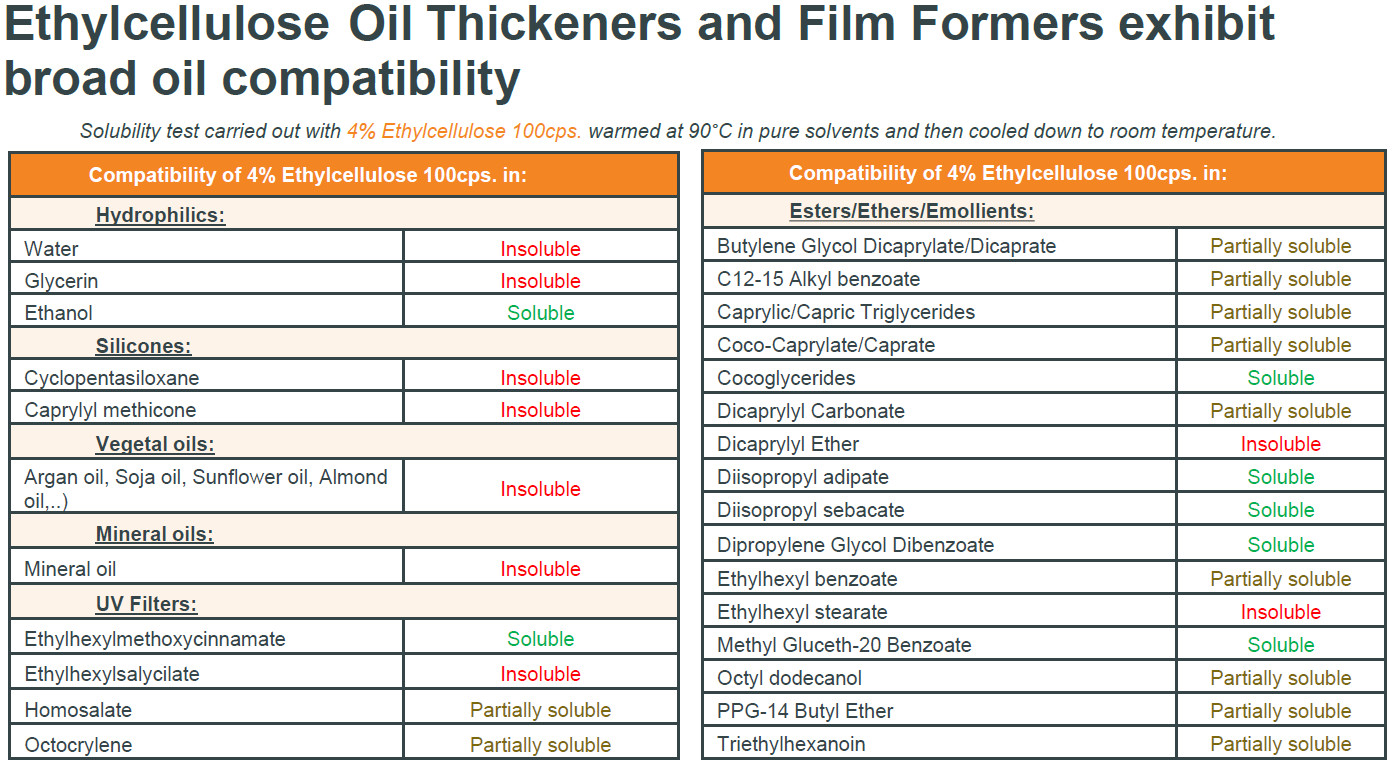
Solubility data Ethylcellulose in various oils (good solubility in polar oil)
Dissolution Instructions Ethylcellulose
1. Add Ethylcellulose to the oil and blend until dispersed.
2. Heat the oil to 70-85 degrees until the ethylcellulose dissolves clear.
3. Turn off the heat when it cools down. will thicken
distribution company Ethylcellulose variety of thickness which is suitable for different applications
1. Ethylcellulose7cps. Low density, suitable as a film former
2. Ethylcellulose 20cps. Low density, suitable as a film former
3. Ethylcellulose 50cps. medium thickness Suitable as a film former and thickening.
4. Ethylcellulose 100cps. High viscosity, suitable for serving as a thickening agent (gelling agent / thickener).
Use: Can be used in all formulations of cosmetic products
Mixing method: mix in the oil can withstand heat
Usage rate: 0.5-20% (choose to suit the desired thickness and film formation level)
Product characteristics: white/light powder
Solubility: It can dissolve in polar oil and ethanol by using temperature of 70-85 degree to dissolve.
INCI Name : Ethylcellulose
| Test Name | Specification |
|---|---|
| Appearance | White granule or powder. Odorless and tasteless |
| Identification | Conforms |
| Viscosity (mpa.s.) | 45.0-55.0 |
| Loss on drying (%) | 3 Max |
| Burning residue (%) | 0.4 Max |
| Heavy Metals (ppm) | 20 Max |
| Acetaldehyde (%) | 0.01 Max |
| Chloride (%) | 0.1 Max |
| Ethoxyl Content (%) | 44.0-51.0 |
No products
film forming agent The highlight is Gives a soft, fast-drying, moderately durable film, therefore it is commonly used in products that do not require high durability. but provides skin comfort soft film make it feel natural not hardened
Ethylcellulose Acts as an Oil Thickener (Oil Gelling) or as a Film Former in any cosmetic formula with an oil composition.
Solubility data Ethylcellulose in various oils (good solubility in polar oil)
Dissolution Instructions Ethylcellulose
1. Add Ethylcellulose to the oil and blend until dispersed.
2. Heat the oil to 70-85 degrees until the ethylcellulose dissolves clear.
3. Turn off the heat when it cools down. will thicken
distribution company Ethylcellulose variety of thickness which is suitable for different applications
1. Ethylcellulose7cps. Low density, suitable as a film former
2. Ethylcellulose 20cps. Low density, suitable as a film former
3. Ethylcellulose 50cps. medium thickness Suitable as a film former and thickening.
4. Ethylcellulose 100cps. High viscosity, suitable for serving as a thickening agent (gelling agent / thickener).
Use: Can be used in all formulations of cosmetic products
Mixing method: mix in the oil can withstand heat
Usage rate: 0.5-20% (choose to suit the desired thickness and film formation level)
Product characteristics: white/light powder
Solubility: It can dissolve in polar oil and ethanol by using temperature of 70-85 degree to dissolve.
INCI Name : Ethylcellulose
| Mechanism | - |
| Appearance | - |
| Longevity | - |
| Strength | - |
| Storage | - |
| Shelf Life | - |
| Allergen(s) | - |
| Dosage (Range) | - |
| Recommended Dosage | - |
| Dosage (Per Day) | - |
| Recommended Dosage (Per Day) | - |
| Mix Method | - |
| Heat Resistance | - |
| Stable in pH range | - |
| Solubility | - |
| Product Types | - |
| INCI | - |