


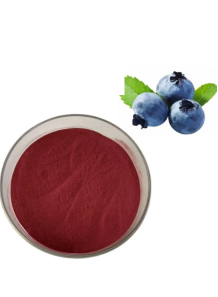
Bilberry Extract (25% Anthocyanin) is a standardized Vaccinium myrtillus fruit extract for eye-comfort, antioxidant and microcirculation-support supplement formulas. “25% anthocyanins” means anthocyanins account for 25% of the extract weight; for example, 400 mg extract provides about 100 mg anthocyanins. Anthocyanins are the purple/blue polyphenol pigments that give bilberry its strong antioxidant story and make the extract useful in formulas for screen fatigue, ocular-surface comfort and capillary-support concepts.
| Benefit | Typical study dose* | Key human findings | High-quality sources |
|---|---|---|---|
| 1 Eye strain / “screen fatigue” | ~240 mg/day for 12 weeks | Randomized placebo-controlled trial in near-work/VDT context reported improvements in measures related to eye fatigue/ciliary muscle strain. A useful human signal for eye-comfort positioning; keep claims tied to the study design and dose. | Nutrients (MDPI) |
| 2 Dry eye symptoms | Daily bilberry extract for 4 weeks | Small randomized placebo-controlled study reported improved tear production (Schirmer’s test) and changes in oxidative-stress/antioxidant markers after 4 weeks. | European Review |
| 3 Minor venous circulation (traditional use) | Traditional use (EMA) | EMA lists bilberry fruit preparations as traditional herbal medicinal products for symptoms of minor venous circulation issues (e.g., heavy/tired legs) and capillary fragility; this provides a recognized traditional-use basis for microcirculation and capillary-support concepts. | EMA herbal monograph |
| Safety profile | Typical supplement ranges | Bilberry is generally well-tolerated and has not been strongly linked to liver injury. | LiverTox (NCBI) |
*Doses shown refer to the extract used in studies. For a “25% anthocyanins” extract, 240 mg/day corresponds to ~60 mg/day anthocyanins (25% by weight). Extract specifications and bioavailability can vary by manufacturer.
No products
Bilberry Extract (25% Anthocyanin) is a standardized Vaccinium myrtillus fruit extract for eye-comfort, antioxidant and microcirculation-support supplement formulas. “25% anthocyanins” means anthocyanins account for 25% of the extract weight; for example, 400 mg extract provides about 100 mg anthocyanins. Anthocyanins are the purple/blue polyphenol pigments that give bilberry its strong antioxidant story and make the extract useful in formulas for screen fatigue, ocular-surface comfort and capillary-support concepts.
| Benefit | Typical study dose* | Key human findings | High-quality sources |
|---|---|---|---|
| 1 Eye strain / “screen fatigue” | ~240 mg/day for 12 weeks | Randomized placebo-controlled trial in near-work/VDT context reported improvements in measures related to eye fatigue/ciliary muscle strain. A useful human signal for eye-comfort positioning; keep claims tied to the study design and dose. | Nutrients (MDPI) |
| 2 Dry eye symptoms | Daily bilberry extract for 4 weeks | Small randomized placebo-controlled study reported improved tear production (Schirmer’s test) and changes in oxidative-stress/antioxidant markers after 4 weeks. | European Review |
| 3 Minor venous circulation (traditional use) | Traditional use (EMA) | EMA lists bilberry fruit preparations as traditional herbal medicinal products for symptoms of minor venous circulation issues (e.g., heavy/tired legs) and capillary fragility; this provides a recognized traditional-use basis for microcirculation and capillary-support concepts. | EMA herbal monograph |
| Safety profile | Typical supplement ranges | Bilberry is generally well-tolerated and has not been strongly linked to liver injury. | LiverTox (NCBI) |
*Doses shown refer to the extract used in studies. For a “25% anthocyanins” extract, 240 mg/day corresponds to ~60 mg/day anthocyanins (25% by weight). Extract specifications and bioavailability can vary by manufacturer.
| Mechanism | - |
| Appearance | - |
| Longevity | - |
| Strength | - |
| Storage | - |
| Shelf Life | - |
| Allergen(s) | - |
| Dosage (Range) | - |
| Recommended Dosage | - |
| Dosage (Per Day) | - |
| Recommended Dosage (Per Day) | - |
| Mix Method | - |
| Heat Resistance | - |
| Stable in pH range | - |
| Solubility | - |
| Product Types | - |
| INCI | - |