


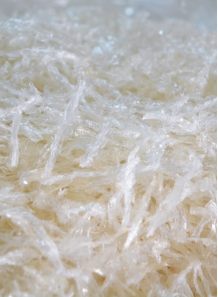
Food‑grade plant‑based gelling/thickening agent. Use 0.2–1.5%; dissolve at 90–95°C, sets on cooling.
Agar Agar (Strip) food‑grade hydrocolloid used as a plant‑based gelling and thickening agent in desserts, confectionery, and beverages.
| Benefit | Typical use level | Key food/tech findings | Sources |
|---|---|---|---|
| Gelling agent | 0.2–1.5% w/w | Thermo‑reversible gel; sets ~35–45°C after dissolving at ~90–95°C | Food Hydrocolloids |
| Texture & suspension | 0.1–0.5% w/w | Stabilizes particulates and provides clean, high‑clarity gel matrix | Codex |
*Use level refers to percentage in finished food. Adjust with sugar, acid, and salts to tune texture.
| Test Name | Specification |
|---|---|
| Sensory – Odor | Characteristic; no off‑odors; non‑irritating |
| Sensory – State | Uniform powder or strips |
| Sensory – Color | Off‑white to pale yellow |
| Moisture | ≤22.0 % |
| Ash | ≤5.0 % |
| Gelatin test | Pass |
| Water‑insoluble matter | ≤1.0 % |
| Starch test | Pass |
| Lead (as Pb) | ≤3.0 mg/kg |
| Arsenic (as As) | ≤3.0 mg/kg |
No products
Food‑grade plant‑based gelling/thickening agent. Use 0.2–1.5%; dissolve at 90–95°C, sets on cooling.
Agar Agar (Strip) food‑grade hydrocolloid used as a plant‑based gelling and thickening agent in desserts, confectionery, and beverages.
| Benefit | Typical use level | Key food/tech findings | Sources |
|---|---|---|---|
| Gelling agent | 0.2–1.5% w/w | Thermo‑reversible gel; sets ~35–45°C after dissolving at ~90–95°C | Food Hydrocolloids |
| Texture & suspension | 0.1–0.5% w/w | Stabilizes particulates and provides clean, high‑clarity gel matrix | Codex |
*Use level refers to percentage in finished food. Adjust with sugar, acid, and salts to tune texture.
| Mechanism | - |
| Appearance | - |
| Longevity | - |
| Strength | - |
| Long-term storage | - |
| Shelf Life | - |
| Allergen(s) | - |
| Dosage (Range) | - |
| Recommended Dosage | - |
| Dosage (Per Day) | - |
| Recommended Dosage (Per Day) | - |
| Mix Method | - |
| Heat Resistance | - |
| Stable in pH range | - |
| Solubility | - |
| Product Types | - |
| INCI | - |