


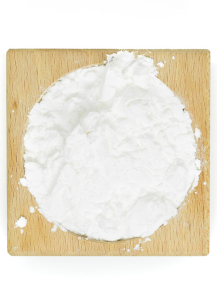
Modified food starch (E1422) used as a thickener and stabilizer for sauces, soups, fillings, dairy desserts, and frozen foods where better heat, shear, acid, and freeze-thaw stability is needed.
Acetylated distarch adipate (E1422) modified food starch; crosslinked and acetylated starch thickener/stabilizer is a processing-oriented texture ingredient used when a formulation needs starch body with better heat, shear, and acid tolerance than native starch. In finished foods it is mainly chosen to build viscosity, reduce syneresis, improve moisture retention, and keep sauces, fillings, soups, and dairy-style systems more consistent through cooking, pumping, hot-fill, pasteurization, or chilled/frozen storage. Quality profile: standard food-grade white to off-white powder with moisture 12.5%, fineness 99.8%, whiteness 93.1%, pH (10% aqueous) 6.1, SO2 residue 1.469 mg/kg, vinyl acetate 0.32%, lead <1.0 mg/kg, and arsenic <0.5 mg/kg.
| Function | Typical use level* | Key technical effect | Suitable food systems |
|---|---|---|---|
| 1 Viscosity building and body | About 1-4% in sauces and gravies; about 0.5-3% in soups | Builds smooth starch viscosity, improves body, and helps finished products hold texture during cooking and hot holding better than native starch alone. | Soups, gravies, seasoning sauces, ready-meal sauces |
| 2 Water binding and syneresis control | Often 1-4% in frozen prepared foods and 1-3% in dairy or dessert bases | Improves water retention, reduces weeping, and helps the texture stay more stable after chill storage or freeze-thaw cycling. | Dairy desserts, frozen sauces, chilled desserts, frozen ready meals |
| 3 Process tolerance | Usually 1-5%, then fine-tuned against solids, sugar, acid, and shear | Crosslinked starch granules tolerate heat, shear, and moderate acidity better than many native starches, so viscosity loss during pumping or cook processing is reduced. | Hot-fill products, cooked fillings, pasteurized foods, retorted systems |
| 4 Filling and bakery texture support | Commonly 2-5% in pie or bakery fillings, depending on total starch system | Helps maintain cohesive filling viscosity during baking, reduces water migration, and can be paired with gums when extra yield value or suspension is required. | Fruit fillings, cream fillings, bakery creams, dessert preparations |
*Use level is an ingredient-in-formula range rather than a dietary dose. Final optimization should be set from the actual food matrix, target viscosity, sugar level, pH, thermal profile, and storage conditions. Instant dry systems may require a pregelatinized or instantized grade; standard cook-up grades develop full viscosity only after the proper heating step.
| Test Name | Specification |
|---|---|
| Color | White, off-white or light yellow |
| Appearance | Granular, flaky or powdery; no visible impurities |
| Odor | Has product-specific odor, no off-odor |
| Dry loss, % | ≤14.0 |
| Fineness, % | ≥98.0 |
| Whiteness (457nm reflectance), % | ≥88.0 |
| pH (10% aqueous solution) | 5.0-8.0 |
| SO₂ residue, mg/kg | ≤30 |
| Acetyl content, % | ≤2.5 |
| Lead (as Pb), mg/kg | ≤1.0 |
| Arsenic (as As), mg/kg | ≤0.5 |
No products
Modified food starch (E1422) used as a thickener and stabilizer for sauces, soups, fillings, dairy desserts, and frozen foods where better heat, shear, acid, and freeze-thaw stability is needed.
Acetylated distarch adipate (E1422) modified food starch; crosslinked and acetylated starch thickener/stabilizer is a processing-oriented texture ingredient used when a formulation needs starch body with better heat, shear, and acid tolerance than native starch. In finished foods it is mainly chosen to build viscosity, reduce syneresis, improve moisture retention, and keep sauces, fillings, soups, and dairy-style systems more consistent through cooking, pumping, hot-fill, pasteurization, or chilled/frozen storage. Quality profile: standard food-grade white to off-white powder with moisture 12.5%, fineness 99.8%, whiteness 93.1%, pH (10% aqueous) 6.1, SO2 residue 1.469 mg/kg, vinyl acetate 0.32%, lead <1.0 mg/kg, and arsenic <0.5 mg/kg.
| Function | Typical use level* | Key technical effect | Suitable food systems |
|---|---|---|---|
| 1 Viscosity building and body | About 1-4% in sauces and gravies; about 0.5-3% in soups | Builds smooth starch viscosity, improves body, and helps finished products hold texture during cooking and hot holding better than native starch alone. | Soups, gravies, seasoning sauces, ready-meal sauces |
| 2 Water binding and syneresis control | Often 1-4% in frozen prepared foods and 1-3% in dairy or dessert bases | Improves water retention, reduces weeping, and helps the texture stay more stable after chill storage or freeze-thaw cycling. | Dairy desserts, frozen sauces, chilled desserts, frozen ready meals |
| 3 Process tolerance | Usually 1-5%, then fine-tuned against solids, sugar, acid, and shear | Crosslinked starch granules tolerate heat, shear, and moderate acidity better than many native starches, so viscosity loss during pumping or cook processing is reduced. | Hot-fill products, cooked fillings, pasteurized foods, retorted systems |
| 4 Filling and bakery texture support | Commonly 2-5% in pie or bakery fillings, depending on total starch system | Helps maintain cohesive filling viscosity during baking, reduces water migration, and can be paired with gums when extra yield value or suspension is required. | Fruit fillings, cream fillings, bakery creams, dessert preparations |
*Use level is an ingredient-in-formula range rather than a dietary dose. Final optimization should be set from the actual food matrix, target viscosity, sugar level, pH, thermal profile, and storage conditions. Instant dry systems may require a pregelatinized or instantized grade; standard cook-up grades develop full viscosity only after the proper heating step.
| Mechanism | - |
| Appearance | - |
| Longevity | - |
| Strength | - |
| Long-term storage | - |
| Shelf Life | - |
| Allergen(s) | - |
| Dosage (Range) | - |
| Recommended Dosage | - |
| Dosage (Per Day) | - |
| Recommended Dosage (Per Day) | - |
| Mix Method | - |
| Heat Resistance | - |
| Stable in pH range | - |
| Solubility | - |
| Product Types | - |
| INCI | - |