


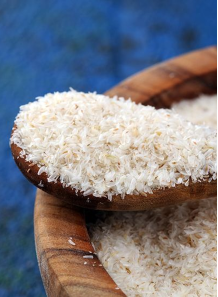
Psyllium Husk (Flakes, Delay-Dissolve, Non-Clumping) is a processed Plantago ovata soluble-fiber ingredient made in flake form to slow immediate surface hydration and reduce clumping. It is easier to mix into drinks, baking, and everyday recipes than fast-swelling psyllium powders, while still forming the viscous gel customers expect after intake.
Psyllium is valued because it binds water strongly and forms a thick gel in the digestive tract. That gel supports stool water and stool volume, and it also gives brands a strong fiber story for bowel regularity, cholesterol-conscious formulas, post-meal glucose-response positioning, and pre-meal satiety concepts.
Commercial positioning
Research-supported use context
How it works: Psyllium hydrates into a viscoelastic gel that increases stool water and bulk. Its intestinal viscosity and bile-acid binding can support cholesterol-management positioning, while slower carbohydrate absorption can help moderate post-meal glucose response. Water binding, gastric distension, and slower gastric emptying also support pre-meal satiety concepts.
Use guidance: The daily-intake field for this product is set to 3,000-20,000 mg/day (3-20 g/day) as a formulation-oriented range, not as a medical recommendation. Research doses are usually reported as total psyllium per day and may be divided into 2-3 servings. Start low and increase gradually to the desired serving size.
Practical handling: Mix into water, juice, smoothies, or recipes. For direct consumption, use sufficient water, such as a full glass, to reduce choking risk and support the intended gel-forming effect.
Safety and timing: Temporary bloating, gas, or abdominal discomfort can occur, especially when the dose is increased too quickly. Because viscous fiber can reduce absorption of some medicines or supplements, separate psyllium from oral medications by about 2 hours unless a clinician advises otherwise. People with swallowing difficulties, known gastrointestinal strictures or obstruction, severe motility disorders, or those using glucose-lowering therapy should use high-dose psyllium only with medical oversight.
| Test Name | Specification |
|---|---|
| Description | Pale-Buff-Coloured Husk. The Odour is not Marked |
| Taste | Blend Mucilaginous |
| Moisture | 10% Max |
| Swell Volume | Min. 40 Ml. / Gram |
| Psyllium Mucilloid Content | 98% Min |
| Total Ash | 4% Max |
| Acid Insoluble Ash | 1% Max |
| Heavy Extraneous Matter | 0.4% Max |
| Light Extraneous Matter | 5.0% Max |
| Insect Infestation | NMT 100 insect fragments per 25 grams, including Mites, psocids, no eggs larva or whole insects present. |
| Microbiological Limit | Absence of Salmonella Sp. And Escherichia Coli |
No products
Psyllium Husk (Flakes, Delay-Dissolve, Non-Clumping) is a processed Plantago ovata soluble-fiber ingredient made in flake form to slow immediate surface hydration and reduce clumping. It is easier to mix into drinks, baking, and everyday recipes than fast-swelling psyllium powders, while still forming the viscous gel customers expect after intake.
Psyllium is valued because it binds water strongly and forms a thick gel in the digestive tract. That gel supports stool water and stool volume, and it also gives brands a strong fiber story for bowel regularity, cholesterol-conscious formulas, post-meal glucose-response positioning, and pre-meal satiety concepts.
Commercial positioning
Research-supported use context
How it works: Psyllium hydrates into a viscoelastic gel that increases stool water and bulk. Its intestinal viscosity and bile-acid binding can support cholesterol-management positioning, while slower carbohydrate absorption can help moderate post-meal glucose response. Water binding, gastric distension, and slower gastric emptying also support pre-meal satiety concepts.
Use guidance: The daily-intake field for this product is set to 3,000-20,000 mg/day (3-20 g/day) as a formulation-oriented range, not as a medical recommendation. Research doses are usually reported as total psyllium per day and may be divided into 2-3 servings. Start low and increase gradually to the desired serving size.
Practical handling: Mix into water, juice, smoothies, or recipes. For direct consumption, use sufficient water, such as a full glass, to reduce choking risk and support the intended gel-forming effect.
Safety and timing: Temporary bloating, gas, or abdominal discomfort can occur, especially when the dose is increased too quickly. Because viscous fiber can reduce absorption of some medicines or supplements, separate psyllium from oral medications by about 2 hours unless a clinician advises otherwise. People with swallowing difficulties, known gastrointestinal strictures or obstruction, severe motility disorders, or those using glucose-lowering therapy should use high-dose psyllium only with medical oversight.
| Mechanism | - |
| Appearance | - |
| Longevity | - |
| Strength | - |
| Storage | - |
| Shelf Life | - |
| Allergen(s) | - |
| Dosage (Range) | - |
| Recommended Dosage | - |
| Dosage (Per Day) | - |
| Recommended Dosage (Per Day) | - |
| Mix Method | - |
| Heat Resistance | - |
| Stable in pH range | - |
| Solubility | - |
| Product Types | - |
| INCI | - |