


“Direct blend evidence: a non-animal cholesteric liquid crystal containing Cholesteryl Nonanoate showed moisturizing effect in an artificial skin test; scope is LC blend, not neat Cholesteryl Nonanoate.”
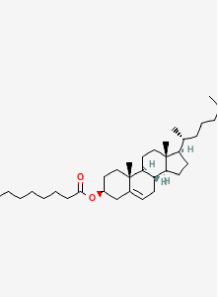
Cholesteryl Nonanoate (also known as cholesteryl pelargonate) is a cholesterol fatty-acid ester used primarily as a thermotropic cholesteric (chiral nematic) liquid-crystal former and secondarily as a lipidic emollient/structuring wax in oil phases.
It is highly lipophilic and essentially water-insoluble, so it partitions into the oil phase and can contribute to a richer, more structured feel when used in lipids and emulsions.
In cholesteric liquid-crystal blends, Cholesteryl Nonanoate often plays the role of a waxy, mid-to-higher melting mesogen that helps tune phase behavior, optical intensity, and stability when combined with lower-melting (more flexible) and higher-melting (more rigid) cholesteryl mesogens.
Product Description: Cholesteryl Nonanoate is used to build cholesteric LC domains that can produce temperature-dependent structural color (iridescence) when the formulation and processing conditions support domain formation. From an engineering perspective, it is best treated as a waxy, oil-phase structurant whose outcome depends on (1) the oil/ester selection, (2) the co-mesogen set, and (3) the thermal pathway used during manufacturing.
How to use with Cholesteryl Oleyl Carbonate + Cholesteryl Benzoate (3-component tuning):
- Cholesteryl Oleyl Carbonate: lower-melting/flexible mesogen (helps shift transitions downward and improve spreadability).
- Cholesteryl Nonanoate (this item): waxy aliphatic C9 cholesteryl ester that helps add consistency and can broaden the mesophase window.
- Cholesteryl Benzoate: rigid/high-melting mesogen that increases order and thermal stability (but can crystallize if over-used or cooled too fast).
Practical ratio set to screen (w/w within the LC mesogen blend):
- 50:35:15 (COC:CN:CB) for easier melting/softer feel.
- 40:40:20 as a balanced starting point.
- 30:45:25 when more order/thermal stability is needed (validate crystallization risk).
Binary anchor (COC:CN): A commonly cited tunable pair is around 36:64 (COC:CN) (w/w). If you want a more ordered/stable system, add a smaller CB fraction and re-optimize your oil phase.
Key formulation notes (LC systems):
- Solubilization can suppress structure: if the mesogens are fully dissolved by strong solvents or highly compatible oils, cholesteric domain formation and optical response can weaken.
- Thermal history matters: cooling rate and post-processing thermal cycling can shift appearance and stability.
- Blending is usually required: combining multiple cholesteryl mesogens can broaden the working window and reduce slow crystallization drift.
When used for sensorial/structuring (not optical effects), it functions as a lipophilic wax that can increase viscosity/consistency and contribute to a more cushiony, emollient feel.
Usage: Oil-based serums, balms, lip products, make-up/oil gels, and emulsions (oil phase). Also used as part of cholesteric LC blends where temperature-dependent iridescence/appearance is desired.
Mixing method:
- Pre-melt into the oil phase with heat (often 75–90°C; higher may be required when CB is included) until uniform.
- Cool under controlled, gentle mixing; validate appearance after thermal cycling in the final base and packaging.
- For optical effects, balance oils/esters and co-mesogens so the system forms a stable structured domain after cooling (not fully dissolved, not crystallized out).
Usage rate: 0.1–5%
For optical cholesteric effects, a common starting point is ~0.2–3% of a cholesteric LC blend in the finished formula, then optimize for tack, stability, and visual intensity.
Product characteristics: White to off-white waxy solid/powder; slight characteristic odor; oil-phase lipid.
Solubility: Insoluble in water. Soluble in oils and many organic solvents (especially with heat); may crystallize if overloaded or if the oil phase is insufficiently compatible.
Storage: Store tightly closed, dry, and away from excessive heat and light. Validate stability after repeated heat/cool cycles when used for optical appearance.
No products
Cholesteryl Nonanoate (also known as cholesteryl pelargonate) is a cholesterol fatty-acid ester used primarily as a thermotropic cholesteric (chiral nematic) liquid-crystal former and secondarily as a lipidic emollient/structuring wax in oil phases.
It is highly lipophilic and essentially water-insoluble, so it partitions into the oil phase and can contribute to a richer, more structured feel when used in lipids and emulsions.
In cholesteric liquid-crystal blends, Cholesteryl Nonanoate often plays the role of a waxy, mid-to-higher melting mesogen that helps tune phase behavior, optical intensity, and stability when combined with lower-melting (more flexible) and higher-melting (more rigid) cholesteryl mesogens.
Product Description: Cholesteryl Nonanoate is used to build cholesteric LC domains that can produce temperature-dependent structural color (iridescence) when the formulation and processing conditions support domain formation. From an engineering perspective, it is best treated as a waxy, oil-phase structurant whose outcome depends on (1) the oil/ester selection, (2) the co-mesogen set, and (3) the thermal pathway used during manufacturing.
How to use with Cholesteryl Oleyl Carbonate + Cholesteryl Benzoate (3-component tuning):
- Cholesteryl Oleyl Carbonate: lower-melting/flexible mesogen (helps shift transitions downward and improve spreadability).
- Cholesteryl Nonanoate (this item): waxy aliphatic C9 cholesteryl ester that helps add consistency and can broaden the mesophase window.
- Cholesteryl Benzoate: rigid/high-melting mesogen that increases order and thermal stability (but can crystallize if over-used or cooled too fast).
Practical ratio set to screen (w/w within the LC mesogen blend):
- 50:35:15 (COC:CN:CB) for easier melting/softer feel.
- 40:40:20 as a balanced starting point.
- 30:45:25 when more order/thermal stability is needed (validate crystallization risk).
Binary anchor (COC:CN): A commonly cited tunable pair is around 36:64 (COC:CN) (w/w). If you want a more ordered/stable system, add a smaller CB fraction and re-optimize your oil phase.
Key formulation notes (LC systems):
- Solubilization can suppress structure: if the mesogens are fully dissolved by strong solvents or highly compatible oils, cholesteric domain formation and optical response can weaken.
- Thermal history matters: cooling rate and post-processing thermal cycling can shift appearance and stability.
- Blending is usually required: combining multiple cholesteryl mesogens can broaden the working window and reduce slow crystallization drift.
When used for sensorial/structuring (not optical effects), it functions as a lipophilic wax that can increase viscosity/consistency and contribute to a more cushiony, emollient feel.
Usage: Oil-based serums, balms, lip products, make-up/oil gels, and emulsions (oil phase). Also used as part of cholesteric LC blends where temperature-dependent iridescence/appearance is desired.
Mixing method:
- Pre-melt into the oil phase with heat (often 75–90°C; higher may be required when CB is included) until uniform.
- Cool under controlled, gentle mixing; validate appearance after thermal cycling in the final base and packaging.
- For optical effects, balance oils/esters and co-mesogens so the system forms a stable structured domain after cooling (not fully dissolved, not crystallized out).
Usage rate: 0.1–5%
For optical cholesteric effects, a common starting point is ~0.2–3% of a cholesteric LC blend in the finished formula, then optimize for tack, stability, and visual intensity.
Product characteristics: White to off-white waxy solid/powder; slight characteristic odor; oil-phase lipid.
Solubility: Insoluble in water. Soluble in oils and many organic solvents (especially with heat); may crystallize if overloaded or if the oil phase is insufficiently compatible.
Storage: Store tightly closed, dry, and away from excessive heat and light. Validate stability after repeated heat/cool cycles when used for optical appearance.
| Mechanism | - |
| Appearance | - |
| Longevity | - |
| Strength | - |
| Long-term storage | - |
| Shelf Life | - |
| Allergen(s) | - |
| Dosage (Range) | - |
| Recommended Dosage | - |
| Dosage (Per Day) | - |
| Recommended Dosage (Per Day) | - |
| Mix Method | - |
| Heat Resistance | - |
| Stable in pH range | - |
| Solubility | - |
| Product Types | - |
| INCI | - |