


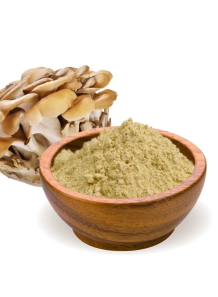
Maitake, Hen of the Woods Mushroom Powder fruitbody powder standardized to Pure Beta Glucan >30% is a Grifola frondosa ingredient for food supplements and functional foods that need a clear fruitbody beta-glucan marker instead of a generic mushroom blend. Its best commercial fit is metabolic-wellness and immune-support mushroom supplement concepts in capsules, tablets, sachets, nutrition powder blends, and savory functional foods. Quality limits are controlled for moisture <9.0%, total ash <9.0%, heavy metals, pesticide residue <LOQ, and the stated microbiological limits in the COA.
| Benefit | Typical study dose* | What this usually means in practice | Evidence basis |
|---|---|---|---|
| 1 Often used in metabolic-wellness products | Often around 0.5-3.0 g/day in repeated-use formats | Maitake is commonly positioned around metabolic resilience and glucose-related wellness; keep the language in wellness support rather than disease-style claims, and design the serving size to deliver a useful daily amount. | Limited human data plus larger preclinical/traditional base |
| 2 Works well in mushroom blends | Commonly within 500-3000 mg/day (0.5-3.0 g/day) | The fruitbody powder format fits well in multi-mushroom immune blends where a defined beta-glucan marker and a realistic serving size help make the product story stronger. | Mushroom-polysaccharide formulation practice |
| 3 Works best in products that can deliver enough per serving | Practical finished-product range 500-3000 mg/day (0.5-3.0 g/day) | The fruitbody powder format works best when the finished serving can realistically deliver a meaningful mushroom dose without forcing the formula into an impractical fill weight. This works best when the serving size can deliver a useful amount in the finished product. | Dosage-form practicality and serving design |
*Study doses in the literature may use species-specific powders or extracts rather than this exact batch. For this shop SKU, a practical general range is 500-3000 mg/day unless the finished formula supports a different serving size.
| Test Name | Specification |
|---|---|
| Pure Beta Glucan (%) | >30 |
| Moisture (%) | <9.0 |
| Total Ash (%) | <9.0 |
| Arsenic (ppm) | <1.0 |
| Lead (ppm) | <1.0 |
| Cadmium (ppm) | <1.0 |
| Mercury (ppm) | <0.1 |
| Pesticide Residue | <LOQ |
| Total Plate Count (CFU/g) | <10000 |
| Mold and Yeast (CFU/g) | <1000 |
| Coliforms (CFU/g) | <10 |
| Pathogenic Bacteria | Not detected/25g |
No products
Maitake, Hen of the Woods Mushroom Powder fruitbody powder standardized to Pure Beta Glucan >30% is a Grifola frondosa ingredient for food supplements and functional foods that need a clear fruitbody beta-glucan marker instead of a generic mushroom blend. Its best commercial fit is metabolic-wellness and immune-support mushroom supplement concepts in capsules, tablets, sachets, nutrition powder blends, and savory functional foods. Quality limits are controlled for moisture <9.0%, total ash <9.0%, heavy metals, pesticide residue <LOQ, and the stated microbiological limits in the COA.
| Benefit | Typical study dose* | What this usually means in practice | Evidence basis |
|---|---|---|---|
| 1 Often used in metabolic-wellness products | Often around 0.5-3.0 g/day in repeated-use formats | Maitake is commonly positioned around metabolic resilience and glucose-related wellness; keep the language in wellness support rather than disease-style claims, and design the serving size to deliver a useful daily amount. | Limited human data plus larger preclinical/traditional base |
| 2 Works well in mushroom blends | Commonly within 500-3000 mg/day (0.5-3.0 g/day) | The fruitbody powder format fits well in multi-mushroom immune blends where a defined beta-glucan marker and a realistic serving size help make the product story stronger. | Mushroom-polysaccharide formulation practice |
| 3 Works best in products that can deliver enough per serving | Practical finished-product range 500-3000 mg/day (0.5-3.0 g/day) | The fruitbody powder format works best when the finished serving can realistically deliver a meaningful mushroom dose without forcing the formula into an impractical fill weight. This works best when the serving size can deliver a useful amount in the finished product. | Dosage-form practicality and serving design |
*Study doses in the literature may use species-specific powders or extracts rather than this exact batch. For this shop SKU, a practical general range is 500-3000 mg/day unless the finished formula supports a different serving size.
| Mechanism | - |
| Appearance | - |
| Longevity | - |
| Strength | - |
| Storage | - |
| Shelf Life | - |
| Allergen(s) | - |
| Dosage (Range) | - |
| Recommended Dosage | - |
| Dosage (Per Day) | - |
| Recommended Dosage (Per Day) | - |
| Mix Method | - |
| Heat Resistance | - |
| Stable in pH range | - |
| Solubility | - |
| Product Types | - |
| INCI | - |