


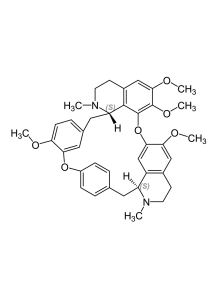
“Preclinical topical tetrandrine nanoemulsion reduced imiquimod-induced psoriasis-like inflammation in mice via Treg expansion and inflammatory-response inhibition.”
Pure-Tetrandrine™ is a high-purity tetrandrine (a plant bis-benzylisoquinoline alkaloid from Stephania tetrandra) supplied as a cosmetic active raw material for topical formulation R&D.
In published studies, topical delivery systems containing tetrandrine have been investigated for inflammation-modulating effects in skin models; however, the overall evidence base is real but limited (mostly in vitro and animal studies, with a small amount of human clinical data in one specific use case).
Tetrandrine is very poorly water-soluble, so performance in finished products is typically delivery-limited; practical use usually requires solubilization (e.g., selected solvents/solubilizers) or encapsulation/dispersions (e.g., nanoemulsions/ethosomes) to reach a controlled delivered-active level on skin.
Product Description: Tetrandrine is widely studied as an immunomodulatory alkaloid that can attenuate inflammatory signaling pathways and downstream mediators. In topical research, reported endpoints include reduced disease scores or inflammatory markers in animal dermatitis models and improved delivery/performance when formulated into penetration-enhancing carriers.
Evidence level notes (important): most topical data are preclinical (mouse/rat) or in vitro. In a randomized double-blind human trial in dermatophytosis, tetrandrine alone did not show overall efficacy, while a combination with ketoconazole reported improved cure rates versus ketoconazole alone.
| Model/System | Key Endpoints (Reported) | Implication |
|---|---|---|
| Psoriasis-like dermatitis (mouse; tetrandrine nanoemulsion; Frontiers in Immunology, 2022) | Reduced psoriasis-like disease development and immune changes consistent with lower inflammation (TNF–TNFR2 / Treg-related findings in the report) | Anti-inflammatory skin-calming concept (preclinical) |
| Dermatophytosis (human RCT; Chinese Journal of Integrative Medicine, 2011) | Combination (ketoconazole + tetrandrine) reported higher cure rates vs ketoconazole; tetrandrine alone reported no overall efficacy | Adjunct concept only; avoid attributing stand-alone antifungal effect |
| Acute radiation dermatitis (rat; Biological & Pharmaceutical Bulletin, 1999) | Reduced peak reaction severity and improved healing in that animal model | Skin-stress/irritation modulation concept (preclinical) |
| Enhanced topical delivery (rat; ethosomes; BioMed Research International, 2013) | Higher skin flux/skin deposition than liposomes and improved efficacy in an inflammation model in the report | Delivery-system dependent performance |
| Hypertrophic scar fibroblasts (in vitro; Burns, 2012) | Reported modulation of TGF-β/Smad signaling and reduced collagen-related outputs in cultured cells | Anti-fibrotic/anti-scar pathway signal (lab evidence only) |
Usage: Technical active ingredient for skin-calming / inflammation-modulating concepts in leave-on products (serums, creams/lotions, gels) and delivery-system R&D (nanoemulsions/ethosomes/liposomes). Use-cases with medical intent are outside cosmetic scope.
Mixing method:
- Because water solubility is very low, pre-dissolve into a compatible solvent/solubilizer system (e.g., selected alcohols/organic solvents) or prepare an encapsulated/dispersed system; then add into the final formula.
- Add during cool-down (<40°C) to reduce risk of precipitation and to protect the delivery system; verify clarity/stability after 24–72 h and after temperature cycling.
- Keep finished-formula pH in a mild acidic-to-neutral window when possible; avoid extreme pH that can drive instability or incompatibility with the chosen carrier.
Usage rate: 0.1–2.0% (as supplied, 98% purity). Typical: ~0.5% (delivers ~0.49% tetrandrine).
Product characteristics: Off-white to pale yellow powder; odorless to faint odor.
Solubility: Practically insoluble in water. Soluble in organic solvents (e.g., DMSO in R&D settings; solubility varies by solvent system). In finished cosmetics, use solubilizers or delivery systems to prevent crystallization.
Storage: Store tightly closed, dry, and protected from light. Avoid prolonged heat and moisture exposure; re-test appearance/solubility if stored for extended periods after opening.
No products
Pure-Tetrandrine™ is a high-purity tetrandrine (a plant bis-benzylisoquinoline alkaloid from Stephania tetrandra) supplied as a cosmetic active raw material for topical formulation R&D.
In published studies, topical delivery systems containing tetrandrine have been investigated for inflammation-modulating effects in skin models; however, the overall evidence base is real but limited (mostly in vitro and animal studies, with a small amount of human clinical data in one specific use case).
Tetrandrine is very poorly water-soluble, so performance in finished products is typically delivery-limited; practical use usually requires solubilization (e.g., selected solvents/solubilizers) or encapsulation/dispersions (e.g., nanoemulsions/ethosomes) to reach a controlled delivered-active level on skin.
Product Description: Tetrandrine is widely studied as an immunomodulatory alkaloid that can attenuate inflammatory signaling pathways and downstream mediators. In topical research, reported endpoints include reduced disease scores or inflammatory markers in animal dermatitis models and improved delivery/performance when formulated into penetration-enhancing carriers.
Evidence level notes (important): most topical data are preclinical (mouse/rat) or in vitro. In a randomized double-blind human trial in dermatophytosis, tetrandrine alone did not show overall efficacy, while a combination with ketoconazole reported improved cure rates versus ketoconazole alone.
| Model/System | Key Endpoints (Reported) | Implication |
|---|---|---|
| Psoriasis-like dermatitis (mouse; tetrandrine nanoemulsion; Frontiers in Immunology, 2022) | Reduced psoriasis-like disease development and immune changes consistent with lower inflammation (TNF–TNFR2 / Treg-related findings in the report) | Anti-inflammatory skin-calming concept (preclinical) |
| Dermatophytosis (human RCT; Chinese Journal of Integrative Medicine, 2011) | Combination (ketoconazole + tetrandrine) reported higher cure rates vs ketoconazole; tetrandrine alone reported no overall efficacy | Adjunct concept only; avoid attributing stand-alone antifungal effect |
| Acute radiation dermatitis (rat; Biological & Pharmaceutical Bulletin, 1999) | Reduced peak reaction severity and improved healing in that animal model | Skin-stress/irritation modulation concept (preclinical) |
| Enhanced topical delivery (rat; ethosomes; BioMed Research International, 2013) | Higher skin flux/skin deposition than liposomes and improved efficacy in an inflammation model in the report | Delivery-system dependent performance |
| Hypertrophic scar fibroblasts (in vitro; Burns, 2012) | Reported modulation of TGF-β/Smad signaling and reduced collagen-related outputs in cultured cells | Anti-fibrotic/anti-scar pathway signal (lab evidence only) |
Usage: Technical active ingredient for skin-calming / inflammation-modulating concepts in leave-on products (serums, creams/lotions, gels) and delivery-system R&D (nanoemulsions/ethosomes/liposomes). Use-cases with medical intent are outside cosmetic scope.
Mixing method:
- Because water solubility is very low, pre-dissolve into a compatible solvent/solubilizer system (e.g., selected alcohols/organic solvents) or prepare an encapsulated/dispersed system; then add into the final formula.
- Add during cool-down (<40°C) to reduce risk of precipitation and to protect the delivery system; verify clarity/stability after 24–72 h and after temperature cycling.
- Keep finished-formula pH in a mild acidic-to-neutral window when possible; avoid extreme pH that can drive instability or incompatibility with the chosen carrier.
Usage rate: 0.1–2.0% (as supplied, 98% purity). Typical: ~0.5% (delivers ~0.49% tetrandrine).
Product characteristics: Off-white to pale yellow powder; odorless to faint odor.
Solubility: Practically insoluble in water. Soluble in organic solvents (e.g., DMSO in R&D settings; solubility varies by solvent system). In finished cosmetics, use solubilizers or delivery systems to prevent crystallization.
Storage: Store tightly closed, dry, and protected from light. Avoid prolonged heat and moisture exposure; re-test appearance/solubility if stored for extended periods after opening.
| Mechanism | - |
| Appearance | - |
| Longevity | - |
| Strength | - |
| Long-term storage | - |
| Shelf Life | - |
| Allergen(s) | - |
| Dosage (Range) | - |
| Recommended Dosage | - |
| Dosage (Per Day) | - |
| Recommended Dosage (Per Day) | - |
| Mix Method | - |
| Heat Resistance | - |
| Stable in pH range | - |
| Solubility | - |
| Product Types | - |
| INCI | - |