


“Defined Evodia biomimetic mixture containing rutaecarpine reduced methyl-nicotinate erythema in human skin and inhibited UVB-induced PGE2 in keratinocytes; not evidence for pure rutaecarpine alone.”
Pure rutaecarpine alkaloid (CAS 84-26-4) researched for anti-redness/anti-inflammatory skin pathways; low water solubility—add with appropriate solubilization below 40°C.
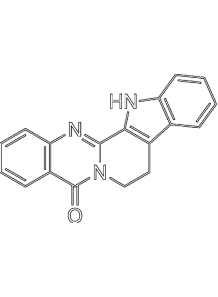
Pure-Rutaecarpine™ is a pure indoloquinazoline alkaloid (rutaecarpine) found in Evodia rutaecarpa (Wu‑Zhu‑Yu); CAS 84-26-4.
When people discuss “topical rutaecarpine”, the best human evidence comes from a defined Evodia biomimetic mixture (rutaecarpine + dehydroevodiamine + evodin) that reduced induced redness in a controlled human skin model; this supports topical anti‑redness potential but does not prove the same effect for pure rutaecarpine alone.
Preclinical data (cell and mouse skin‑inflammation models) suggest rutaecarpine can modulate inflammatory signaling and UV‑stress pathways, making it a research‑positioned cosmetic active for calming/redness‑focused formulas when appropriately solubilized.
Product Description: Rutaecarpine is an Evodia alkaloid researched for skin‑relevant anti‑inflammatory and UV‑stress modulation. In a placebo‑controlled human study using a defined Evodia biomimetic mixture, topical application reduced methyl‑nicotinate–induced erythema and the mixture inhibited UVB‑induced PGE₂ release in keratinocytes (Yarosh et al., J Dermatol Sci 2006). In mouse models of imiquimod‑induced psoriasis‑like dermatitis, topical rutaecarpine preparations improved visible inflammation and reduced pro‑inflammatory signaling/readouts, including reported NF‑κB/TLR7 pathway involvement and reductions in cytokines such as IL‑23/IL‑17A/IL‑22/IL‑6 (Li et al., Biomed Pharmacother 2019; Li et al., Acta Biochim Biophys Sin 2024). In keratinocyte UVA‑stress models, rutaecarpine reduced ROS and suppressed UVA‑driven MMP‑2/MMP‑9 activity/expression (Beak et al., Eur J Pharmacol 2004), supporting a plausible anti‑photoaging mechanism at the cellular level. Note that animal/cell outcomes are not equivalent to clinical skincare efficacy; for product positioning, treat the human evidence as mixture‑based and the pure‑compound evidence as preclinical.
| Model/System | Key Endpoints | Implication |
|---|---|---|
| Human skin (rutaecarpine‑containing mixture) | Reduced induced erythema; inhibited UVB‑PGE₂ in keratinocytes | Anti‑redness concept (mixture evidence) |
| Mouse skin inflammation (IMQ dermatitis) | Improved lesions; reduced cytokine/inflammatory signaling readouts | Calming/anti‑inflammatory positioning (preclinical) |
| Keratinocyte UVA‑stress (cell) | ↓ ROS; ↓ MMP‑2/↓ MMP‑9 | UV‑stress moderation mechanism (in vitro) |
Usage: Calming/redness‑focused serums, gels, emulsions, and post‑UV‑stress formulas where a research‑active supported by human‑mixture evidence and preclinical signaling data is appropriate.
Mixing method:
- Rutaecarpine is poorly water‑soluble; pre‑dissolve in a suitable co‑solvent system (e.g., glycols and/or ethanol) or use an appropriate solubilization technology (surfactant solubilization, microemulsion, encapsulation) based on your base.
- Add in cool‑down below 40°C and mix until fully dissolved/clear (or uniformly dispersed if using a delivery system).
- Use formulation screening to confirm clarity, color stability, and skin feel in your chosen base; avoid strong oxidizers and reduce exposure to light during processing.
Usage rate: 0.05–1.0%
This product is pure rutaecarpine, so the use level equals the delivered active level. The human mixture study used 0.1–1% topical application; start low and optimize for tolerance and stability in your base.
Product characteristics: Off‑white to pale yellow powder (appearance may vary by batch).
Solubility: Practically insoluble in water; soluble in some organic solvents and typically requires co‑solvents/solubilizers for aqueous cosmetic systems.
Storage: Store tightly closed in a cool, dry place, protected from light and moisture.
No products
Pure rutaecarpine alkaloid (CAS 84-26-4) researched for anti-redness/anti-inflammatory skin pathways; low water solubility—add with appropriate solubilization below 40°C.
Pure-Rutaecarpine™ is a pure indoloquinazoline alkaloid (rutaecarpine) found in Evodia rutaecarpa (Wu‑Zhu‑Yu); CAS 84-26-4.
When people discuss “topical rutaecarpine”, the best human evidence comes from a defined Evodia biomimetic mixture (rutaecarpine + dehydroevodiamine + evodin) that reduced induced redness in a controlled human skin model; this supports topical anti‑redness potential but does not prove the same effect for pure rutaecarpine alone.
Preclinical data (cell and mouse skin‑inflammation models) suggest rutaecarpine can modulate inflammatory signaling and UV‑stress pathways, making it a research‑positioned cosmetic active for calming/redness‑focused formulas when appropriately solubilized.
Product Description: Rutaecarpine is an Evodia alkaloid researched for skin‑relevant anti‑inflammatory and UV‑stress modulation. In a placebo‑controlled human study using a defined Evodia biomimetic mixture, topical application reduced methyl‑nicotinate–induced erythema and the mixture inhibited UVB‑induced PGE₂ release in keratinocytes (Yarosh et al., J Dermatol Sci 2006). In mouse models of imiquimod‑induced psoriasis‑like dermatitis, topical rutaecarpine preparations improved visible inflammation and reduced pro‑inflammatory signaling/readouts, including reported NF‑κB/TLR7 pathway involvement and reductions in cytokines such as IL‑23/IL‑17A/IL‑22/IL‑6 (Li et al., Biomed Pharmacother 2019; Li et al., Acta Biochim Biophys Sin 2024). In keratinocyte UVA‑stress models, rutaecarpine reduced ROS and suppressed UVA‑driven MMP‑2/MMP‑9 activity/expression (Beak et al., Eur J Pharmacol 2004), supporting a plausible anti‑photoaging mechanism at the cellular level. Note that animal/cell outcomes are not equivalent to clinical skincare efficacy; for product positioning, treat the human evidence as mixture‑based and the pure‑compound evidence as preclinical.
| Model/System | Key Endpoints | Implication |
|---|---|---|
| Human skin (rutaecarpine‑containing mixture) | Reduced induced erythema; inhibited UVB‑PGE₂ in keratinocytes | Anti‑redness concept (mixture evidence) |
| Mouse skin inflammation (IMQ dermatitis) | Improved lesions; reduced cytokine/inflammatory signaling readouts | Calming/anti‑inflammatory positioning (preclinical) |
| Keratinocyte UVA‑stress (cell) | ↓ ROS; ↓ MMP‑2/↓ MMP‑9 | UV‑stress moderation mechanism (in vitro) |
Usage: Calming/redness‑focused serums, gels, emulsions, and post‑UV‑stress formulas where a research‑active supported by human‑mixture evidence and preclinical signaling data is appropriate.
Mixing method:
- Rutaecarpine is poorly water‑soluble; pre‑dissolve in a suitable co‑solvent system (e.g., glycols and/or ethanol) or use an appropriate solubilization technology (surfactant solubilization, microemulsion, encapsulation) based on your base.
- Add in cool‑down below 40°C and mix until fully dissolved/clear (or uniformly dispersed if using a delivery system).
- Use formulation screening to confirm clarity, color stability, and skin feel in your chosen base; avoid strong oxidizers and reduce exposure to light during processing.
Usage rate: 0.05–1.0%
This product is pure rutaecarpine, so the use level equals the delivered active level. The human mixture study used 0.1–1% topical application; start low and optimize for tolerance and stability in your base.
Product characteristics: Off‑white to pale yellow powder (appearance may vary by batch).
Solubility: Practically insoluble in water; soluble in some organic solvents and typically requires co‑solvents/solubilizers for aqueous cosmetic systems.
Storage: Store tightly closed in a cool, dry place, protected from light and moisture.
| Mechanism | - |
| Appearance | - |
| Longevity | - |
| Strength | - |
| Long-term storage | - |
| Shelf Life | - |
| Allergen(s) | - |
| Dosage (Range) | - |
| Recommended Dosage | - |
| Dosage (Per Day) | - |
| Recommended Dosage (Per Day) | - |
| Mix Method | - |
| Heat Resistance | - |
| Stable in pH range | - |
| Solubility | - |
| Product Types | - |
| INCI | - |