


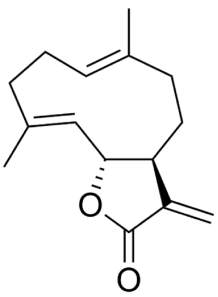
“Costunolide suppressed IL-22/IFN-γ-driven inflammatory gene expression in human keratinocytes and enhanced in-vitro wound closure; preclinical keratinocyte evidence only.”
Pure-Costunolide™ is a high-purity costunolide (a plant-derived sesquiterpene lactone, commonly associated with Saussurea costus / Aucklandia lappa “costus root”) supplied as a cosmetic active raw material for topical formulation R&D.
Important evidence note: most reported “skin benefits” for costunolide are preclinical (cell studies and animal models). This is research-supporting information for formulators, not proof of clinical efficacy in humans.
Costunolide has very low water solubility, so topical performance is typically delivery-limited. Practical use usually requires solubilization (selected solvents/solubilizers) or controlled delivery systems (e.g., dispersions, nanoemulsions, or other carrier approaches) to reach a stable delivered-active level on skin or scalp.
Product Description: Costunolide is a lipophilic sesquiterpene lactone studied for inflammation-modulating activity in skin-relevant systems. Reported mechanisms and pathway signals include attenuation of MAPK/NF‑κB signaling and modulation of cytokine/chemokine outputs in keratinocyte models, plus anti-inflammatory readouts in multiple mouse dermatitis models. Some studies use engineered transdermal delivery (e.g., dissolvable microneedles) to address solubility and delivery constraints, reinforcing that formulation strategy can strongly influence results.
Safety note for formulators: sesquiterpene lactones (including costus-related materials) are a known sensitization class in susceptible users. Start with low delivered-active targets and evaluate irritation/sensitization risk (including patch testing where appropriate).
| Model/System | Key Endpoints (Reported) | Implication |
|---|---|---|
| Atopic dermatitis model (mouse; DNCB; dissolvable microneedle delivery) | Reduced skin thickness and itch/pruritus scores; reduced inflammatory markers (reported IgE, TNF‑α, IL‑13) and improved histology | Skin-calming concept in engineered transdermal delivery (preclinical) |
| Atopic dermatitis model (mouse; MC903; costunolide-derivative lead) | Improved skin injury symptoms; reduced Th2-type cytokines and scratching; supported skin-barrier repair, linked to MAPK/NF‑κB inhibition | Anti-inflammatory / barrier-support research signal (preclinical) |
| Keratinocytes (HaCaT; cytokine-stimulated) | Reduced expression of inflammatory/allergic chemokines (reported TARC/CCL17, MDC/CCL22, RANTES/CCL5, IL‑8) | Mechanistic support for dermatitis-relevant signaling (in vitro) |
| Psoriasis-like dermatitis (mouse; imiquimod-induced) | Improved psoriasis-like pathological changes and inflammatory expression; proposed involvement of P2X7R/IL‑36 signaling | Skin-inflammation modulation concept (preclinical) |
| Two-stage skin carcinogenesis (mouse; DMBA/TPA; topical pre-TPA dosing) | Reduced papilloma formation and reduced proliferation/inflammation markers in skin (reported p‑AKT, COX‑2, Ki‑67) | Topical bioactivity in an animal model (not a cosmetic claim) |
| Hair-growth study (mouse; topical application) | Reported improvement of hair growth in mice with supportive cellular findings in dermal papilla cells | Scalp/hair-delivery concept (preclinical) |
Usage: Technical active ingredient for skin-calming / inflammation-modulating concepts in leave-on products (serums, creams/lotions, gels) and for scalp/hair-delivery R&D. Medical intent use-cases are outside cosmetic scope.
Mixing method:
- Because water solubility is very low, pre-dissolve into a compatible solvent/solubilizer system (e.g., selected glycols/alcohol systems) or pre-disperse into the oil phase/solubilized concentrate; then add into the final formula.
- Add during cool-down (<40°C) and protect from extended heat/light exposure to reduce degradation risk and precipitation; verify stability after 24–72 h and after temperature cycling.
- Keep finished-formula pH in a mild acidic-to-neutral window when possible; avoid extreme pH that can increase instability or incompatibility with the chosen carrier system.
Usage rate: 0.01–0.05% (as supplied). Typical starting point: ~0.02%.
Product characteristics: White to off-white crystalline powder; faint odor.
Solubility: Practically insoluble in water. Soluble in selected organic solvents and solubilizer systems; solubility depends strongly on the chosen carrier and temperature.
Storage: Store tightly closed, dry, and protected from light. Re-check appearance and solubility performance after opening and long storage.
No products
Pure-Costunolide™ is a high-purity costunolide (a plant-derived sesquiterpene lactone, commonly associated with Saussurea costus / Aucklandia lappa “costus root”) supplied as a cosmetic active raw material for topical formulation R&D.
Important evidence note: most reported “skin benefits” for costunolide are preclinical (cell studies and animal models). This is research-supporting information for formulators, not proof of clinical efficacy in humans.
Costunolide has very low water solubility, so topical performance is typically delivery-limited. Practical use usually requires solubilization (selected solvents/solubilizers) or controlled delivery systems (e.g., dispersions, nanoemulsions, or other carrier approaches) to reach a stable delivered-active level on skin or scalp.
Product Description: Costunolide is a lipophilic sesquiterpene lactone studied for inflammation-modulating activity in skin-relevant systems. Reported mechanisms and pathway signals include attenuation of MAPK/NF‑κB signaling and modulation of cytokine/chemokine outputs in keratinocyte models, plus anti-inflammatory readouts in multiple mouse dermatitis models. Some studies use engineered transdermal delivery (e.g., dissolvable microneedles) to address solubility and delivery constraints, reinforcing that formulation strategy can strongly influence results.
Safety note for formulators: sesquiterpene lactones (including costus-related materials) are a known sensitization class in susceptible users. Start with low delivered-active targets and evaluate irritation/sensitization risk (including patch testing where appropriate).
| Model/System | Key Endpoints (Reported) | Implication |
|---|---|---|
| Atopic dermatitis model (mouse; DNCB; dissolvable microneedle delivery) | Reduced skin thickness and itch/pruritus scores; reduced inflammatory markers (reported IgE, TNF‑α, IL‑13) and improved histology | Skin-calming concept in engineered transdermal delivery (preclinical) |
| Atopic dermatitis model (mouse; MC903; costunolide-derivative lead) | Improved skin injury symptoms; reduced Th2-type cytokines and scratching; supported skin-barrier repair, linked to MAPK/NF‑κB inhibition | Anti-inflammatory / barrier-support research signal (preclinical) |
| Keratinocytes (HaCaT; cytokine-stimulated) | Reduced expression of inflammatory/allergic chemokines (reported TARC/CCL17, MDC/CCL22, RANTES/CCL5, IL‑8) | Mechanistic support for dermatitis-relevant signaling (in vitro) |
| Psoriasis-like dermatitis (mouse; imiquimod-induced) | Improved psoriasis-like pathological changes and inflammatory expression; proposed involvement of P2X7R/IL‑36 signaling | Skin-inflammation modulation concept (preclinical) |
| Two-stage skin carcinogenesis (mouse; DMBA/TPA; topical pre-TPA dosing) | Reduced papilloma formation and reduced proliferation/inflammation markers in skin (reported p‑AKT, COX‑2, Ki‑67) | Topical bioactivity in an animal model (not a cosmetic claim) |
| Hair-growth study (mouse; topical application) | Reported improvement of hair growth in mice with supportive cellular findings in dermal papilla cells | Scalp/hair-delivery concept (preclinical) |
Usage: Technical active ingredient for skin-calming / inflammation-modulating concepts in leave-on products (serums, creams/lotions, gels) and for scalp/hair-delivery R&D. Medical intent use-cases are outside cosmetic scope.
Mixing method:
- Because water solubility is very low, pre-dissolve into a compatible solvent/solubilizer system (e.g., selected glycols/alcohol systems) or pre-disperse into the oil phase/solubilized concentrate; then add into the final formula.
- Add during cool-down (<40°C) and protect from extended heat/light exposure to reduce degradation risk and precipitation; verify stability after 24–72 h and after temperature cycling.
- Keep finished-formula pH in a mild acidic-to-neutral window when possible; avoid extreme pH that can increase instability or incompatibility with the chosen carrier system.
Usage rate: 0.01–0.05% (as supplied). Typical starting point: ~0.02%.
Product characteristics: White to off-white crystalline powder; faint odor.
Solubility: Practically insoluble in water. Soluble in selected organic solvents and solubilizer systems; solubility depends strongly on the chosen carrier and temperature.
Storage: Store tightly closed, dry, and protected from light. Re-check appearance and solubility performance after opening and long storage.
| Mechanism | - |
| Appearance | - |
| Longevity | - |
| Strength | - |
| Long-term storage | - |
| Shelf Life | - |
| Allergen(s) | - |
| Dosage (Range) | - |
| Recommended Dosage | - |
| Dosage (Per Day) | - |
| Recommended Dosage (Per Day) | - |
| Mix Method | - |
| Heat Resistance | - |
| Stable in pH range | - |
| Solubility | - |
| Product Types | - |
| INCI | - |